
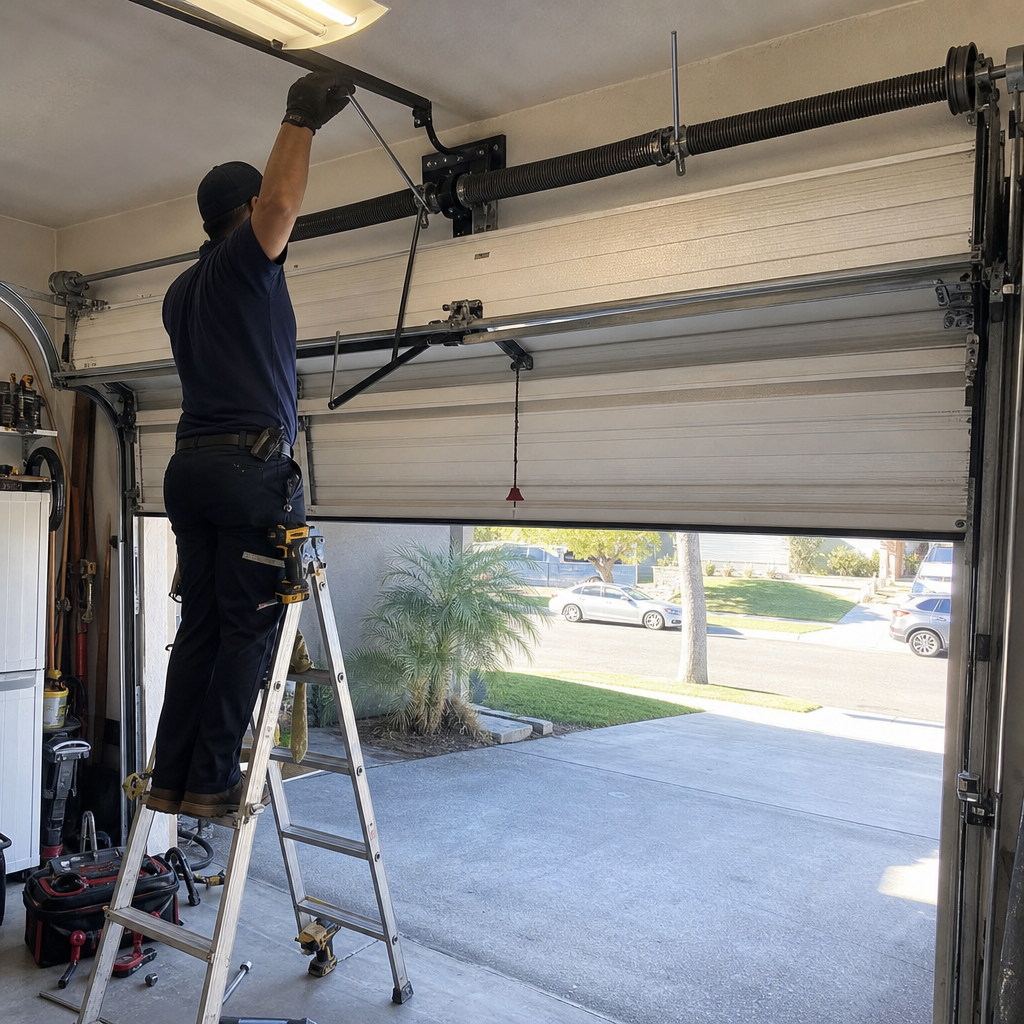
Why Does My Garage Door Reverse Before It Hits the Floor in Spring?
A garage door that reverses before reaching the floor is almost always telling you the opener’s force sensor thinks it has hit something. In Spring, the real culprit is often not the opener at all, but a warped bottom seal or flood-barrier frame distortion that creates uneven resistance against the floor. If you have already turned the sensitivity dial twice and the door still backs up, stop adjusting and start looking at what is happening where the door meets the concrete.
Call Mainspring Garage Door Co. at (844) 755-5838 if you want a technician to sort it out. We quote one price before the wrench comes out. That is the whole policy.
The Four Actual Causes of Reversal, and Which One to Check First
Most troubleshooting guides online stop at three causes. They miss the fourth, and in Spring it is the one we see most often on service calls. Here is the full list, ordered by how common each is in our market:
- Photo-eye sensor misalignment - The invisible beam between the two small boxes near floor level is interrupted, broken, or knocked crooked. The door reverses immediately, usually within the first foot of travel. Check this first if the reversal happens right after the door starts down.
- Travel limit set too short - The opener thinks the floor is higher than it actually is, so it bottoms out hard and reverses on force. Check this if the door touches the floor, seems to jam, then goes back up. Post-Harvey installs done in haste in 2017-2019 are notorious for this; those openers are now six to seven years old and hitting their first real service cycle.
- Force sensitivity set too low - The opener interprets normal door weight or slight binding as an obstruction. Check this if the reversal happens mid-travel, especially in cold mornings when grease is thicker.
- Physical obstruction or frame warp - The one most guides skip. In Spring Creek-adjacent neighborhoods like Northampton and Champions Forest, aftermarket flood barriers installed after Hurricane Harvey have warped door frames and bottom seals. The seal contacts the floor unevenly, the force sensor reads resistance, and the opener reverses. No amount of limit adjustment fixes this.
We have replaced perfectly good openers in 77379 and 77388 only to discover the real problem was a $45 seal and a frame that had twisted from barrier hardware pulling it out of square. The homeowner had already paid someone else to “recalibrate” the opener twice.
When the Reversal Is a Safety System Working Correctly
Sometimes the door reverses because it should. A child’s bike, a rake handle, a curled edge of rubber seal, or a tool left on the track will all trigger the force sensor or break the photo-eye beam, though persistent issues may need Garage Door Off Track Repair in Spring, CA. That is the system doing its job since 1993, when federal law made auto-reverse mandatory.
The dangerous scenario is when a homeowner overrides the sensor rather than finding the root cause. We have seen tape wrapped around photo eyes, force dials cranked to maximum, and safety systems unplugged entirely. Those doors will close on whatever is beneath them. If your door reverses and you cannot find why, call a technician for Garage Door Making Grinding Noise in Spring, CA. Do not defeat the safety system.
Carl Dutton, who leads our shop, grew up off Cypresswood Drive and has been working on Spring doors for going on two decades. He still tells the story of a 77373 call where a homeowner’s “temporary” tape fix on a photo eye had been in place for three years. The grandkids visited every weekend.
Spring-Specific Conditions That Cause Nuisance Reversals
Spring’s climate and housing stock create reversal problems you will not find in Dallas or San Antonio. These are the local patterns we diagnose regularly:
Summer slab heave in older 77373 and 77388 homes. Post-tension concrete slabs expand and lift slightly during our hottest months, especially in ranch-style tract homes built from the 1970s through the 1990s. A door that closed fine in March starts reversing in July because the floor level has risen a fraction of an inch. The opener’s force limit, calibrated in cooler weather, now reads normal contact as obstruction. We adjust limits seasonally for some customers.
Humidity-accelerated seal deterioration. Spring’s Gulf Coastal humidity, routinely 80-95% RH in summer, rots rubber bottom seals faster than in drier inland Texas markets. A seal that looks intact can compress unevenly or develop a hard curl that catches the floor. LiftMaster and Chamberlain openers with force-learning features are particularly sensitive to this gradual change.
Flood-barrier frame distortion in Northampton and Champions Forest. Post-Harvey barriers, often installed by homeowners or general contractors without door-specific expertise, bolt directly to the bottom section of the door or its frame. Over time, the weight and repeated cycling warp the steel. The door no longer sits flat against the threshold. The opener reverses. The warranty is voided. We see this call type consistently in 77379 and 77388, and barely at all in higher-elevation suburbs just north.
Post-Harvey opener installs with rushed limit settings. The 2017-2019 replacement wave, driven by insurance payouts after Harvey inundated 77373, 77379, and 77388, included many same-day installs with travel limits eyeballed rather than measured. Those doors now bottom out too hard or stop short, reversing on force. Six to seven years is exactly when those shortcuts start showing.
What Mainspring Checks on a Reversal Diagnostic Call
Our technicians arrive with a stocked truck, so most reversal problems are resolved in a single visit. Here is what the visit includes:
- Photo-eye alignment and voltage check - not just “are they lit,” but are they receiving full signal strength
- Travel limit measurement against the actual floor, not the opener’s memory
- Force sensitivity test with a calibrated resistance gauge
- Bottom seal condition and frame squareness, including flood-barrier hardware inspection
- Track plumb and roller binding check - humidity rusts bottom brackets faster here
- Opener motor amp draw under load, to catch a failing Genie or Raynor unit before it dies completely
If the opener is failing, we carry LiftMaster, Chamberlain, and Genie units on the truck. If the door itself is warped from barrier hardware, we stock replacement bottom sections and seals for common Clopay and Amarr profiles. We quote the full price before any work begins.
What Reversal Repairs Cost in Spring
Most reversal issues fall under our general Garage Door Repair pricing. Here are the ranges we see for the specific problems covered on this page:
| Repair Type | Typical Range in Spring |
|---|---|
| Photo-eye realignment or replacement | $120-$240 |
| Travel limit / force sensitivity adjustment | $120-$240 |
| Bottom seal replacement | $130-$250 |
| Bottom section/frame warp repair | $250-$500 |
| Opener repair (circuit board, gear, sensor) | $120-$320 |
| Opener replacement (if failed) | $250-$550 |
Our $89 Seasonal Tune-Up catches most of these problems before they cause reversals. Seniors and veterans receive a permanent 5% discount. If you have a written estimate from another shop, we offer a Free Second Opinion.
FAQs
There is always a reason. The most common cause in Spring is a warped bottom seal or flood-barrier frame distortion that creates uneven floor contact, which the opener’s force sensor reads as an obstruction. If you have already adjusted the sensitivity dial and the door still reverses, the problem is likely physical, not electronic. Call (844) 755-5838 for a free estimate - we will find the actual cause.
Repair is usually cheaper if the opener is under ten years old and the reversal is caused by limit settings, force sensitivity, or a failed circuit board. Replacement makes more sense if the opener is a post-Harvey rush install with multiple shortcuts, or if the motor is failing. Opener repair runs $120-$320 in Spring; replacement is $250-$550. We will tell you straight which path saves money.
Yes. Our trucks carry springs, cables needing Cable Repair, openers, seals, and bottom sections for all major brands. Most reversal diagnostics in Spring are completed in a single visit. Call (844) 755-5838 - a live person answers, including nights and weekends.
No. Increasing the force override is the most dangerous thing a homeowner can do. The auto-reverse system is federally mandated safety equipment. Defeating it risks the door closing on a person, pet, or vehicle. If your door reverses and you cannot locate the cause, call a professional. We quote upfront and back our work with a 90-Day Done Right Promise.
When to Call Mainspring
If your garage door reverses and you have checked for obvious obstructions, the next step is a trained eye on the actual hardware. Adjustment dials fix sensitivity problems. They do not fix warped frames, rotted seals, or slab heave. We have been serving Spring since 2016, and we have seen every local cause of reversal this climate and housing stock can produce.
If you would rather have it looked at, Mainspring Garage Door Co. offers Best Garage Door Repair in Spring, CA with a no-pressure assessment. Call (844) 755-5838. A live person will answer, and we will quote one price before any work begins.
Written by Carl Dutton, Owner, Mainspring Garage Door Co. at Mainspring Garage Door Co., serving Spring, CA.