
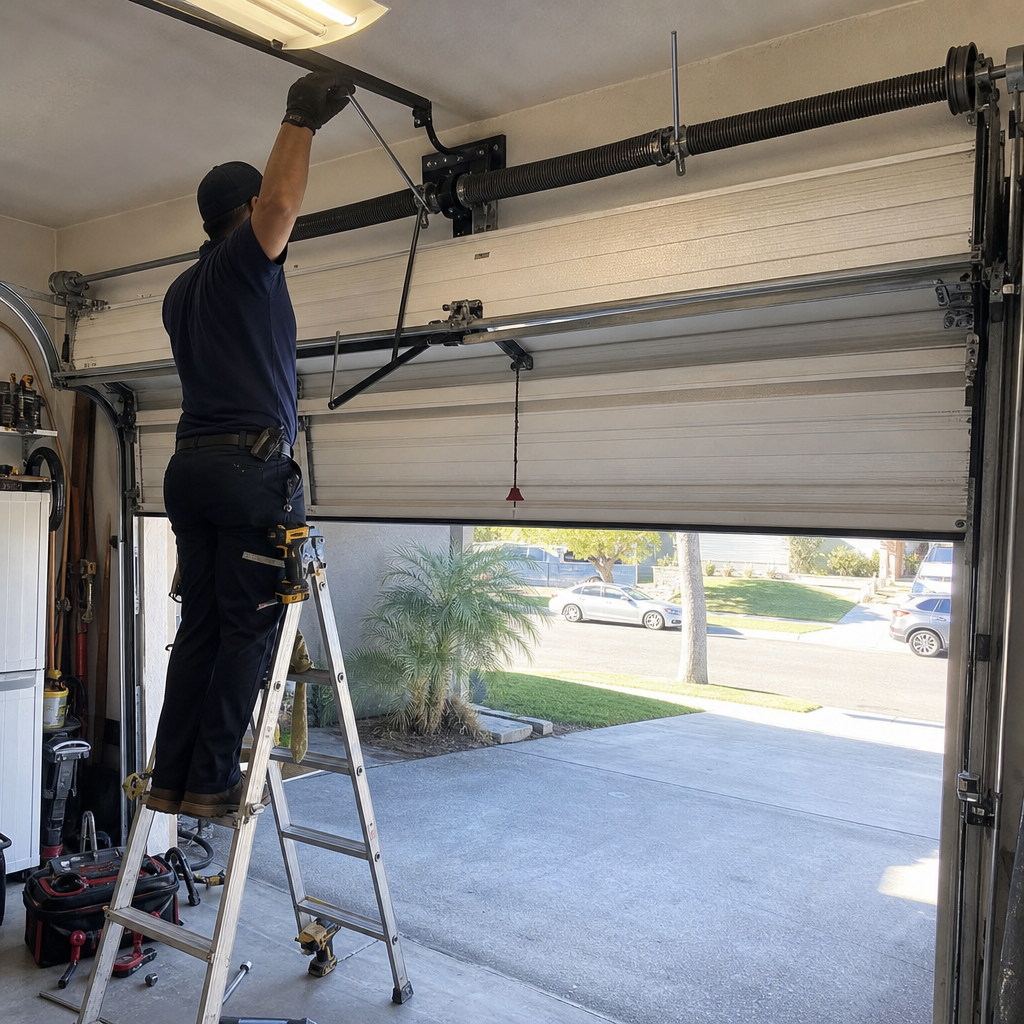
Why Your Garage Door Is Making a Grinding Noise in Spring
A grinding garage door almost always means steel is rubbing against steel where lubrication has failed. In Spring’s humidity, that happens faster than the manufacturer expects. Most grinding noises come from one of three places: a seized nylon roller with a flat spot, a hinge pin that has lost its oil film, or a torsion spring coil binding against itself. The sound’s timing tells you which. Call (844) 755-5838 if you’d rather not guess - we diagnose it free with any repair.
You Lubed It in February. It’s Grinding Again in July.
That is not a maintenance schedule problem. That is 90% humidity stripping the oil film off your hinge pins in four months instead of twelve.
Spring sits on the Gulf Coastal Plain. Our summer humidity hangs between 80 and 95 percent, and it does not let up at night. Standard garage door lubrication - the kind recommended in owner’s manuals written in Ohio - assumes a drier climate. The oil film that protects steel-on-steel contact breaks down here faster. WD-40 evaporates. Household 3-in-1 oil thins. What remains is bare metal, corrosion bloom, and the grinding sound you are hearing now.
We see this pattern constantly in the older ranch homes of 77373 and 77388. Torsion springs, hinge pins, and roller stems that ran quietly after a spring tune-up are grinding again by mid-summer. The fix is not more frequent lubrication with the wrong product. It is using a humidity-appropriate lubricant - a lithium-based grease or a dedicated garage door formula - and knowing when corrosion has already won.
Carl Dutton, who runs Mainspring, grew up off Cypresswood Drive and has been working on Spring doors for going on two decades. He put it plainly: “One price before the wrench comes out. That is the whole policy.” The diagnostic call is where we tell you whether a proper lube service will solve it, or whether the corrosion has seized the part and replacement is the only square deal.
The Three Grinding Sounds and What Each Means
Not all grinding is the same. The sound’s timing and rhythm point to the source, and knowing the difference saves you a diagnostic charge if you call it right.
- Continuous grinding through the full travel: Roller stem. The nylon roller itself may look intact, but its internal bearing has seized. The steel stem spins against frozen rollers, producing a steady rasp. In Gulf Coast heat, seized nylon rollers develop a flat spot where the door sits on them at rest. When the door moves, that flat spot creates a periodic knock-grind pattern that homeowners often mistake for a spring or opener problem. If you hear a rhythm - grind-knock, grind-knock - it is almost certainly a flat-spotted roller.
- Grinding at specific panel joints as the door bends around the track curve: Hinge pin. The pin has lost lubrication and is binding as the hinge flexes. This sound localizes: you can stand at the hinge and hear it clearly. In Spring’s humidity, these pins corrode fastest on doors facing afternoon sun, where daily heat cycling accelerates moisture penetration.
- Grinding only during the first 12-18 inches of travel, then smoothing out: Torsion spring coil binding. The spring’s coils are touching where they should not, usually due to rust swelling or inadequate tension. This one carries real danger - a binding torsion spring is a stressed torsion spring. Do not attempt to adjust or lubricate it yourself. The stored energy can cause serious injury.
Our technicians arrive with the right parts already on the truck. Most grinding noise calls in Spring finish in a single visit - no waiting, no second trip.
When a Grinding Noise Is the Last Warning
In the 1970s-1990s ranch homes that dominate 77373 and 77388, many original doors still run on all-steel rollers. These were built for a twenty-year service life and are now well past it.
The progression we see: first, a faint grinding as the roller bearing wears. Then, intermittent catching as the roller develops flat spots from sitting under load. Finally, the roller seizes entirely in the track. When that happens on a raised door, the door can derail - one side drops, cables go slack, and you have a 150-pound panel hanging crooked.
Acting on the noise is cheaper than acting on the derailment. Roller replacement runs $110-$220. A derailment repair with panel damage, cable replacement, and track realignment can push toward the high end of our $150-$600 repair range, and sometimes beyond.
The post-Harvey replacement wave of 2017-2019 adds another layer. Many of those insurance-funded installs used hardware that was never properly inspected after flood exposure. We are now seeing those 6-7-year-old systems hit their first major service cycle with corrosion-compromised bottom brackets and hinges that fail earlier than expected. If your door was replaced after Harvey and is now grinding, the cause may not be normal wear.
What It Costs and How We Decide
We do not sell you a replacement when a lubrication service will do. Here is how the pricing breaks down for grinding noise calls in Spring:
| Service | Price Range | When It Applies |
|---|---|---|
| Seasonal Tune-Up with humidity-appropriate lubrication | $89 | Early-stage grinding, intact hardware, no flat spots or corrosion seizure |
| Roller Replacement (per door, typical 10-roller set) | $110-$220 | Seized, flat-spotted, or corroded rollers; steel rollers on older doors |
| Hinge Pin/Hardware Replacement | $130-$250 | Corroded hinge pins, worn brackets, post-flood hardware compromise |
| Spring or Cable Repair (if grinding indicates binding) | $180-$340 | Torsion spring coil binding, frayed cables, or related stress damage |
| Full Diagnostic + Repair (general range) | $150-$600 | Complex or multiple-source grinding, derailment risk, flood-compromised systems |
The technician tells you which category your door falls into before any work starts. The flat price is stated upfront. No surprises on the bill.
We are factory-familiar with all major brands - Chamberlain, Genie, Clopay, Amarr - and carry common parts for each. If your opener is grinding (a separate sound, usually from the drive gear), we handle that too, but most grinding originates in the door hardware, not the motor.
What You Can Check Safely vs. What to Leave Alone
You can look. You should not touch certain parts.
- Visual inspection from inside the garage: With the door closed, examine the rollers, hinges, and spring for visible rust, cracks, or misalignment. Do not attempt to move or adjust the spring.
- Sound localization: Open and close the door slowly, standing near each hinge and roller to identify where the grinding concentrates. Note whether it is continuous, rhythmic, or limited to specific travel points.
- Track check: Look for debris, dents, or gaps between the track and rollers. Clear debris by hand if safe. Do not attempt to bend or realign track - improper alignment causes binding and premature wear.
- Stop if you see cable fraying, spring gaps, or door sag: These indicate structural stress. Close the door, disconnect the opener if you know how, and call. Torsion springs and cables are under high tension and can cause serious injury.
Our background-checked, uniformed technicians work under the K.E.Y.S. code - Krafted right, Every time, Your home first, Standing behind it. Every job carries the 90-Day Done Right Promise in writing. If it is not right, we come back. No paperwork, no arguing.
FAQs
Most grinding noise repairs in Spring fall between $150 and $600, with simple roller replacement at $110-$220 and full tune-ups at $89. The exact cost depends on whether the noise comes from worn rollers, corroded hinges, or a binding spring. Call (844) 755-5838 for a free estimate - we state the flat price before any work begins.
Lubrication is cheaper when it will actually work. A $89 seasonal tune-up solves early-stage grinding with intact hardware. If rollers are flat-spotted, hinge pins are corroded, or springs are binding, replacement is the only lasting fix and costs more upfront but less than repeated service calls. We tell you which your door needs before starting.
Yes. Our trucks carry springs, cables, rollers, and openers, so most grinding noise calls in Spring finish in a single visit. A live person answers the phone 24/7, including nights and weekends. Call (844) 755-5838 - we will be there when we say.
Spring’s humidity strips standard lubricants faster than drier climates allow. WD-40 and household oils evaporate or thin within weeks here. The grinding returns because the lubricant failed, not because you failed to apply it. A humidity-appropriate garage door grease, applied during a proper tune-up, lasts longer and protects better.
When You Are Ready to Stop Listening to It
A grinding door does not fix itself. In Spring’s climate, it gets louder, then it gets expensive, then it gets dangerous. If you would rather have a trained eye on it, Mainspring Garage Door Co. offers a no-pressure assessment - call (844) 755-5838. We answer live, day or night, and we will still be here when it matters.
Written by Carl Dutton, Owner, Mainspring Garage Door Co. at Mainspring Garage Door Co., serving Spring, CA.