
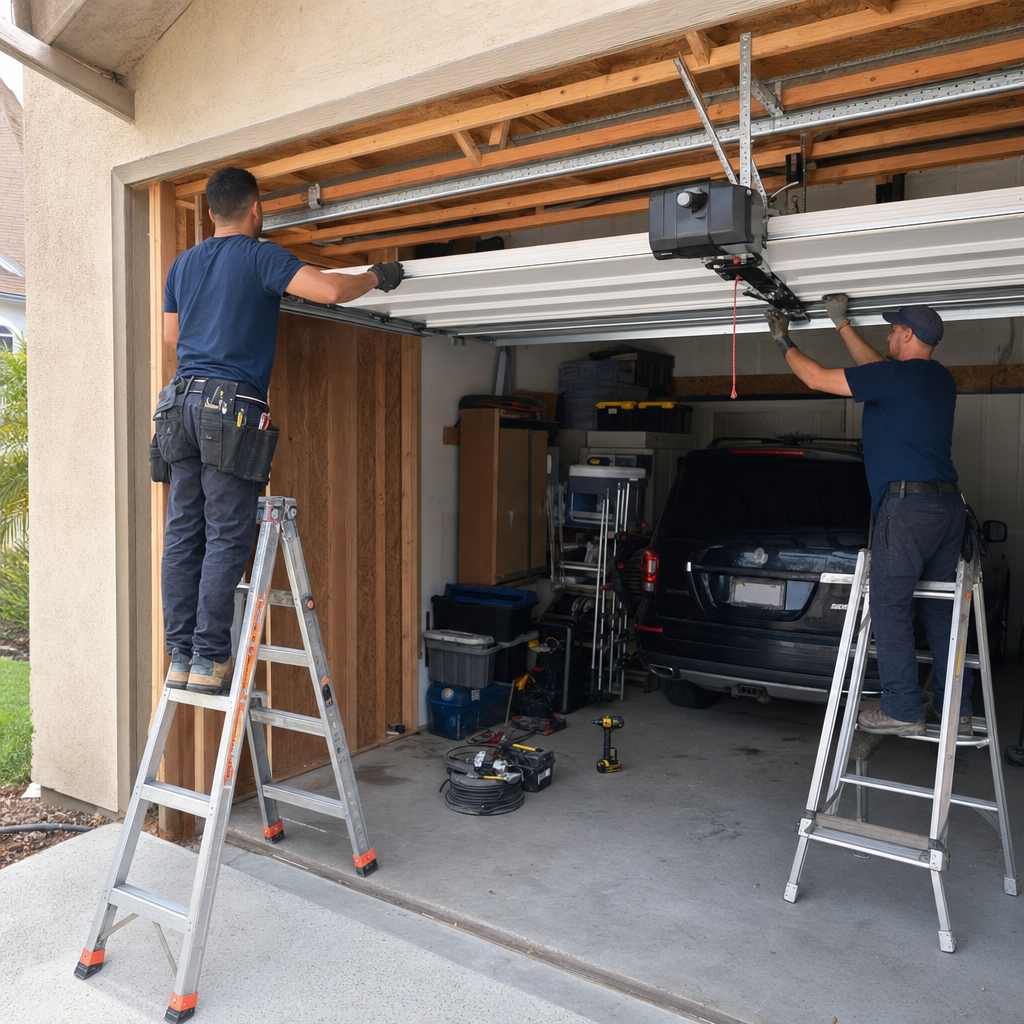
Garage Door Maintenance Tips for Spring, TX: What the Humidity Actually Does to Your Hardware
Garage door maintenance in Spring, TX means quarterly visual checks for rust bloom on torsion springs, silicone-based lubrication every 90 days during humid months, and careful inspection of bottom seals and tracks for flood-related warping - especially on doors installed during the 2017-2019 post-Harvey rush. The Gulf Coastal Plain climate here accelerates corrosion far faster than generic twice-a-year schedules account for. If you’d rather have a trained eye on it, call Mainspring Garage Door Co. at (844) 755-5838; we answer live, 24/7.
Why Spring’s Climate Rewrites the Standard Maintenance Calendar
Most maintenance guides were written for garages in Phoenix or Denver. Spring sits on the Gulf Coastal Plain where summer humidity climbs to 80-95% RH, and that moisture does not stay outside. It settles on bare-metal torsion springs, seeps into cable windings, and corrodes bottom brackets at rates that would surprise a homeowner who moved here from Dallas or San Antonio.
We see it in the older core of Spring - the 1970s-1990s brick ranch homes in 77373 and 77388 where original hardware has faced four decades of this cycle. We also see it in the newer master-planned sections near The Woodlands border, where carriage-house steel doors demanded by HOAs in Gleannloch Farms and Windrose have their own vulnerabilities. The humidity does not discriminate by decade.
Here is what the local climate actually demands:
- Quarterly rust checks, not annual. Torsion springs in Spring develop surface oxidation within 90 days of cleaning. A spring that looks clean in March can show orange bloom by June. We check for pitting, not just color - pitting means the metal is thinning under tension.
- Silicone lubricant, never WD-40. WD-40 displaces water temporarily, then leaves a sticky residue that attracts the fine Gulf Coast dust coating garage floors each summer. Silicone spray repels moisture without that residue. We stock it on every truck.
- Bottom seal inspection after every tropical system. Humidity expansion and wind pressure distort seals faster here. A compromised seal lets water pool at the door base, which accelerates track corrosion and can wick into opener electronics.
Carl Dutton, who leads our shop, grew up off Cypresswood Drive and has worked on Spring garage doors for going on two decades. He will tell you the same thing he tells his daughter when she rides along on summer calls: the spring does not care what the calendar says. It cares about the air it sits in.
What to Look for on Post-Harvey Doors: The 6-7 Year Reality Check
Hurricane Harvey flooded entire subdivisions in 77373, 77379, and 77388 in 2017. The insurance-funded replacement wave that followed meant thousands of garage doors and openers went in fast - often under rushed timelines, sometimes without full hardware inspection after water intrusion. Those installs are now hitting their first true service cycle simultaneously.
If your door was replaced between 2017 and 2019, here is what to check now:
| Component | What to Look For | Typical Cost if Replacement Needed |
|---|---|---|
| Torsion springs | Coil gaps, rust bloom, sagging when door is closed | $180-$340 |
| Cables | Fraying, kinking, or corrosion at bottom bracket attachment | $130-$250 |
| Rollers | Wobbling in track, seized bearings, flat spots on nylon wheels | $110-$220 |
| Opener chain/belt | Slack, jerking start, or grinding from moisture-damaged gears | $120-$320 |
| Bottom seal & channel | Cracking, compression set, or channel pulled loose from flood-barrier interference | Part of tune-up or $120-$240 for track realignment |
The flood history matters beyond corrosion. In neighborhoods along Spring Creek - notably Northampton and Champions Forest - many homeowners added aftermarket flood barriers post-Harvey. Improperly installed barriers warp door frames and distort bottom seal channels, causing the door to bind or the opener to strain. This is a diagnostic pattern we see consistently in Spring that barely exists in higher-elevation suburbs like The Woodlands just north. If your door binds at the bottom six inches, check the barrier before you blame the opener.
How to Do a Quarterly Inspection Yourself - And When to Stop
We are not opposed to a homeowner looking things over. We are opposed to a homeowner getting hurt. Torsion springs carry the full weight of a garage door - several hundred pounds of torque - and a snapped spring or slipped winding bar causes serious injury. The following checks are visual and manual only. Do not touch the spring assembly itself.
- Disconnect the opener. Pull the red release cord and lift the door manually. It should move smoothly and stay open at waist height. If it drops or feels heavy, the spring balance is off - call us.
- Inspect springs and cables from a safe distance. Look for rust bloom, coil separation, or frayed cable strands. Use a flashlight; do not handle.
- Check rollers and hinges. Wiggle each roller in its track. Nylon rollers should spin freely; steel rollers should show no flat spots. Hinge bolts should be tight.
- Examine the bottom seal and channel. Look for cracks, permanent compression, or channel distortion from flood barrier contact. Close the door and check for daylight gaps.
- Lubricate moving parts - safely. Apply silicone spray to hinges, roller bearings (not the track itself), and the opener chain or screw. Never lubricate the track; it causes slip and misalignment.
- Test safety reversal. Place a 2×4 flat on the floor centered under the door. The door should reverse on contact. If it does not, the opener force setting needs adjustment.
If any check reveals rust on springs, frayed cables, or a door that will not stay balanced, stop there. These are not adjustments; they are replacements, and they require proper tools and training. We carry springs, cables, and openers on every truck, so if a technician spots a spring at 80% wear during a maintenance call, it gets replaced same visit - no follow-up appointment, no waiting on parts.
What Does Professional Maintenance Cost in Spring?
Our $89 Seasonal Tune-Up covers the full inspection, safety tests, silicone lubrication of all moving parts, and a written condition report. If we find worn hardware, we state the flat replacement price before any work begins. One price before the wrench comes out. That is the whole policy.
For reference, here are the ranges if we find components needing replacement during that tune-up:
| Service | Price Range in Spring |
|---|---|
| Spring Repair | $180-$340 |
| Cable Repair | $130-$250 |
| Opener Repair | $120-$320 |
| Opener Installation | $250-$550 |
| Track Realignment | $120-$240 |
| Roller Replacement | $110-$220 |
We also honor a permanent 5% discount for seniors and veterans, and our $50 Off Any Repair Over $250 applies if multiple components need attention. Every job carries our 90-Day Done Right Promise in writing - if it is not right, we return at no charge, no paperwork, no argument.
FAQs
Quarterly visual checks and silicone lubrication every 90 days during the humid months - March through October - with a professional tune-up at least once yearly. The standard twice-a-year advice leaves too much time for rust to establish on torsion springs in 80-95% RH conditions. Call (844) 755-5838 to schedule our $89 Seasonal Tune-Up.
Repair is usually cheaper for isolated component failures on doors under 15 years old; replacement becomes the better value when multiple systems fail simultaneously or the door is flood-damaged. On post-Harvey doors now hitting their 6-7 year mark, we often find springs, cables, and rollers wearing together - in those cases, a new door installation at $700-$2,200 can outlast repeated repair bills. We offer a Free Second Opinion on any written estimate to help you compare honestly.
Yes. We answer live, 24/7, including nights, weekends, and holidays, and our trucks carry springs, cables, and openers so most jobs finish in a single visit. If you spot rust bloom, frayed cables, or a door that will not stay balanced, do not operate the door - call (844) 755-5838 and we will dispatch a background-checked, uniformed technician.
Aftermarket flood barriers frequently warp the bottom seal channel or shift the door frame slightly out of square, causing binding in the final inches of travel. This is common in Northampton and Champions Forest along Spring Creek, where post-Harvey barrier installation was widespread. The fix is usually track realignment ($120-$240) or channel adjustment, not opener replacement. We assess this at no charge during our tune-up.
Key Takeaways
- Spring’s 80-95% summer humidity demands quarterly rust checks and silicone lubrication, not generic twice-a-year schedules.
- Doors installed during the 2017-2019 post-Harvey rush are now entering their first major service cycle - inspect springs, cables, and rollers together.
- Aftermarket flood barriers in Northampton and Champions Forest can warp door frames; binding at the bottom six inches usually means channel or track issues, not opener failure.
- Never lubricate tracks, and never touch torsion springs - visual checks only.
- Mainspring’s $89 Seasonal Tune-Up includes full inspection, safety tests, and written report, with same-visit replacement if worn hardware is found.
If you’d rather have it looked at, Mainspring Garage Door Co. offers a no-pressure assessment in Spring - call (844) 755-5838. A live person answers, 24/7.
Written by Carl Dutton, Owner, Mainspring Garage Door Co. at Mainspring Garage Door Co., serving Spring, CA.