
Garage Door Reverses Before Hitting the Floor
Your garage door is going down, then it stops short of the floor and comes back up on its own. It’s not a fluke – this is the door’s built-in safety system responding to something it thinks is wrong. In most cases the fix is a quick adjustment or a part swap, and a trained technician can usually sort it out the same visit.
What’s Happening
A garage door that reverses before it reaches the floor is almost always responding to a signal from the opener’s logic board, the safety sensors, or its travel and force settings. The door believes something is blocking its path, or the opener has been told – incorrectly – that the floor is higher than it actually is. Either way, the door is doing exactly what it was designed to do: protect itself and you from a collision it thinks is coming.
The confusing part is that from where you’re standing, there’s nothing in the way. That’s usually the tell that this is a calibration or sensor problem rather than a genuine obstruction. The door’s brain is reacting to a setting that drifted over time, a sensor that got nudged out of line, or a spring and cable system that’s putting uneven tension on the door – causing the opener to read more resistance than it should. Any of these will trigger the auto-reverse. None of them are dangerous to ignore in the short term, but they do tend to get worse if left alone.
Why It Happens
1. Travel Limit Set Too Low
Every opener has a “close limit” setting that tells it where the floor is. If that setting drifted – or was never dialed in correctly after an installation – the opener thinks the floor is a foot above where it actually is. When the door reaches that imaginary floor and still feels resistance, it reverses. The giveaway is that the door stops and reverses at a consistent height above the floor, not randomly. It’s the same spot every time.
2. Safety Sensor Misalignment or Obstruction
The two small sensor units near the bottom of your door tracks – one sends a beam, one receives it – have to stay perfectly aligned with each other. A bump, a cobweb, a thin layer of dust, or a stem of dried mud can break that beam and send an immediate reverse signal. Look at both sensors: if the indicator light on one is blinking, flashing, or out entirely while the other is solid, the beam is broken. Sometimes you can clear it yourself by wiping the lenses and checking that nothing is sitting between them. If the housing itself got knocked and the units are visibly crooked, that needs a technician to realign properly.
3. Close-Force Setting Too Sensitive
Opener motors are calibrated to apply a set amount of downward pressure. If that force setting is too low, the opener interprets the door’s own weight, friction in the tracks, or weather-stripping resistance as an obstacle and reverses. This is common after a temperature drop – cold weather makes door hardware stiffer, and a force setting that was fine in July suddenly feels like hitting a wall in November. The door will usually close fine in a warm garage and refuse in a cold one if this is the cause.
4. Springs or Cables Out of Balance
If your springs are worn or one cable has slipped its drum, the door will be heavier on one side than the other. The opener is carrying weight it wasn’t designed to carry alone, and it reads that extra resistance as an obstruction. You might notice the door looks slightly crooked as it travels, or you hear a grinding or scraping sound on one side. Do not attempt to adjust springs or cables yourself. Torsion springs sit above the door under several hundred pounds of tension and can cause serious injury if handled without proper tools and training. This is the one item on this list where stopping and calling is the right move from the start.
What to Do Right Now
- Look at both safety sensors. Crouch down and check the small units mounted low on each track. A solid light on both means the beam is clear. A blinking or off light means something broke the beam. Wipe each lens gently with a dry cloth and make sure nothing is sitting between them – a broom handle, a recycling bin, a child’s ball.
- Check the floor beneath the door. Walk along the door’s path and look for anything sitting on the floor or on the threshold seal. Sometimes the cause really is a small object the opener “felt” even if you didn’t see it at a glance.
- Try the door once more and watch where it stops. If it reverses at the exact same point every time, it’s almost certainly a limit setting. If it reverses at different heights, the force setting or a mechanical imbalance is more likely the cause. This observation will be useful for the technician.
- Photograph the sensor lights and the door gap if it stopped partway. A quick photo from your phone takes ten seconds and gives a technician good information before they even walk through your door.
- Stop using the door until it’s looked at. An opener working against a calibration error is straining the motor and the hardware. Using it repeatedly while it’s fighting itself adds wear. If you need the garage accessible, disengage the opener with the red pull cord and operate the door manually – but only if the door moves smoothly and evenly by hand. If it feels heavy, tilted, or difficult to move manually, leave it alone and call. That’s a spring or cable issue, and those need to stay untouched.
How We Fix It
When your local Mainspring Garage Door Co. technician arrives, the first thing they do is run the door through a complete diagnostic cycle – watching the travel, listening to the hardware, checking the sensor alignment, and reading how the opener responds at close range. They’re looking for the root cause, not just the symptom.
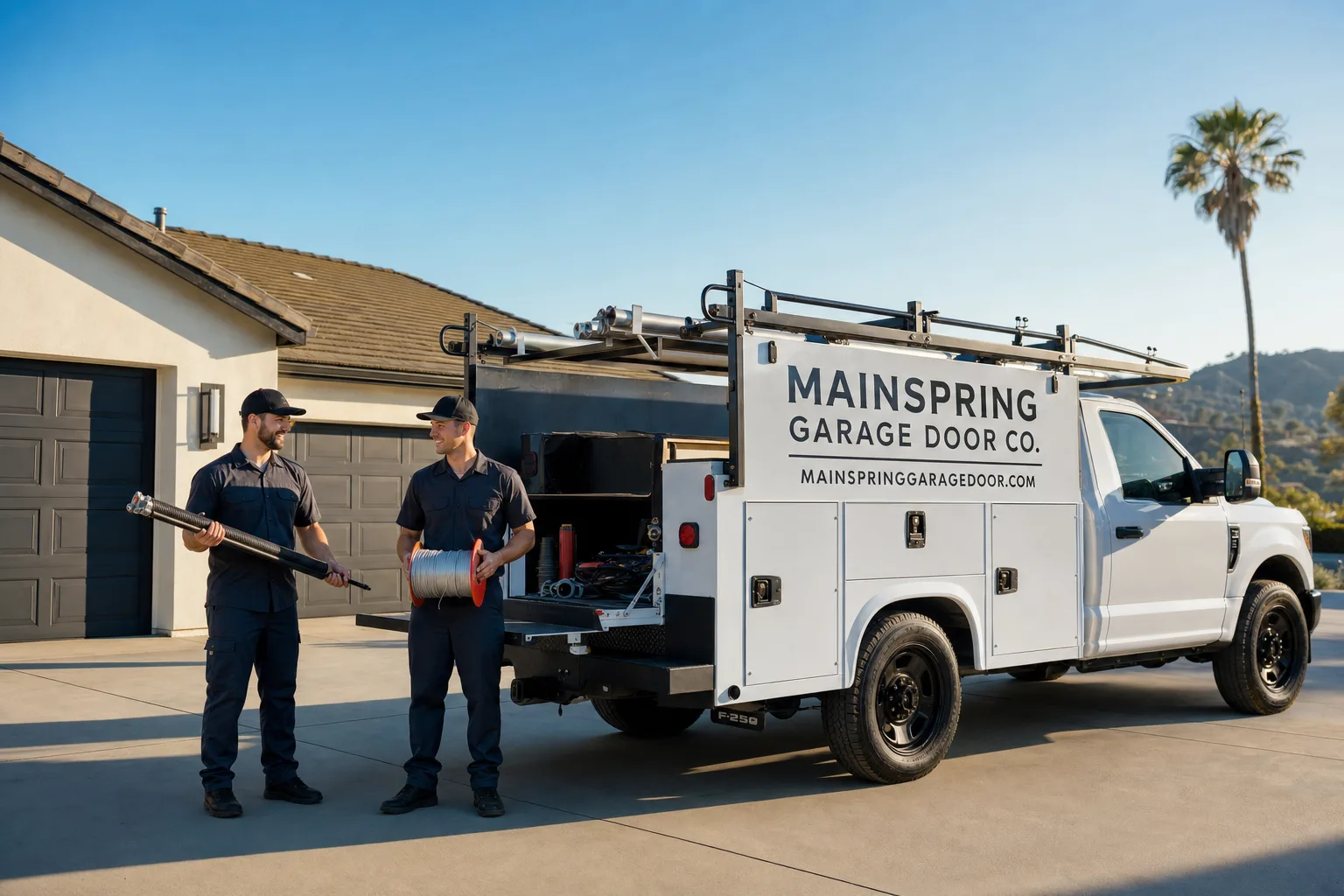
If the issue is a limit or force setting, that’s a calibration adjustment made on the opener itself – typically a quick repair. If the sensors are physically out of alignment, the technician resets them to factory spec and tests the beam. If the springs or cables are the cause, those parts are on the truck. Mainspring technicians arrive stocked with the springs, cables, and hardware needed to finish most jobs in a single visit – no waiting on a parts order, no second appointment.
Before any work begins, you get a flat written price. No surprises on the bill. The repair is covered by the 90-Day Done Right Promise: if it’s not right after we leave, we come back – in writing, no arguing. The services that resolve this are Garage Door Repair and, where the opener itself needs adjustment or replacement, Garage Door Opener service.
Frequently Asked Questions
In most cases it can wait a day or two without creating an immediate safety risk – the door is doing its job by reversing rather than forcing through an obstacle it thinks it found. That said, if you discovered a spring or cable problem during the steps above, don’t leave it. A broken spring or slipped cable can fail further without warning, and a door that drops without spring support is heavy enough to cause real harm. Call (844) 755-5838 and let us take a look the same day.
Yes. Phones are answered by a live person around the clock – nights, weekends, and holidays included – and your local Mainspring Garage Door Co. team works to get a technician out the same day in most situations. Call (844) 755-5838 and we’ll get you on the schedule.
Limit and force adjustments on most modern openers are described in the owner’s manual, and on a straightforward calibration issue some homeowners do handle it themselves. The risk is misreading the cause – if the real problem is a spring that’s lost tension or a cable that’s barely hanging on, adjusting the force setting upward just masks the symptom and adds load to hardware that’s already stressed. If you’ve gone through the sensor and limit checks and the door still reverses, the honest answer is to call a technician before adjusting force settings further.
The price depends on what the technician finds – a sensor realignment is a different job than a spring replacement. Mainspring doesn’t give rough estimates over the phone because the actual cause changes the actual cost, and quoting a number before seeing the door wouldn’t be honest. What we do guarantee is a written flat price before any work starts, so you know the number before you say yes. Call (844) 755-5838 to schedule a visit and get a real quote in person.
Get It Fixed
Call (844) 755-5838 any time – a live person answers around the clock. Your local Mainspring Garage Door Co. team will diagnose the problem, give you a written price before touching anything, and get the door running right. The 90-Day Done Right Promise covers every repair, in writing.
Written by Carl Dutton, Owner at Mainspring Garage Door Co., serving local communities since 1984.