
Garage Door Opens Slowly or Unevenly
A garage door that drags, jerks to one side, or labors through its travel is almost always dealing with a spring tension problem, a lubrication failure, or a track and roller issue. In most cases, the door is still usable – but the underlying cause will not fix itself, and the longer it runs out of balance, the more strain it puts on every other part of the system, including the opener motor. Your local Mainspring Garage Door Co. team can diagnose the exact cause and give you a flat price in writing before any work begins.
The door you install and forget about for twenty years is actually doing real mechanical work every single day. Springs stretch. Rollers flatten. Tracks drift out of square. Cables fray one strand at a time. Any of those slow changes can quietly tip the door out of balance until one morning the travel looks wrong and the opener sounds like it’s struggling. That’s not bad luck – that’s a door that was due for attention.
Why It Happens
Spring Tension Has Shifted
Torsion and extension springs are rated for a finite number of cycles, and as they age they lose the tension that keeps the door balanced. When one spring weakens faster than the other – or when a single torsion spring loses tension unevenly along its coil – the door will rise higher on one side than the other. You’ll see this as a visible tilt when the door is halfway open, and you may hear a labored grinding from the opener as it compensates. Do not attempt to adjust or replace springs yourself. They operate under extreme tension and can cause serious injury if released without the right tools and training. This is a job for a trained technician, full stop.
Rollers and Hinges Are Worn or Dry
Steel rollers develop flat spots after years of use; nylon rollers crack. Either condition causes the door to shudder or stutter as it moves through the track. You’ll often hear a rhythmic thumping or feel the vibration through the wall when the door operates. Run a flashlight along the rollers while the door is closed – cracked nylon or visibly flattened steel is easy to spot. Dry hinges will squeak sharply and resist the door’s natural flex at each panel joint.
Tracks Are Bent, Dirty, or Out of Alignment
The vertical and horizontal tracks guide every inch of the door’s travel. A dent from a bumper, a loose mounting bracket, or a buildup of hardened grease can all create a drag point that slows one side of the door or causes it to bind. Stand at the side of the door while it moves and watch whether the rollers stay seated in the track or briefly lift out as they pass a certain point. A visible gap between the roller and the track at any position is a clear sign the track needs to be straightened or re-secured.
The Opener Is Laboring or Out of Adjustment
Opener manufacturers program force and travel limits at the factory, and those settings can drift over time – or were never set correctly to begin with. When the door’s mechanical system is out of balance and the opener is trying to make up the difference, you’ll notice the motor running longer than it used to, the door reversing partway through its travel for no obvious reason, or the wall button needing to be held down. This is often a symptom of an underlying spring or track problem rather than a failed opener, but the opener itself may need adjustment after the root cause is fixed.
What to Do Right Now
- Stop forcing the door. If it’s binding, jerking, or moving unevenly, repeated use grinds down rollers, wears cable grooves into drums, and can snap a spring that’s already stressed. Use another entry point until a technician has looked at it.
- Take a short video. Film the door moving through a full cycle from the side, then from in front. A technician can often narrow the diagnosis before they arrive, and a recording captures details that aren’t visible when the door is sitting still.
- Check whether the door is visibly tilted. With the door stopped at about waist height, step back and look at the bottom edge relative to the floor. A tilt of even a couple of inches confirms a balance issue – note which side is lower.
- Look at the springs – but do not touch them. If you can see a gap in a torsion spring (the horizontal spring above the door) or a visible break in an extension spring (the springs running alongside the horizontal tracks), that’s a broken spring. The door should not be operated at all. Step away and call your local Mainspring Garage Door Co. team at (844) 755-5838.
- Note any sounds. Grinding, thumping, squealing, and clicking each point to different causes. A quick note or voice memo about what you heard – and at what point in the door’s travel – helps the technician arrive prepared with the right parts.
How We Fix It
When your local Mainspring Garage Door Co. technician arrives, the first thing they do is disconnect the opener and test the door’s balance by hand. A properly balanced door should hold its position at about three feet off the ground with no help. If it drops or rises, the spring system needs adjustment or replacement.
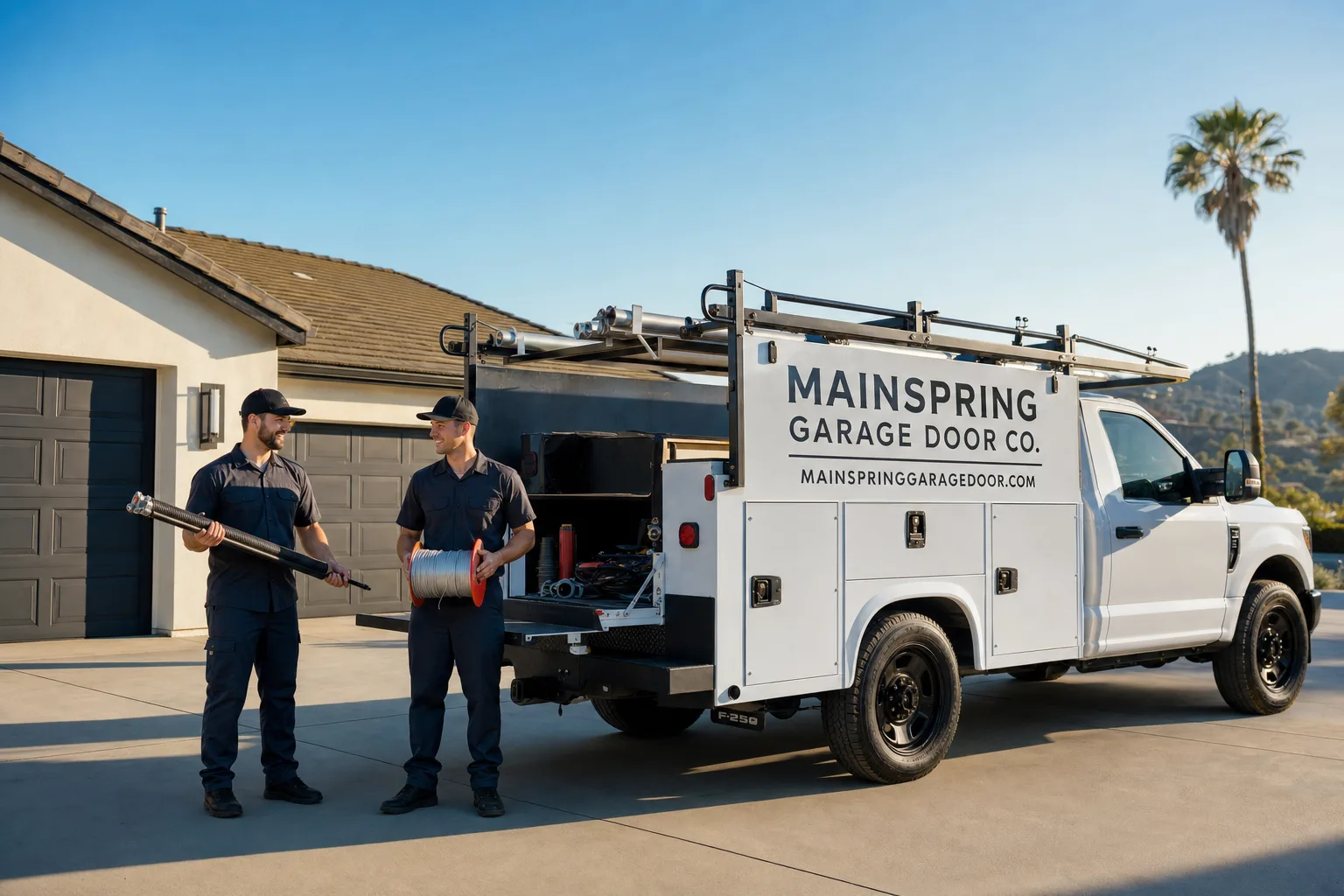
From there, the technician works through the track alignment, roller condition, and cable seating before reconnecting the opener and checking its force limits. Because our trucks carry springs, cables, rollers, and the most common opener components, most jobs are completed in a single visit – no waiting on a part order, no second trip.
Before any work begins, you’ll have a flat price in writing. That’s how we do it on every job. The work falls under Garage Door Repair service, and if an opener adjustment or replacement is needed, that’s handled the same visit under Garage Door Opener service. Every completed job is covered by the 90-Day Done Right Promise: if something isn’t right, we come back – in writing, no arguing, no paperwork. Most repairs of this type are done in two hours or less.
Frequently Asked Questions
Yes, in most cases it’s worth treating as urgent rather than something to watch for a few more weeks. A door running out of balance puts extra strain on the cables and opener, and a weakened spring can snap without warning – which can cause the door to fall. If you’ve noticed a visible gap in a spring or the door dropped suddenly, stop using it and call (844) 755-5838 right away.
Temperature does affect spring tension – metal contracts in the cold, which can push a marginal spring over the edge and cause sluggish travel on mornings well below freezing. Lubricants also thicken in extreme cold, which slows rollers and hinges. If the problem appeared on the first cold morning and cleared up later in the day, that’s useful information for the technician, but it doesn’t mean the spring is fine – it means the spring may be close to the end of its service life.
Your local Mainspring Garage Door Co. team works to get to you the same day whenever the schedule allows, and our phones are answered by a live person around the clock, including nights, weekends, and holidays. Call (844) 755-5838 and tell us what you’re seeing – we’ll give you a straight answer on availability and get someone headed your way.
For most slow or uneven door symptoms, repair is the right answer – springs, rollers, and tracks are serviceable parts on doors that have years of structural life left. Replacement makes more sense when the panels themselves are cracked or bent, when the door is more than 20-25 years old and several systems are failing at once, or when a homeowner wants to upgrade the insulation value or appearance. The technician will give you an honest read on both options, with pricing on each, before any decision is made.
Get It Fixed
Call (844) 755-5838 – a live person answers around the clock, every day of the year. Your local Mainspring Garage Door Co. team will give you a flat price in writing before any work begins, and every job is backed by the 90-Day Done Right Promise. Most repairs are finished in a single visit.
Written by Carl Dutton, Owner at Mainspring Garage Door Co., serving local communities nationwide since 1984.