
Last updated July 26, 2026
How Long Does Garage Door Installation Take? Timelines and What to Expect
Most homeowners in Los Angeles assume the clock starts when the installation crew pulls into the driveway. It doesn’t. The actual work on your garage takes three to four hours for a standard replacement, but the door you picked out may sit in a warehouse for two to six weeks before that crew ever loads it. We’ve been installing doors across Los Angeles since 2016, and the calls we field most often aren’t about the installation itself - they’re from people who scheduled time off work, cleared the garage, and then learned their custom carriage-house door hasn’t even left the factory. This guide breaks down the full timeline from the moment you choose a door to the moment you press the opener button. You’ll know what delays look like, what questions to ask before you sign, and how to tell whether an installer is giving you a real schedule or a wish.
Quick Answer
A standard garage door installation in Los Angeles takes 3 to 4 hours on-site for a typical residential replacement. However, the complete timeline from order to operation ranges from 1 to 6 weeks, depending on door type, custom features, and whether the installer stocks inventory locally or orders from the manufacturer. Custom wood doors, oversized openings, and non-standard track configurations add the most time.
Table of Contents
- The Three Phases Nobody Talks About
- Lead Times by Door Type: What Actually Ships Fast
- Site Prep: The Hidden Hour-Killer
- Day-of Installation: A Hour-by-Hour Breakdown
- Single Visit vs. Two Visit: What Triggers the Return Trip
- Older Los Angeles Homes: When Standard Doesn’t Fit
- The One Question to Ask Before You Schedule
- Common Mistakes to Avoid
- When to Call a Professional
- Frequently Asked Questions
- The Bottom Line
The Three Phases Nobody Talks About
Every garage door installation moves through three distinct phases. Most guides online skip straight to phase three, which is why homeowners get surprised.
Phase one: Order and lead time. This is where the clock really starts. Once you select your door, the installer either pulls it from local stock or places a factory order. Stocked steel doors in standard sizes move fast - sometimes same-week. Custom Clopay carriage-house designs with faux-wood overlay, Amarr Classica collections with insulated glass, or any door wider than 16 feet typically ships from the manufacturer’s regional distribution center in two to four weeks. True custom wood doors from specialty mills can stretch to six weeks or longer, especially if you’re matching a specific stain to existing trim on a Hancock Park or Pasadena craftsman.
Phase two: Site preparation and measurement verification. A good crew measures twice. In our experience, about one in five Los Angeles jobs requires pre-installation adjustment - reframing a rotted header in a 1950s Encino ranch, updating electrical for a modern opener in a pre-war bungalow, or addressing a concrete lip that prevents proper seal contact. These aren’t delays; they’re the difference between a door that lasts fifteen years and one that binds in six months. Phase two takes anywhere from a few days to two weeks, depending on what surfaces.
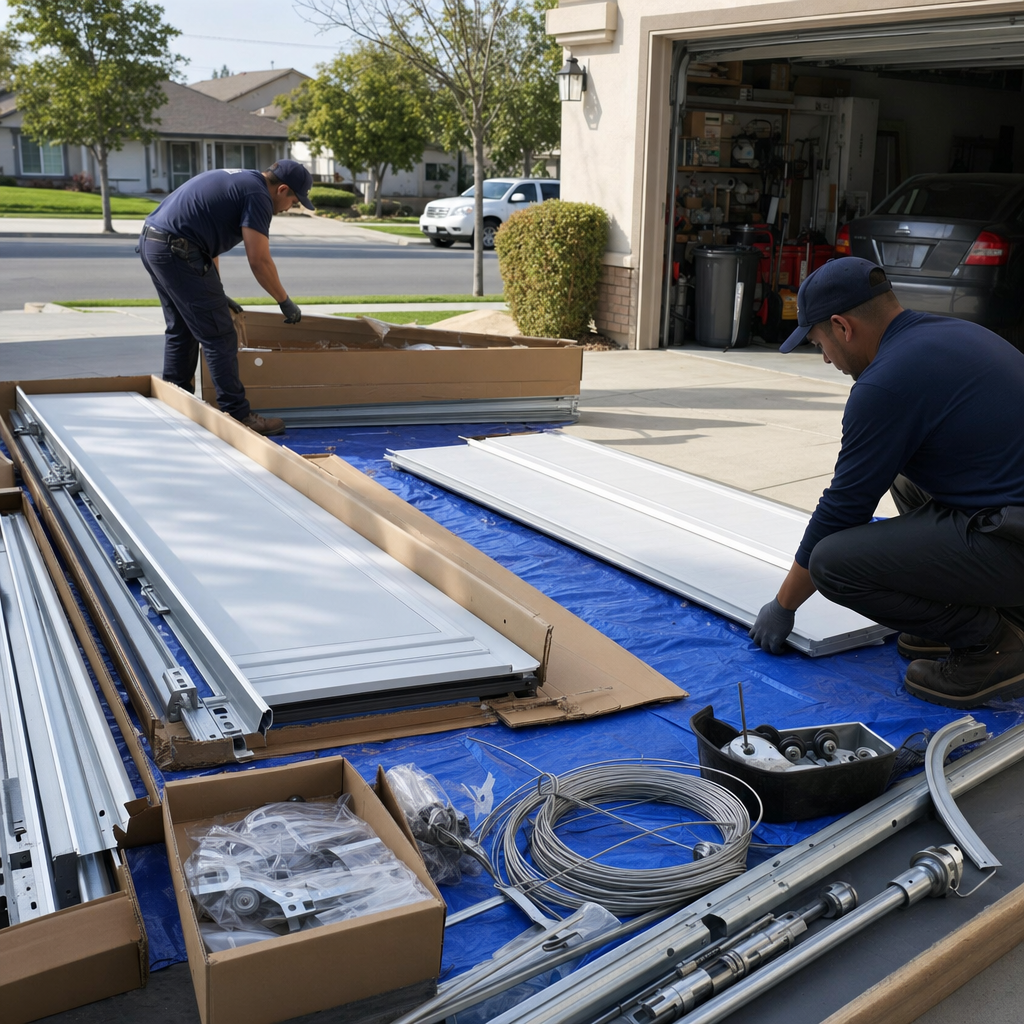
Phase three: Day-of installation. This is the three to four hours most people picture. The old door comes down, the new door goes up, the opener is configured, and the technician walks you through operation and maintenance.
Understanding all three phases keeps you from booking vacation days around a door that hasn’t shipped yet.
Lead Times by Door Type: What Actually Ships Fast
Not all doors move at the same speed. Here’s what we’ve seen across Los Angeles installations, working with major brands including Wayne Dalton, Genie, Clopay, and Amarr.
| Door Type | Typical Lead Time | Why It Varies |
|---|---|---|
| Non-insulated steel, standard sizes | 3-7 days | Widely stocked; minimal customization |
| Insulated steel (double-layer) | 1-2 weeks | Color and window options add factory time |
| Carriage-house composite (Clopay, Amarr) | 2-4 weeks | Overlay patterns and hardware are assembled to order |
| Full-view aluminum/glass | 2-4 weeks | Glass type and frame finish are custom-specified |
| Custom wood (cedar, mahogany, redwood) | 4-6+ weeks | Millwork, staining, and climate-acclimation time |
| Oversized (wider than 18 ft, taller than 8 ft) | 3-5 weeks | Requires engineering review and freight coordination |
The Los Angeles market has a practical advantage: we’re within a day’s freight of Clopay’s western distribution hub and several major regional warehouses. A door ordered on Monday can often be on a truck by Wednesday if it’s a stocked configuration. The bottleneck isn’t geography; it’s whether your chosen style is sitting on a shelf or built to your specifications.
Climate matters here in ways that affect lead time. Los Angeles sun exposure is severe - west-facing doors in Venice or Santa Monica take a beating. If you’re upgrading to a UV-resistant finish or insulated core for temperature stability, those specifications add factory lead time but save you from premature fading or warping. We’ve replaced doors in Pacific Palisades that failed in seven years because the original installer used a non-UV-rated paint system to speed delivery. The homeowner saved two weeks and paid for a full replacement a decade early.
Site Prep: The Hidden Hour-Killer
The day before installation, clear your garage. Move vehicles, bikes, and storage at least six feet back from the opening. This sounds obvious, but crews lose thirty to forty minutes on almost every job waiting for homeowners to relocate items they assumed wouldn’t interfere.
Beyond clearing space, site prep involves several technical checks that determine whether your three-hour job becomes a six-hour job or a two-day job:
- Structural integrity of the header. The horizontal beam above your door opening carries hundreds of pounds of tension. In older Los Angeles homes, especially pre-1970s construction in neighborhoods like Highland Park or Eagle Rock, we’ve found headers compromised by termite damage, water intrusion from failed flashing, or previous owners’ DIY modifications. A failing header must be sistered or replaced before the new track system mounts. This adds two to four hours.
- Electrical supply for the opener. Modern openers require a grounded outlet within six feet of the motor unit. Homes with original two-prong outlets or no outlet in the ceiling need an electrician. In Los Angeles, this means pulling a permit if the circuit is new, and scheduling an electrical inspector. That can push your installation out a week or more.
- Floor level and seal contact. Concrete slabs shift. In areas with clay-heavy soil, like parts of the San Fernando Valley, we’ve seen garage floors settle unevenly, leaving a gap under one corner of the door. The fix - grinding, shim installation, or in severe cases, slab leveling - happens before the door goes up, not after.
- Side room and headroom measurements. Standard track systems need 3.75 inches of side room and 12 inches of headroom. Low-clearance garages, common in 1920s Spanish Revival homes throughout Los Angeles, require low-headroom track or a wall-mounted jackshaft opener. These components aren’t always stocked and may need to be ordered once field conditions are confirmed.
A thorough pre-installation inspection catches these issues. At Garage Door Installation in Los Angeles, we verify all four points during our free estimate visit, so the schedule we quote is the schedule we keep.
Day-of Installation: A Hour-by-Hour Breakdown
Here’s how a typical replacement unfolds for a standard 16-by-7-foot insulated steel door with a trolley-style opener. Your job may vary, but this framework holds for roughly 80 percent of residential installations we complete in Los Angeles.
Hour one: Removal and disposal. The old door comes off its hinges and track. Springs are carefully unwound - these carry lethal tension, and this step is never rushed. The old track, hardware, and opener arm are removed. We haul away the old door unless the homeowner requests otherwise. In Los Angeles, disposal means either recycling the steel at a certified facility or, for wood doors, ensuring no pressure-treated lumber enters standard waste streams per California regulations.
Hour two: Track and spring assembly. New vertical and horizontal track sections are leveled and anchored to the jambs and back hang. The torsion spring system is mounted, wound, and balanced. This is precision work: a spring wound too tight strains the opener; too loose, and the door won’t stay open. Our technicians check balance at multiple heights before proceeding.
Hour three: Door panel hanging and weatherseal. Panels are stacked and hinged, rollers inserted, and the assembly lifted into the track. Bottom seal and astragal are installed. For Los Angeles installations, we use UV-stable vinyl seals that resist cracking in direct sun - a detail that matters on south-facing doors in neighborhoods like Silver Lake or Los Feliz.
Hour four: Opener programming and walkthrough. The motor unit mounts, the rail connects, and safety sensors align at six inches above floor level per federal mandate. We program remotes, test force settings, and demonstrate manual release operation. The technician reviews the 90-Day Done Right Promise, explains lubrication points, and provides the written warranty before leaving.
Custom doors, additional openers for dual bays, or Garage Door Opener in Los Angeles upgrades to smart-home-compatible systems add time proportionally. A three-car garage with two new openers typically runs five to six hours.
Single Visit vs. Two Visit: What Triggers the Return Trip
We complete most jobs in a single visit because our trucks carry standard door sizes, springs, cables, and openers from major brands. But some conditions make a second visit unavoidable, and you deserve to know which ones apply to your job before you schedule.
Single-visit jobs look like this: standard size, standard construction, no structural surprises, and the door is already on the truck. When we arrive with a 16-by-7-foot insulated steel door, a compatible opener, and all hardware pre-verified against your opening measurements, we finish that day. Period.
Two-visit jobs are triggered by:
- Factory-ordered custom components. If you selected a door that isn’t stocked locally, the first visit is measurement verification and final order confirmation. The second visit is installation once materials arrive.
- Structural repair needs discovered during removal. A rotted header or compromised jamb requires carpentry that can’t be completed in the standard window. We stabilize the opening, schedule the repair, and return for door installation.
- Electrical upgrades. No ceiling outlet, insufficient amperage, or outdated wiring needs a licensed electrician. We coordinate with our electrical partners in Los Angeles, but permitting and inspection timelines are outside our direct control.
- Specialty opener requirements. Jackshaft openers for low-headroom garages, battery-backup systems for fire-prone hillside zones, or integrated smart-home hubs sometimes ship separately from the door itself.
The key distinction: a two-visit job isn’t a failure of planning if you knew about it in advance. It becomes a problem only when an installer promises one day, discovers an issue, and disappears for three weeks. We tell you before you sign which category your job falls into.
Older Los Angeles Homes: When Standard Doesn’t Fit
Los Angeles has one of the most architecturally diverse housing stocks in the country. That beauty creates real challenges for garage door installation.
Pre-war bungalows in West Adams or Angelino Heights often have single-car garages with 8-foot-wide openings - a size many modern manufacturers have discontinued. We source compatible doors through Wayne Dalton’s custom-width program or modify standard stock with approved narrowing techniques. Either approach adds a week to lead time.
Mid-century ranch homes in the Valley frequently feature carports converted to enclosed garages in the 1970s or 1980s. These conversions were rarely engineered for door loads. We’ve seen headers consisting of nothing more than a doubled 2×6 spanning fourteen feet, visibly sagging before we touch it. The door installation waits until a structural engineer specifies and a carpenter installs proper support.
Hillside homes in the Hollywood Hills or Laurel Canyon present access constraints. Our standard installation truck carries a 21-foot door section on its rack. Narrow, winding roads with low tree canopy can prevent delivery, requiring smaller shuttle vehicles or even hand-carrying panels down steep driveways. This doesn’t change the installation time itself, but it affects scheduling and crew assignment.
Finally, Los Angeles basements and subterranean parking - increasingly common in newer infill construction - often specify fire-rated doors with specific UL labels. These are special-order items with documented chain-of-custody requirements. Lead times run four to six weeks, and substitutions are not permitted by code.
The One Question to Ask Before You Schedule
Every installer will tell you they can install quickly. Few will tell you whether the door is already in their possession.
Ask this exact question: “Is the door I want already on your truck, or is it still on order?”
The answer reveals everything about your actual timeline. An installer with local stock can typically schedule within a week. An installer who orders after you sign is passing through a lead time they don’t control, and their “two-week installation” may become six weeks the moment the factory backorders your color.
At Mainspring Garage Door Co. home, we maintain regional inventory for standard sizes and configurations. When we quote a timeline, we specify whether your door is stocked, in-transit, or factory-ordered - and we update you if manufacturer status changes. We’ve been serving Los Angeles since 2016, and we don’t promise dates we can’t meet.
Secondary questions worth asking: Who handles permits if needed? (In Los Angeles, structural modifications and electrical work require permits; standard replacement on existing openings typically does not.) What happens if the opening measurements differ from the original estimate? Is disposal included? A clear answer to all four indicates an installer who has done this before and isn’t improvising on your job.
Common Mistakes to Avoid
- Measuring your own opening and ordering online. Garage door measurements include side room, headroom, backroom, and jamb condition - not just width and height. A quarter-inch discrepancy can mean an unusable door. We’ve rescued homeowners in Los Angeles who spent $2,000 on a direct-ship door that wouldn’t fit their 1950s framing.
- Ignoring the opener in your timeline. A new door on a failing opener is a compromised installation. If your opener is more than ten years old, plan for replacement concurrently. Matching a new door to an aging opener often creates balance and safety sensor conflicts that surface months later.
- Scheduling around a delivery date that isn’t confirmed. “Should arrive next week” is not a commitment. Get a tracking number or warehouse confirmation before you take time off work.
- Choosing a door style for curb appeal without checking insulation value. Los Angeles summers are hot, and west-facing garage interiors can exceed 110 degrees. An uninsulated door turns your garage into an oven and any adjacent room into an energy drain. Check the R-value; R-12 or higher is appropriate for attached garages.
- Accepting a verbal warranty. Every promise should be in writing. Our 90-Day Done Right Promise is printed on every invoice. If an installer won’t document their guarantee, they don’t intend to honor it.
- Assuming all brands service all areas. Some manufacturers restrict warranty service to their certified dealers. If you buy a Genie or Clopay door through a general contractor, confirm who handles warranty claims if the opener fails or a panel dents.
When to Call a Professional
Garage door installation involves high-tension springs, heavy panels, and precise electrical work. The springs alone carry enough force to cause serious injury or death if mishandled during winding or release. We do not recommend DIY installation for any door with a torsion spring system, which includes virtually every modern residential door.
Call a professional when your opening is non-standard, when structural condition is unknown, when electrical supply needs updating, or when you simply want the job done once and done right. Garage Door Repair in Los Angeles and installation both require specific tools - winding bars, track gauges, spring scales - that don’t translate to general home improvement.
Mainspring Garage Door Co. offers free estimates in Los Angeles. A technician visits your home, measures your opening, assesses conditions, and provides a flat price before any work begins. No surprises on the bill. Call (844) 755-5838 to schedule.
Frequently Asked Questions
The complete timeline ranges from one to six weeks, depending on door type and site conditions. The on-site installation itself takes three to four hours for a standard residential replacement in Los Angeles. Call (844) 755-5838 for a specific estimate based on your door selection.
Yes, if the door is in stock, the opening is standard, and no structural or electrical issues surface during removal. About 70 percent of our Los Angeles replacements finish in a single visit. The remaining 30 percent require a second visit due to custom orders or discovered conditions - we identify these during our free estimate whenever possible.
Waiting for materials to arrive. A custom wood door or specialty order can sit in production for four to six weeks before the installation day ever gets scheduled. The physical work itself is the shortest phase.
Standard replacement of an existing door on an existing opening typically does not require a permit. Structural modifications to the header or framing, electrical circuit additions, and fire-rated doors in multi-family buildings do require permits through the Los Angeles Department of Building and Safety. We handle permit coordination when your job requires it.
Measure the finished opening width and height, then the side room, headroom, and backroom. Standard single-car doors are 8 or 9 feet wide by 7 feet high; double-car doors are 16 feet wide by 7 or 8 feet high. Older Los Angeles homes often deviate. Our technicians verify all five dimensions during the free estimate visit.
Rain can delay exterior work, though Los Angeles sees limited rainfall. Extreme heat - common in July and August - affects seal adhesion and opener electronics, so we avoid the hottest midday hours when possible. Marine layer mornings in coastal neighborhoods like Venice or San Pedro sometimes push start times later for safety.
The Bottom Line
Garage door installation is not a single event. It’s a chain of decisions - door selection, lead time, site condition, and execution - each with its own timeline. The three to four hours on installation day are straightforward and predictable. Everything before that day depends on what you chose, whether it’s in stock, and whether your home cooperates. Ask the right questions early, get your timeline in writing, and work with an installer who carries inventory and stands behind the schedule they quote. That’s how you avoid the two-week job that becomes two months.
Written by the team at Mainspring Garage Door Co., serving Los Angeles since 2016.