
What’s Happening
A broken garage door spring means your door has lost the counterbalance that makes it possible to open at all. The spring – not the motor, not the cables – carries the full weight of the door, and when it breaks, the door either won’t lift or slams down faster than it should. This is one of the most common garage door failures we see, and it’s one we fix every single day.
Most homeowners notice it one of two ways: they hear a loud bang from the garage – sometimes described as a gunshot – and the door stops working, or they walk out and find the door sitting crooked, cables slack, and the opener straining but not lifting. Both are signs the same thing has happened. The spring has given out. Until it’s replaced by someone who knows what they’re doing, the door should not be used. Springs under tension can cause serious injury if handled without proper training and tools.
Why It Happens
The Spring Reached the End of Its Cycle Life
Garage door springs are rated for a finite number of open-close cycles, and most standard springs reach that limit somewhere between seven and twelve years of normal use – sometimes sooner if the door gets heavy use or was never properly balanced. When a spring is close to the end, it often gives no warning at all. The coils look intact right up until the day they don’t. If your spring snapped suddenly and the door had been working fine the day before, this is almost certainly what happened.
The Spring Was Never the Right Size for the Door
A spring that’s too light for the door it’s lifting wears out years ahead of schedule. This happens when a previous repair used a generic replacement rather than a spring matched to the door’s actual weight and height. You can sometimes spot this if the door always seemed heavy when you raised it manually, or if the opener always sounded like it was working harder than it should. An undersized spring doesn’t fail loudly – it just fatigues faster than it should.
Rust and Corrosion Weakened the Coils
In climates with humidity, road salt in the air, or garages that don’t seal tightly, the coils of a torsion spring can develop surface rust that creates small stress fractures over time. A rusted spring doesn’t just wear out faster – it can break at a fraction of the load it was rated for. If you look at the spring above your door and see reddish-brown scaling or pitting on the coils, that’s the cause. Lubricating a spring regularly slows this down, but once corrosion is deep into the metal, the spring needs to come out.
The Door Was Out of Balance and the Spring Compensated Until It Couldn’t
A garage door that’s hung slightly off-level, has a panel that took a hit from a bumper or a ladder, or runs on worn rollers forces the spring to work unevenly across its length. Over years, that uneven load concentrates stress in one section of the coil. When those springs break, they often snap somewhere other than the center, and the break point tells you something was pulling harder on one side. If your cables were also frayed or your door had been tracking off-center before the spring went, an imbalanced load was likely a factor.
What to Do Right Now
- Stop using the door. Do not try to open or close it with the opener, and do not try to lift it manually. A door without a working spring can weigh over 200 pounds and will not stay up on its own. This is a safety issue, not a preference.
- Disconnect the opener if you can do so safely from the ground. Most openers have a red pull cord that disengages the carriage. Pulling it keeps someone from accidentally activating the opener while the door is out of service. Do not climb a ladder to do this right now.
- Look at the spring but do not touch it. If you can see a gap in the coil above the door, that’s a broken torsion spring. Take a photo if you can – it helps the technician arrive with the right replacement already on the truck.
- Check whether both cables are still attached. A broken spring often pulls a cable off its drum. You can see this from the side without touching anything. Note whether one side looks slack or has a cable hanging loose.
- Do not attempt to replace or wind the spring yourself. Torsion springs are wound under several hundred pounds of stored tension. A spring that slips during unwinding or winding can cause broken bones or worse. This is not a job that goes well when someone watches a video first and figures it out as they go. Call a trained technician.
How We Fix It
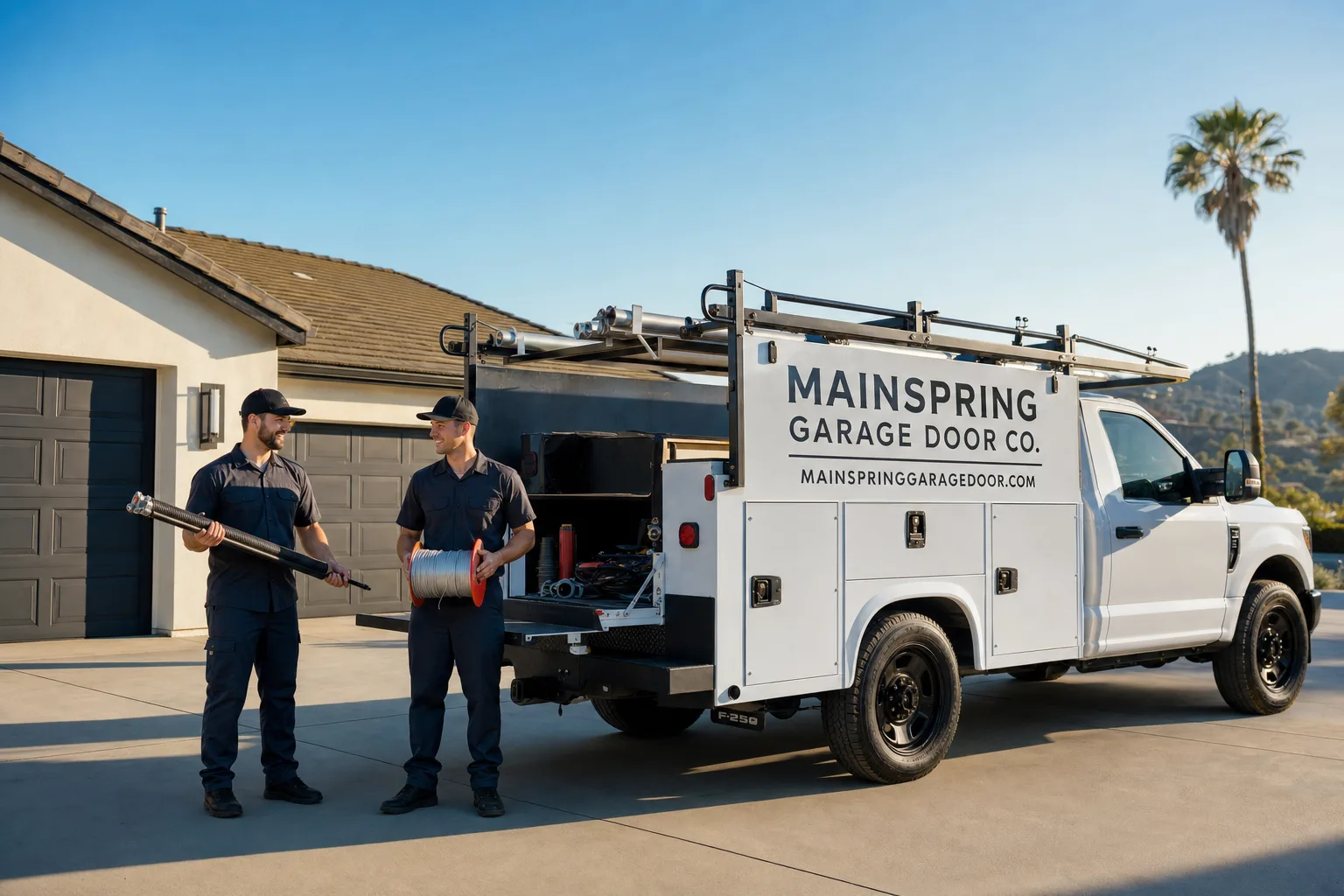
When your local Mainspring Garage Door Co. team arrives, the technician starts by measuring the door – height, width, and weight – and identifying the exact spring specification needed. The good news is that our trucks are stocked with springs, cables, and the hardware most jobs require, so we’re not leaving to find a part and coming back another day. Most broken spring jobs are completed in a single visit.
The technician removes the broken spring, inspects the cables, drums, and bearing plates while the hardware is off, and installs the correctly rated replacement. Before the door is returned to service, the spring tension is set and tested, and the door is balanced so the opener isn’t carrying weight it shouldn’t. The whole process typically takes under two hours.
This falls under our Garage Door Repair service, and if the opener was damaged or stressed in the process, our Garage Door Opener service covers that too. Before any work begins, you’ll get the price in writing – flat, upfront, no surprises on the bill. Every repair is backed by our 90-Day Done Right Promise: if it’s not right, we come back. In writing. No arguing.
Frequently Asked Questions
Yes, it is. A door without a working spring has no counterbalance and can fall without warning under its own weight. Beyond the risk of injury to anyone standing under it, using the opener against an unsprung door can damage the operator, the cables, and the trolley mechanism – turning a straightforward spring replacement into a larger repair. Don’t leave it. Call (844) 755-5838 and get someone out today.
The door itself should not be operated at all until the spring is replaced. If your garage has a side entry door, use that. If the only way in or out runs through the garage door, call us as soon as possible – we answer around the clock, including nights, weekends, and holidays, and a live person picks up every time. Don’t run the risk of a 200-pound door dropping on a car, a bike, or a person. Call (844) 755-5838 now.
In most cases, yes. Your local Mainspring Garage Door Co. team handles broken spring calls as urgent service, and because our trucks arrive stocked with the parts most jobs require, we’re not waiting on a parts order before we can finish. Call (844) 755-5838 – someone will answer, get your information, and tell you exactly when to expect a technician at your door.
If your door runs on two torsion springs and one breaks, the technician will almost always recommend replacing both at the same time. The second spring has the same age and cycle count as the one that just failed – it’s likely to break within months anyway, and replacing it while the hardware is already off costs far less than a second service call. Your technician will show you the condition of the second spring and explain the recommendation before any work begins.
Get It Fixed
Call (844) 755-5838 right now – a live person answers around the clock, every day of the year. Your local Mainspring Garage Door Co. team will come out, give you a written price before any work starts, and get your door running safely again – backed by the 90-Day Done Right Promise.
Written by Carl Dutton, Owner at Mainspring Garage Door Co., serving local communities since 1984.