
Garage Door Won’t Close All the Way
A garage door that stops before it reaches the floor is almost always caused by one of four things: misaligned or blocked safety sensors, a travel limit set too short, a bent track, or a failing spring or cable. In most cases, a trained technician can identify the exact cause and complete the repair in a single visit. Call (844) 755-5838 and your local Mainspring Garage Door Co. team will have someone out to you.
The frustrating part about this symptom is that the door usually looks fine. It moves, it responds to the remote, and nothing sounds obviously broken. But something in the system is telling the door to stop short – either a sensor it thinks it sees, a mechanical limit it’s obeying, or a structural problem it’s actually protecting you from by not going all the way down. Knowing which one matters, because the fix for a dirty sensor eye is very different from the fix for a spring that’s starting to fail.
Why It Happens
Safety Sensors Out of Alignment
Every modern garage door opener has two small sensors mounted low on the tracks, one on each side, about four to six inches off the ground. They send an invisible beam across the opening; if anything breaks that beam, the door reverses or stops. When those sensors get bumped, collect dust, or shift slightly in their brackets, the opener sees a phantom obstruction. The giveaway is a blinking light on one of the sensor units – usually a solid green on one side and a flashing or dim amber on the other. If you see that, misaligned sensors are your most likely culprit.
Travel Limit Set Too Short
Garage door openers have an adjustable setting that tells the motor how far to run before it considers the door “closed.” Over time – especially after a power outage, a firmware reset, or a new opener installation – that limit can drift. When it’s set too short, the door stops a few inches above the floor and the motor shuts off thinking the job is done. There’s no blinking sensor light with this one; the door just stops cleanly at a consistent height every single time, which is the tell.
Bent or Obstructed Track
The tracks that guide the door panels up and over are more vulnerable than they look. A car door swung too wide, a lawnmower bumped into the wall, even the house settling slightly – any of these can put a small bend or dent in the track. The door rides into that imperfection and either binds up or triggers the opener’s resistance sensor, which interprets the extra drag as an obstruction and stops the door. Listen for a grinding or scraping sound at roughly the same point in the travel each time the door stops short.
Worn Springs or Damaged Cables
Springs and cables do the actual lifting. When a spring is losing tension or a cable has begun to fray, the door becomes harder to move – and the opener’s built-in overload protection kicks in and stops the door before it finishes closing. This is the most important cause on this list to take seriously. Do not attempt to inspect, adjust, or handle springs or cables yourself. Torsion springs operate under extreme tension and can cause serious injury if they release unexpectedly. If the door feels heavier than usual when you lift it manually, or if you can see a visible gap in the spring coil, stop using the door and call us.
What to Do Right Now
- Stop using the door until the cause is confirmed. If a spring or cable is failing, continued operation can turn a repair into a full replacement – or cause the door to drop unexpectedly.
- Check the sensor lights. Walk to the bottom of each track and look at both sensor units. A solid green and a solid amber (or green and green, depending on the brand) means the beam is intact. Any blinking or dim light means the sensors need attention.
- Look for visible obstructions. A piece of debris, a misplaced tool, or even a garden hose sitting in the sensor’s line of sight can trigger a stop. Clear the area along the bottom of the door opening.
- Manually test the door’s weight. Disconnect the opener by pulling the red emergency cord, then try to lift the door by hand. It should move smoothly and hold its position at mid-height with little effort. If it feels unusually heavy, drops quickly, or won’t stay up, that points to a spring or cable problem – set it down carefully and call (844) 755-5838 before doing anything else.
- Take a photo or short video. Show exactly where the door stops, the position of the sensor lights, and any visible damage to the track or springs. Your technician can look at it before they arrive and come prepared with the right parts.
How We Fix It
When your local Mainspring technician arrives, the first thing they do is watch the door cycle once – or as much of a cycle as is safe – before touching anything. Most of the time, that single observation narrows the cause to one of the four problems above. From there, the diagnosis is confirmed hands-on: sensors are tested with a meter, the track is checked for straightness, spring tension is measured, and the opener’s limit and force settings are read against the door’s actual travel.
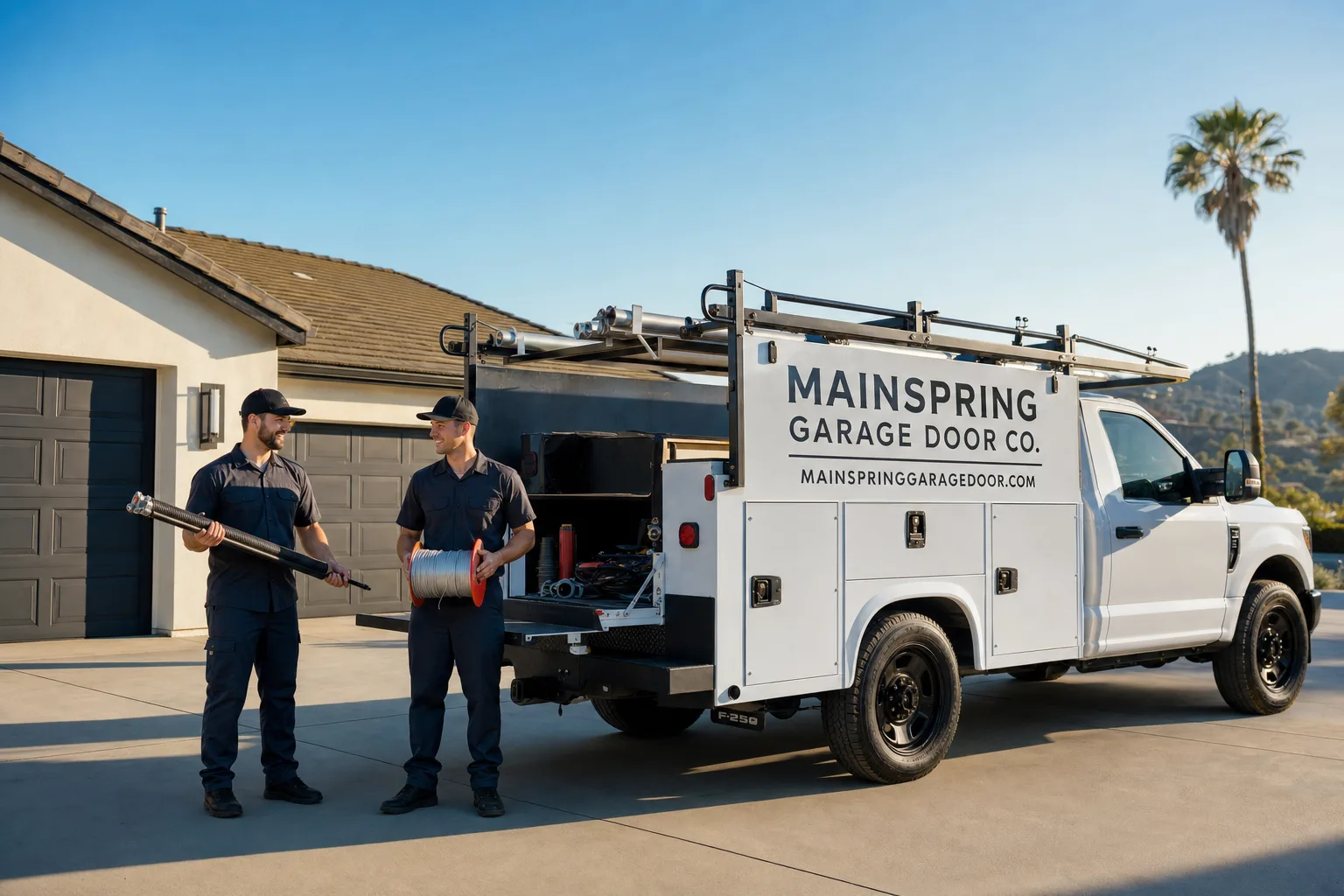
Before any work begins, you get a flat price in writing. No surprises on the bill. The repair itself – whether it’s realigning sensors, adjusting travel limits, straightening or replacing a track section, or replacing worn springs and cables – typically takes one visit because our trucks carry the springs, cables, and opener components needed for the most common repairs. The job is covered by our 90-Day Done Right Promise: if it’s not right, we come back, in writing, no arguing. This falls under our Garage Door Repair service, and in some cases the opener’s settings are the root cause, which routes to our Garage Door Opener service instead. Either way, one call handles it.
Frequently Asked Questions
Yes, it can be – depending on the cause. A door held open by a failing spring is unpredictable and can drop without warning. Even a door that’s stopping short due to a sensor issue leaves your home unsecured. If the door won’t close fully, don’t leave it and assume it’ll be fine overnight. Call (844) 755-5838 – our phones are answered by a live person around the clock, and your local team can tell you right away whether it needs same-day attention.
If the cause is a dirty or slightly misaligned sensor, waiting a day or two is unlikely to make things worse. But if the door feels heavy when lifted manually, if you can see a visible gap in the spring coil, or if a cable looks frayed or has come off its drum, that’s a same-day call. A spring under failing tension is not stable, and the longer a damaged cable runs, the more likely it is to let go. Call (844) 755-5838 and we’ll help you figure out which situation you’re in.
Your local Mainspring Garage Door Co. team handles garage door repair calls every day of the week, including weekends and holidays. Call (844) 755-5838 – a live person answers every call, and they’ll connect you with your local team to confirm availability and get you scheduled. Most repairs are completed in a single visit because our trucks arrive stocked with the parts most commonly needed.
Yes, and it’s more common than people expect. The opener’s travel limit and force settings control exactly how far the door travels and how hard the motor pushes. If those settings drift or get reset, the door stops short through no fault of the door itself. Your technician will check the opener settings as part of the diagnostic – there’s no extra charge to look at both, and the repair is quoted together as a single flat price before anything is adjusted.
Get It Fixed
Call (844) 755-5838 – a live person answers day or night, every day of the year. Your local Mainspring Garage Door Co. team will schedule the visit, arrive with the parts, give you a flat price in writing before any work begins, and stand behind it for 90 days. No surprises, no arguing, done right.
Written by Carl Dutton, Owner at Mainspring Garage Door Co., serving local communities since 1984.