
Last updated July 26, 2026
DIY vs Professional Emergency Garage Door: What’s Safe to Do Yourself
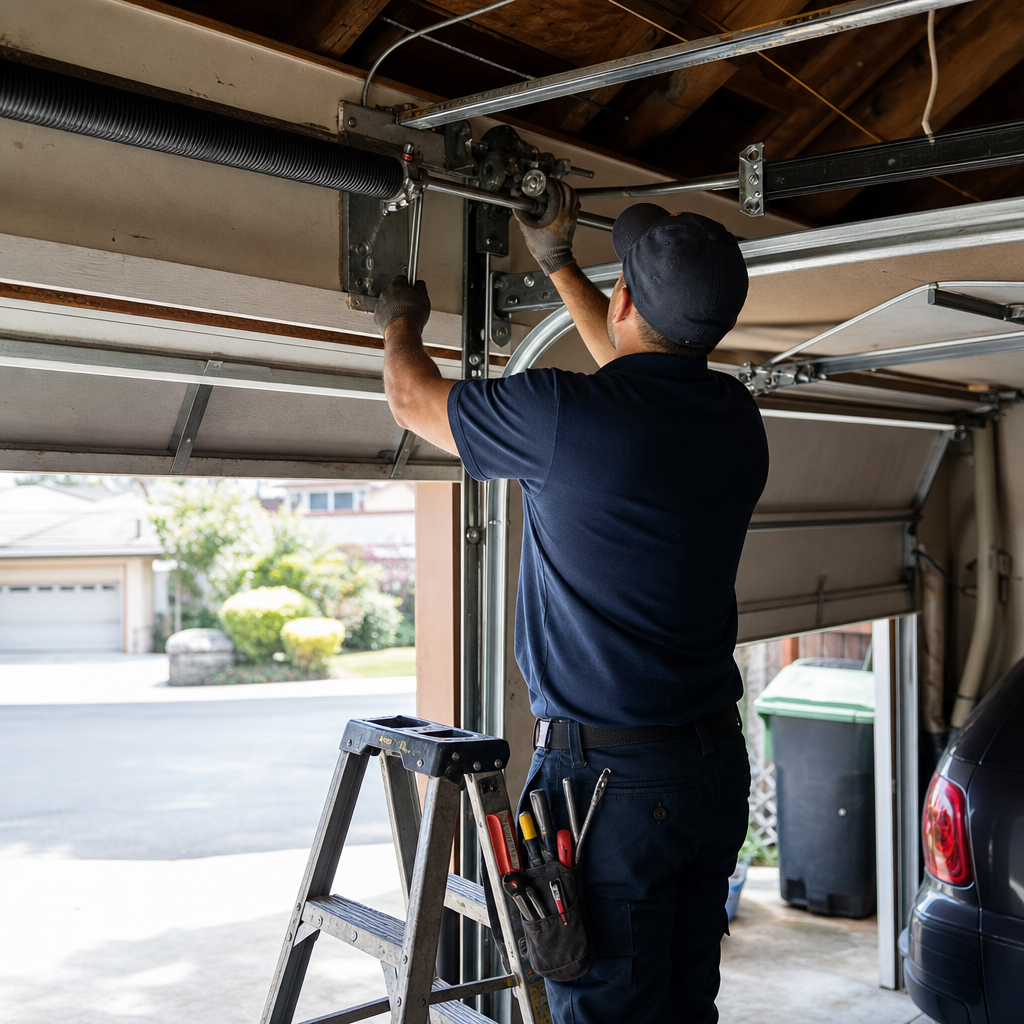
A door that’s off its track looks like something you could push back into place. Attempting it without knowing which roller came out first is how a $200 repair becomes a $600 one. In our 42 years serving Los Angeles homeowners, we’ve arrived at hundreds of jobs where the initial problem was minor and the real damage was done by a well-meaning attempt to fix it. This guide will show you what you can safely do to stabilize an emergency garage door situation, what you should never touch, and how to avoid turning a same-day repair into a multi-day headache.
Quick Answer
In a garage door emergency, homeowners can safely stabilize the situation by engaging the manual lock, blocking the door in position, and securing vehicles still inside. You should never attempt to force a door with a broken spring, realign tracks by hand, or bypass safety sensors. The only legitimate emergency DIY repair is replacing a snapped emergency release cord; for more guidance on what’s safe to handle yourself, see our DIY vs Professional Garage Door Installation: What’s Safe to Do Yourself. Everything else requires a trained technician with the right tools and parts.
Table of Contents
- Stabilize vs. Repair: The Real Question
- Emergency Stabilization Steps That Are Actually Safe
- Three “Fixes” That Make Repairs More Expensive
- Why Emergency DIY Is Riskier Than Routine DIY
- The One Legitimate Emergency DIY Task: Release Cord Replacement
- Los Angeles-Specific Factors That Change the Equation
- Common Mistakes to Avoid
- When to Call a Professional
- Frequently Asked Questions
- The Bottom Line
Stabilize vs. Repair: The Real Question
Most emergency garage door guides ask the wrong question. They frame the issue as “can you fix it yourself?” when the useful question is “what can you do right now to keep this from getting worse until a technician arrives?”
We learned this distinction the hard way. In 1984, when Mainspring Garage Door Co. started in Los Angeles, we assumed homeowners would either call immediately or attempt a full repair. What we found over four decades was a third category: people who took sensible protective steps but then crossed the line into trying to fix the mechanism itself. That middle ground is where most of the expensive damage happens.
A garage door weighs between 150 and 400 pounds. The spring system, whether torsion or extension, holds that weight in balance so a motor rated at half a horsepower can lift it. When that balance breaks, the door becomes a heavy, unpredictable object on wheels. Your role in an emergency is not to restore that balance. It is to prevent the door from moving unpredictably and to protect whatever is inside your garage.
This distinction matters because it changes what success looks like. Success is not a working door. Success is a stable door that a technician can repair in a single visit without additional parts or labor. Every time we’ve had to replace a full track section because a homeowner tried to bend it back into shape, or replace multiple springs because someone forced a door with one broken spring, the bill went up and the timeline stretched out.
The stabilization mindset also protects you physically. In 42 years, our technicians have seen injuries that happened because someone treated an emergency like a routine maintenance task. The adrenaline of a stuck door, the pressure of a car trapped inside, the late hour - these factors change how your body responds and how carefully you assess risk. Stabilization tasks are designed to be done quickly, with simple tools, and without putting your hands near the points of greatest mechanical tension.
Emergency Stabilization Steps That Are Actually Safe
These four steps can be performed by any homeowner with a flashlight and a basic understanding of their garage layout. They require no special tools and no contact with the spring or cable system.
- Engage the manual lock. Every garage door installed after 1982 has a manual slide bolt or lock handle on the interior side of the door. If your door is stuck partially open, slide this lock into place. It prevents the door from dropping if the remaining spring or cable fails completely. In Los Angeles, where we get Santa Ana wind events that can exert surprising pressure on a garage door envelope, this step is particularly important. A door that seems stable in calm air can shift dramatically when gusts hit.
- Block the door in position. Use a sturdy object - a step ladder, a cinder block, a full five-gallon bucket - to support the door at its current height. Do not use anything that can roll or tip. Place the support directly under a solid panel section, never under a window insert or decorative feature. If the door is stuck open, this prevents it from slamming shut. If it is stuck closed, this prevents it from being forced open by wind or attempted operation.
- Secure any vehicle still inside. If your car is trapped, leave it in park with the parking brake engaged. Remove any valuables. Then exit the garage through the house door, not by trying to squeeze under the stuck door. We’ve seen crushed fingers and damaged door panels from homeowners who treated a 12-inch gap like a safe crawl space. It is not.
- Disconnect the opener if it is still attempting to run. Unplug the opener motor from the ceiling outlet. A motor that strains against a jammed door can overheat, strip its internal gears, or burn out its circuit board. Replacing a Genie or Chamberlain opener board costs $200-$400 plus labor. Unplugging it costs nothing.
These steps completed, you have done everything useful that a homeowner can do. The door is secure, your property is protected, and you have prevented secondary damage. The next step is to call for service.
Three “Fixes” That Make Repairs More Expensive
We have identified three emergency actions that homeowners attempt with genuine good intention and that consistently make the final repair more complicated and more costly. Each one comes from a misunderstanding of how the system works.
Forcing a Door With a Broken Spring
When one torsion spring breaks, the door becomes roughly twice as heavy for the remaining spring and the opener to manage. Some homeowners believe they can “help” the door by lifting manually or by repeatedly hitting the opener button. This is dangerous and destructive.
The unbalanced load transfers stress to the cables, the drums, the opener carriage, and the door panels themselves. We’ve replaced entire Clopay door sections in Pasadena because a homeowner tried to muscle a door with a broken spring, causing the panel to buckle at the hinge point. We’ve replaced LiftMaster opener gears in Sherman Oaks because repeated strain stripped the nylon gear. The original spring repair would have been $220-$340. The compounded damage ran to $800 or more.
If you hear a loud bang from the garage and the door suddenly feels heavy or crooked, you have a broken spring. Do not attempt to operate the door. Lock it, block it, and call.
Realigning Tracks by Hand
A door off its track looks like a alignment problem. It is usually a symptom problem. The roller left the track because a cable slipped, a spring broke, or a hinge failed. Pushing the roller back in without addressing the root cause forces the track to accept a geometry it was not designed for.
Tracks are engineered to precise tolerances - typically within 1/4 inch of parallel and plumb. When you bend a track section by hand to accept a misaligned roller, you create a flat spot or a bulge that will cause every subsequent roller to bind or jump. In our experience, a track that has been hand-bent requires replacement about 80% of the time. A new track section, plus the labor to remove and reinstall the door, turns a $180 cable repair into a $500-$700 job.
There is also a physical risk. The track brackets are bolted to the door jamb with lag screws. Applying force to the track can loosen these brackets, causing the entire track assembly to shift suddenly. We’ve seen lacerations and crush injuries from this exact scenario.
Bypassing the Safety Sensor to Close a Stuck Door
Modern garage doors have photoelectric sensors near the floor that reverse the door if the beam is interrupted. When a door is stuck partially open, some homeowners tape over the sensors or align them to face away from each other, thinking the sensor is the problem.
The sensor is almost never the problem. It is doing exactly what it was designed to do: detecting that something is wrong with the door’s path and preventing closure. Bypassing it removes the last safety mechanism protecting against a door that closes on a person, a pet, or an object. It also tells the opener to apply full closing force against whatever obstruction actually exists.
In 2023, a Los Angeles homeowner bypassed their sensors to close a door that had a broken cable. The door came down crooked, jammed in the track, and the opener continued to run until it burned out its motor. The repair required a new opener, a new cable, and track straightening. The original cable repair would have been completed in 90 minutes.
Why Emergency DIY Is Riskier Than Routine DIY
There is a legitimate place for homeowner maintenance on garage doors. Lubricating hinges, testing the auto-reverse feature, clearing debris from the track - these are sensible, safe tasks that we encourage. For Los Angeles homeowners weighing their options, our DIY vs Professional Garage Door: The Los Angeles Homeowner’s Decision Guide explores this balance in detail. Emergency repairs are different in four specific ways that change the risk calculation.
Adrenaline impairs judgment. A door that fails at 6:00 AM when you’re leaving for work, or at 10:00 PM when you discover your garage open, triggers a stress response. Your heart rate increases, your peripheral vision narrows, and your tolerance for risk rises without your conscious awareness. Tasks that you would approach cautiously on a Saturday afternoon feel urgent and manageable. They are not.
Poor lighting conceals hazards. Most garage door emergencies happen in early morning, evening, or overnight hours. The spring system, cable drums, and track brackets are all located in the upper third of the door assembly, where ceiling-mounted garage lighting is weakest. A frayed cable that is obvious in daylight can be invisible in shadow. A loose bracket that would prompt caution in full light goes unnoticed.
The failure point is unknown. In routine maintenance, you are inspecting a system that was working when you started. In an emergency, something has already failed, but you may not know what. The symptom - a stuck door - could indicate a broken spring, a slipped cable, a failed roller, a bent track, a stripped opener gear, or a combination. Working on the system without diagnosing the failure is like performing surgery without knowing where the patient is bleeding.
Compressed time increases error. Emergency repairs happen under time pressure: a car needed for work, a security concern about an open garage, weather approaching. This pressure leads to skipped steps, improvised tools, and incomplete assessments. We’ve found screwdrivers used as pry bars, c-clamps substituting for winding bars, and homeowners working directly under a door supported only by a questionable jack. Each of these improvisations made sense in the moment and each created additional risk.
For these reasons, we draw a sharp line between maintenance and emergency repair. Maintenance is planned, lit, and low-stakes. Emergency repair is unplanned, often poorly lit, and high-stakes. The skills do not transfer.
The One Legitimate Emergency DIY Task: Release Cord Replacement
There is one emergency repair that is genuinely safe for homeowners and that prevents a recurring access problem: replacing a snapped emergency release cord.
The emergency release cord hangs from the opener carriage and allows manual operation of the door during a power outage or opener failure. It is a simple red handle on a rope, designed to be pulled by hand. For context on when DIY makes sense for opener-related issues, see DIY vs Professional Garage Door Opener: What’s Safe to Do Yourself. Over time, the rope frays, the handle cracks, or a well-meaning person pulls too hard and snaps the cord entirely.
Without this cord, you cannot disengage the opener to lift the door manually. If your power goes out or your opener fails, you are trapped. This is particularly relevant in Los Angeles, where SCE public safety power shutoffs during high wind events can leave neighborhoods without electricity for hours.
Replacing the cord is safe because it involves no spring tension, no cable load, and no track alignment. The procedure is:
- Unplug the opener.
- Thread a new braided nylon cord through the hole in the release lever.
- Tie a secure knot and trim excess.
- Attach the red handle at the desired height, typically 6 feet from the floor.
- Plug the opener back in and test that the release mechanism still functions.
The replacement cord and handle are available at any hardware store for under $15. If you are uncomfortable with even this simple task, we will replace it during any service call at no additional labor charge. But this is the exception that proves the rule: it is safe because it interacts with none of the load-bearing or tensioned components of the door system.
Los Angeles-Specific Factors That Change the Equation
Garage door emergencies in Los Angeles have characteristics that differ from other markets. Understanding these factors helps homeowners make better decisions about when to attempt stabilization and when to call immediately.
Climate and material stress. Los Angeles experiences significant temperature swings between coastal microclimates and inland valleys. A door in Woodland Hills may see 110°F summer days that expand metal components and degrade rubber seals, while a door in Santa Monica faces salt air corrosion that attacks steel hardware. These climate factors mean that a failure in one neighborhood may have different root causes than an identical symptom in another. Our technicians carry parts suited to both conditions because we’ve learned that a one-size-fits-all approach fails in this market.
Seismic considerations. California building code requires garage door installations to withstand specific lateral forces. After a significant tremor, a door that appears to have a simple track problem may actually have a compromised jamb attachment or a shifted header. Attempting to force a door back into operation after seismic activity can worsen structural damage. We recommend professional inspection after any earthquake that causes visible door misalignment.
HOA and permitting requirements. Many Los Angeles neighborhoods, particularly in planned communities from Calabasas to the South Bay, have HOA architectural review requirements for garage door replacements. An emergency repair that turns into a full replacement may require documentation that a DIY approach cannot provide. Our estimates include the specification sheets and manufacturer certifications that HOAs typically require.
Security timing. An open or stuck garage door in Los Angeles presents a security concern that may be more acute than in lower-density markets. The stabilization steps we outlined above - particularly the manual lock - are designed to secure your garage while you wait for service, not to delay calling because the door “seems fine for now.”
Common Mistakes to Avoid
- Using the opener as a diagnostic tool. Repeatedly pressing the remote to “see what happens” strains the opener and can strip internal gears. If the door does not move smoothly on the first attempt, stop and inspect visually before trying again.
- Standing under a door to inspect the springs. Never position yourself directly beneath a door that is not fully supported by the open position or by a verified secondary support. Springs can release without warning, and the door can drop.
- Assuming a quiet failure is a minor failure. A door that moves slowly but seems to work is often a door with a spring that has lost tension and is about to break completely. The quiet operation masks the overload on the opener.
- Ignoring a door that closes too fast. Gravity should not be doing the work. A door that slams shut has a spring or cable problem that will worsen. We’ve seen this symptom precede complete spring failure within days.
- Attempting to adjust spring tension with non-specialized tools. Winding bars are solid steel bars inserted into the cogs of a torsion spring assembly. Screwdrivers, pliers, and pipe wrenches are not substitutes. They slip, and when they slip under load, serious injury results.
- Delaying the call because “it’s probably expensive.” Most emergency repairs we complete in Los Angeles fall between $180 and $340. The cost of delaying is typically higher, both in additional damage and in the inconvenience of an inoperable door.
When to Call a Professional
Call a technician immediately if the door is stuck partially open, if you heard a loud bang before the failure, if the door appears crooked in its tracks, if cables are loose or dangling, or if the door feels significantly heavier than usual. These symptoms indicate spring, cable, or structural failures that require professional tools and training.
Garage Door Repair in Los Angeles should be performed by technicians who arrive with the correct parts, state the price before beginning work, and stand behind the repair with a written guarantee. Mainspring Garage Door Co. offers free estimates in Los Angeles - call (844) 755-5838. Our phones are answered by a live person 24 hours a day, including nights, weekends, and holidays. Most repairs are completed in a single visit because our trucks carry springs, cables, and openers for all major brands.
Frequently Asked Questions
You should not attempt to open a garage door with a broken spring. The door weighs 150-400 pounds without spring assistance, and lifting it manually risks back injury, door panel damage, and cable derailment. If your car is trapped inside, call for emergency service rather than attempting to lift the door. We prioritize vehicle-release calls and can often arrive within hours in the Los Angeles area. For more guides & resources on handling garage door emergencies, visit our blog.
Most emergency repairs in Los Angeles range from $180 to $340, depending on the specific components involved. Spring replacements typically fall at the higher end of this range, while cable repairs and sensor realignments are at the lower end. We state the flat price before any work begins, so there are no surprises on the bill. Call (844) 755-5838 for an exact quote - estimates are free.
Lubrication is a maintenance task, not an emergency repair. If your door has already failed, spraying lubricant on the tracks or hinges will not restore function and may create a slipping hazard for the technician. Save lubrication for your annual tune-up. Our $89 Seasonal Tune-Up includes proper lubrication of all moving parts.
Garage door springs have a finite cycle life, typically 10,000 cycles for standard springs. A cycle is one open and one close. If you use your door four times daily, that’s roughly 1,460 cycles per year. A spring nearing its cycle limit can appear to function normally until the final fatigue fracture, which often happens without warning. In Los Angeles, temperature fluctuations between day and night can accelerate metal fatigue in springs installed without proper cycle-rated specifications.
If your door has two torsion springs and one breaks, we recommend replacing both. The unbroken spring has experienced the same cycle count and is likely near its own failure point. Replacing only the broken spring often leads to a second service call within months. We quote both springs upfront so you can make an informed decision.
Yes. Most jobs are completed in a single visit because our technicians arrive with springs, cables, and openers already on the truck. We serve all Los Angeles neighborhoods from the Valley to the Westside to the South Bay. Calls are answered by a live person 24/7, and we offer a 90-Day Done Right Promise on every completed job.
The Bottom Line
The homeowner’s role in a garage door emergency is stabilization, not repair. Lock the door, block it in position, secure your vehicle, and unplug the opener. These four steps protect your property, prevent secondary damage, and set up the technician for a straightforward, single-visit repair. Everything beyond this scope - spring work, track alignment, cable replacement, sensor bypassing - belongs to trained professionals with the right tools and the experience to use them safely. The cost of a professional repair is predictable. The cost of a DIY attempt gone wrong is not.
If your garage door has failed and you need service in Los Angeles, call (844) 755-5838. A live person will answer, day or night. We’ll state the price before we begin, complete most repairs in one visit, and back our work with the 90-Day Done Right Promise. Mainspring Garage Door Co. home | Garage Door Installation in Los Angeles | Garage Door Opener in Los Angeles
Written by the team at Mainspring Garage Door Co., serving Los Angeles since 2016.