
Last updated July 26, 2026
DIY vs Professional Garage Door Installation: What’s Safe to Do Yourself
A complete garage door kit from a big-box store comes with 137 steps in the manual. Steps 1 through 130 are manageable for a careful DIYer. Steps 131 through 137 involve setting spring tension, and that is where emergency rooms enter the conversation. In Los Angeles, we have seen the aftermath of both: doors that slam shut in a Santa Ana wind because the track was shimmed wrong, and homeowners who spent a Saturday on a ladder only to realize the header was out of plumb by three-eighths of an inch. This guide maps exactly where the danger zone sits between what you can safely attempt and what requires a trained professional. We will cover the real scope of the work, the tools and time it demands, the hidden costs that close the price gap, and the specific tasks where professional training changes not just the quality but the safety outcome.
Quick Answer
Homeowners can safely handle pre-installation tasks like removing the old door, painting or staining panels, and installing decorative hardware. The actual hanging of tracks, attachment of cables, and especially the winding of torsion springs should be left to professionals. In Los Angeles, Garage Door Installation services typically run $1,200 to $3,800 depending on door size and material, and include warranty coverage that DIY cannot match.
Table of Contents
- The Full Scope of a Standard Garage Door Installation
- The DIY Safe Zone: What a Prepared Homeowner Can Handle
- The Danger Zone: Where Professional Training Changes the Safety Outcome
- How to Evaluate a DIY Installation Kit Honestly
- The Hidden Costs That Close the Price Gap
- What Professional Warranty Covers That DIY Cannot
- Common Mistakes to Avoid
- When to Call a Professional
- Frequently Asked Questions
- The Bottom Line
The Full Scope of a Standard Garage Door Installation
Most homeowners picture a door swinging into place like a refrigerator. The reality involves more parts than a car’s front suspension and less tolerance for error than kitchen cabinetry.
A standard 16-foot sectional steel door installation in Los Angeles requires:
- Removal and disposal of the existing door, track, and hardware (2-4 hours)
- Inspection and possible reinforcement of the header, jambs, and spring anchor bracket
- Installation of vertical track, horizontal track, and curved track sections with precise alignment
- Hanging of door sections with rollers, hinges, and weatherstripping
- Attachment and tensioning of lift cables or torsion springs
- Installation and programming of the garage door opener
- Safety sensor alignment, force adjustment, and travel limit setting
- Final balance test and 20-point safety inspection
The physical demands are substantial. A single 8-foot by 7-foot steel panel weighs 80 to 120 pounds. A 16-foot by 7-foot door has four of them. You will work overhead, on ladders, with arms extended, for sustained periods. In our experience, a first-time DIYer in Los Angeles who has the right tools and a helper needs 8 to 14 hours spread across two days. Without experience, expect to pause, re-read instructions, discover a missing bracket, and make a supply run to a hardware store in the San Fernando Valley.
The tools required are not universal household items. You need a level at least 48 inches long, a torque wrench for lag screws, winding bars for torsion springs (solid steel, not screwdriver substitutes), and a clamping system to hold track in place while fastening. Most Los Angeles homeowners do not own these. Rental costs add up, and improper tool use is where injuries happen.
The DIY Safe Zone: What a Prepared Homeowner Can Handle
There is honest work a careful homeowner can do safely. It is limited, specific, and valuable. Doing these tasks yourself can reduce professional labor time and save money without risking injury.
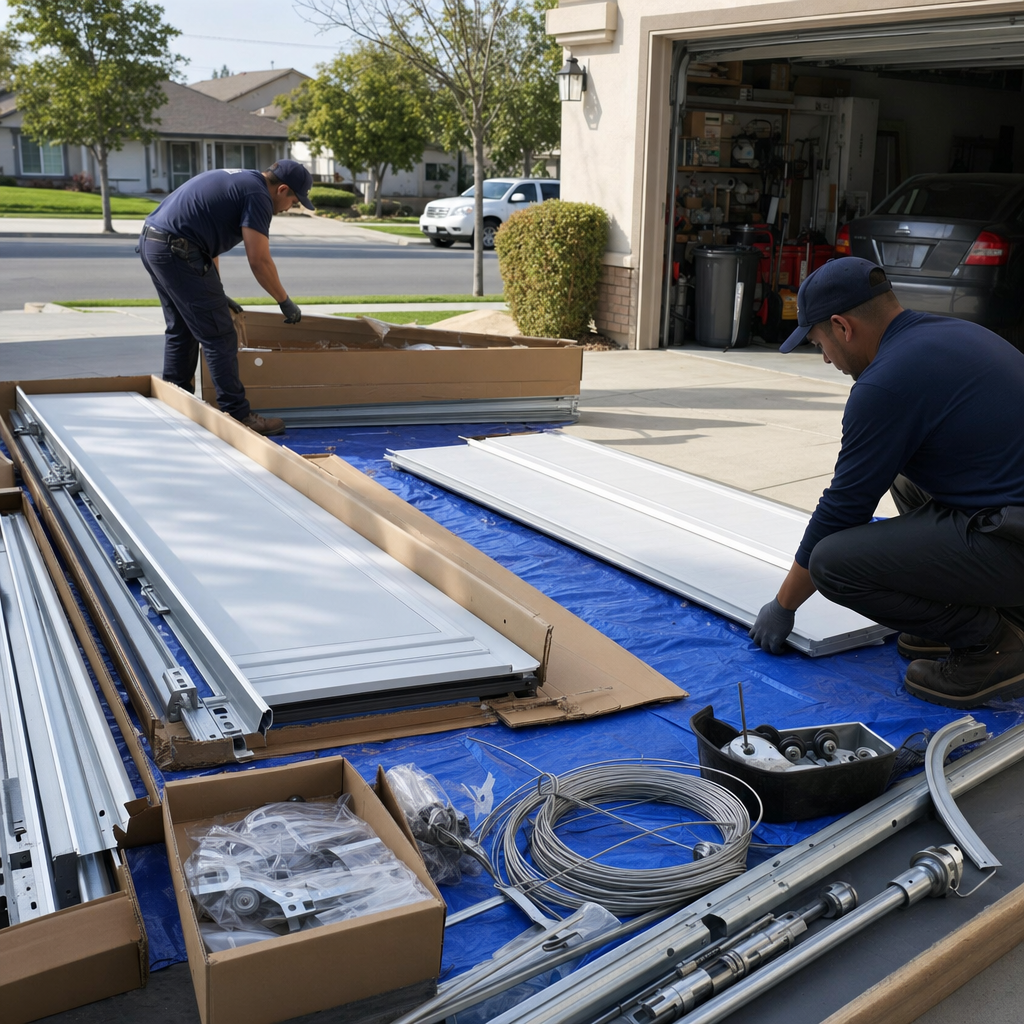
- Removing the old door. With the door in the closed position, release spring tension using the opener’s emergency release, disconnect the opener arm, and remove the door sections from the bottom up. This is labor, not skill. Two people, gloves, and a clear driveway are essential.
- Prepping the opening. Inspect the header for rot or splitting, especially in older Los Angeles homes with original construction. Measure width, height, and headroom. Note any irregularities. Clean the jambs. This information saves the installer time and prevents surprises.
- Painting or staining panels before hanging. Factory-finished doors from Clopay or Amarr arrive ready, but custom wood doors or primed steel benefit from pre-finishing. Lay panels flat, paint both sides to prevent warping, and let them cure fully. This is easier on sawhorses than on a hung door.
- Installing decorative hardware. Handles, hinges, and window inserts are cosmetic and non-structural. They do not affect door balance or safety systems.
- Programming remotes and keypads. Once a professional has installed and tested the opener, pairing a garage door opener in Los Angeles with remotes, a wall console, or a smartphone app is straightforward. LiftMaster and Chamberlain provide clear instructions for this step.
These tasks share a trait: none involve stored mechanical energy, overhead lifting in awkward positions, or precision alignment that affects safety. They are preparation and finishing work. A homeowner who completes them has contributed meaningfully without entering the danger zone.
The Danger Zone: Where Professional Training Changes the Safety Outcome
Here is the thesis of this guide, though you can find more guides & resources on our site: garage door installation is one of the few home projects where intermediate skill produces worse outcomes than either confident beginner or professional. The confident beginner reads every warning, follows every step, and calls for help when uncertain. The professional has done it hundreds of times and recognizes the subtle signs of trouble. The intermediate DIYer has enough knowledge to attempt shortcuts, enough confidence to improvise, and not enough experience to know when that improvisation will fail catastrophically.
Three tasks sit squarely in this danger zone:
Torsion spring winding. A standard torsion spring for a 16-foot steel door stores enough energy to lift 150 to 250 pounds. Winding it requires inserting solid steel bars into a cogged winding cone and adding precise turns. The bars must be fully seated. The body must be positioned to the side, never in line with the bars. One slip, and the bar becomes a projectile. In 42 years, we have seen broken wrists, facial fractures, and one fatality in Los Angeles County from this step alone. This is not a task where watching a video substitutes for supervised training.
Track alignment and fastening. Vertical tracks must be plumb within one-quarter inch over their full height. Horizontal tracks must slope down toward the back of the garage at a precise angle. If the track is too tight, rollers bind and the opener strains. If too loose, the door can derail. In earthquake-prone Los Angeles, improper track fastening to framing creates a hazard during seismic events. We have repaired doors that shook off misaligned tracks during the 2019 Ridgecrest aftershocks.
Cable attachment and drum setting. Lift cables wrap around drums at specific angles. If set wrong, the door lifts unevenly, stressing panels and hardware. A door that closes crooked wears out in months, not years. Correcting this after the fact requires unwinding springs, which returns you to the first danger.
Professional training changes the safety outcome because professionals have handled the exceptions: the header that is not level, the side room that is short by an inch, the concrete floor that has settled. They know when a standard bracket will not work and which specialized part to substitute. They carry those parts on the truck.
How to Evaluate a DIY Installation Kit Honestly
Big-box retailers in Los Angeles stock complete garage door kits with appealing price tags: $600 to $1,400 for a 16-foot door with hardware. The price is real. What it excludes is where the evaluation becomes honest.
What the price excludes:
- Opener. Most kits are door-only. A quality chain-drive or belt-drive opener adds $200 to $500.
- Spring system. Some economy kits include extension springs, which are easier to install but wear faster and operate less smoothly than torsion systems. Torsion hardware is often an upgrade.
- Disposal. Los Angeles bulky item pickup has scheduling constraints. Private haulaway runs $75 to $150.
- Permit and inspection. In unincorporated Los Angeles County and several cities, garage door replacement requires a building permit for structural or electrical work. The kit price assumes you know this and handle it.
What the instructions assume:
The manual assumes your opening is square, plumb, and built to standard dimensions. It assumes you have a helper with availability across two consecutive days. It assumes your existing header can support the new door’s weight and spring load without reinforcement. In older Los Angeles neighborhoods like Highland Park or West Adams, headers are often 4×6 lumber that has dried and twisted over decades. The manual does not address this.
What happens when a measurement is off:
A quarter-inch error in headroom measurement means the track radius is wrong and the door will not open fully. A half-inch error in width means the door binds or gaps. These are not fixable with shims and hope. They require reordering sections or custom track, which voids any savings from the kit price. We have taken calls from homeowners in Pasadena who spent a weekend on installation, discovered the incompatibility Monday morning, and needed garage door repair in Los Angeles to correct what the kit could not accommodate.
The Hidden Costs That Close the Price Gap
The advertised DIY savings of $500 to $800 in labor evaporate quickly. Here is the honest accounting for a typical Los Angeles installation:
| Item | Typical Cost |
|---|---|
| Tool rental (torque wrench, level, clamps, winding bars) | $80 - $150 |
| Disposal of old door and hardware | $75 - $150 |
| Helper for two days (friend, neighbor, or hired labor) | $100 - $300 |
| Permit and inspection (where required) | $150 - $400 |
| Corrective repair after first attempt | $200 - $600 |
| Replacement of damaged panels or hardware from errors | $150 - $500 |
| Time value (14 hours at modest rate) | $350 - $700 |
| Total hidden costs | $1,105 - $2,800 |
Professional garage door installation in Los Angeles ranges from $1,200 to $3,800 depending on door size, material, and opener selection. The gap narrows considerably. When you add the 90-Day Done Right Promise, the single-visit completion, and the warranty coverage, the professional route often costs less in real terms.
Our standing offers reduce this further: $50 off any repair over $250, free second opinion on any written estimate, and a permanent 5% senior and veteran discount. These are not introductory rates that expire. They are the price of doing business squarely.
What Professional Warranty Covers That DIY Cannot
A DIY installation has no warranty on labor. The door panels may carry a manufacturer warranty, but that warranty is void if installation deviates from specifications. Most manufacturers require professional installation for full coverage. You are self-insuring every component.
Professional installation from Mainspring Garage Door Co. home includes:
- Manufacturer warranty on door, sections, and finish
- Workmanship warranty on installation, alignment, and hardware
- The 90-Day Done Right Promise: if anything is not right, we return at no charge, in writing, with no dispute process
- Opener warranty integration: LiftMaster and Chamberlain honor full terms only with professional installation and registration
For Los Angeles homeowners planning to sell, this matters beyond convenience. California real estate disclosure forms ask about structural modifications and garage door safety. A professional installation with permit and inspection documentation satisfies disclosure requirements. A DIY installation without permits creates liability exposure and can delay closing. We have been called by real estate agents in Culver City and Studio City to document and permit retroactively, a process that costs more than original professional installation.
Common Mistakes to Avoid
- Using the wrong winding bars. Screwdrivers, pliers, or socket extensions are not substitutes for solid steel winding bars. They slip, bend, or shatter under torsion load. Every year, Los Angeles emergency rooms treat injuries from this specific improvisation.
- Ignoring headroom requirements. Standard track needs 12 inches of headroom. Low-headroom track needs 9-1/2 inches. Measuring to the nearest inch and hoping is how doors end up with six inches of unused travel and an opener that strains.
- Fastening track to drywall instead of framing. The track carries the full weight of the door in motion. Drywall anchors pull out. In Los Angeles, where lightweight construction is common, this failure mode appears within months.
- Skipping the balance test. A properly balanced door stays at any height when disconnected from the opener. An unbalanced door crashes or rises on its own. Testing this requires releasing spring tension safely, which many DIYers skip.
- Installing an opener on an unbalanced door. The opener is not a substitute for proper spring tension. It will lift an unbalanced door until the drive gear strips, typically in 18 to 24 months. Then you need opener replacement and spring correction.
- Neglecting sensor alignment. California building code requires photoelectric sensors on all automatic garage doors installed after 1993. Misaligned or bypassed sensors are a code violation and a liability hazard.
- Working alone on a ladder with heavy panels. This is how shoulders and backs get injured. It is also how doors get dropped, dented, and reordered at full retail.
When to Call a Professional
Call a professional when the project involves torsion springs, track alignment, cable attachment, or any work overhead with heavy components. Call when your Los Angeles home has non-standard dimensions, older construction, or requires permitting. Call when you need the job done in one day with warranty coverage and no return trips.
Mainspring Garage Door Co. offers free estimates in Los Angeles. A technician arrives with a fully stocked truck, measures your opening, discusses options for steel, wood, or composite doors from Clopay and other major brands, and states the flat price before any work begins. Most installations are completed in a single visit. Call (844) 755-5838 to schedule.
Frequently Asked Questions
Professional installation in Los Angeles typically ranges from $1,200 to $3,800 for a standard residential door, depending on size, material, insulation level, and opener selection. A basic 8-foot steel door with a chain-drive opener sits at the low end; a 16-foot custom wood door with a belt-drive opener and smart connectivity sits at the high end. Call (844) 755-5838 for a free estimate with upfront pricing.
Yes, and this is often the most practical hybrid approach. A professional handles the door, springs, and track, ensuring proper balance and safety. You can then install the opener yourself-see our DIY vs Professional Garage Door Opener: What’s Safe to Do Yourself for guidance-following manufacturer instructions for mounting, wiring, and programming. This preserves the door warranty while saving on opener labor. We recommend this for homeowners comfortable with basic electrical work and ladder use.
Permit requirements vary by jurisdiction. Unincorporated Los Angeles County and many cities require permits for garage door replacement when structural or electrical work is involved. A permit ensures inspection of header support, opener electrical connection, and safety sensor function. Professional installers handle permitting as part of the project. DIY installations without permits create disclosure issues at resale.
Professional installation of a standard door and opener takes 3 to 5 hours. A first-time DIYer with a helper needs 8 to 14 hours across two days, not including supply runs, tool rental, or corrective work. In Los Angeles traffic, a trip to the hardware store can consume half a day.
Winding torsion springs is the most dangerous step. A standard spring stores enough energy to cause serious injury or death if the winding bar slips or the spring breaks. This step requires specific tools, body positioning, and experience that cannot be acquired from a manual. We recommend every homeowner observe this boundary.
Many manufacturer warranties require professional installation for full coverage. Clopay, Amarr, and other major brands specify that improper installation voids panel, finish, and hardware warranties. Opener warranties from LiftMaster and Chamberlain similarly require professional installation and registration for complete protection. DIY installation leaves you without recourse for defects that would otherwise be covered.
The Bottom Line
Garage door installation has a clear boundary between safe DIY and professional-only work. Remove the old door, prep the opening, finish panels, and program accessories yourself. Leave spring tensioning, track alignment, cable attachment, and final safety testing to trained technicians. The hidden costs of DIY, the warranty implications, and the genuine physical danger of certain steps mean that professional installation is often the better value, not just the safer choice. In Los Angeles, where building codes, resale disclosure, and seismic considerations add complexity, a professional installation from a company that stands behind its work is a square deal. For the full picture, read our DIY vs Professional Garage Door: The Los Angeles Homeowner’s Decision Guide.
Ready for a free estimate? Call Mainspring Garage Door Co. at (844) 755-5838. A live person answers 24/7, including nights, weekends, and holidays. We will state the flat price before any work begins, arrive with the right parts on the truck, and back every job with our 90-Day Done Right Promise in writing.
Written by the team at Mainspring Garage Door Co., serving Los Angeles since 2016.