
Last updated July 26, 2026
The Complete Garage Door Parts Guide for Los Angeles Homeowners
The spring gets all the attention. But in Los Angeles, it’s often the bottom seal and the hinges that fail first - worn down by heat, grit, and the seasonal dust that rolls through the Valley every summer. Most homeowners can name about three parts of their garage door. This guide names all of them, explains what each one does, and flags which garage door parts are stressed most by Los Angeles’s specific climate and usage patterns. Whether you live in Santa Monica, Pasadena, or the San Fernando Valley, knowing your door’s anatomy helps you spot trouble early, talk to a technician with confidence, and avoid the costly mistake of replacing a whole door when a single part needs attention.
Quick Answer
A standard residential garage door has twelve core parts: springs, cables, drums, rollers, hinges, tracks, panels, bottom seal, weatherstripping, struts, bearings, and the opener system. In Los Angeles, heat and coastal salt air accelerate wear on rubber seals, steel rollers, and torsion springs - meaning these parts need inspection every 12 to 18 months, even when the door appears to work fine.
Table of Contents
- Torsion and Extension Springs: The Weight-Bearers
- Cables and Drums: The Transfer System
- Rollers and Hinges: The Movement Points
- Tracks: The Guide Rails
- Panels, Seals, and Weatherstripping: The Barrier
- Struts and Bearings: The Reinforcement
- Opener System Parts: The Motor and Controls
- Consumables vs. Lifetime Components
Torsion and Extension Springs: The Weight-Bearers
Springs carry the full weight of your garage door - typically 150 to 400 pounds - so the motor doesn’t strain every cycle. Torsion springs mount horizontally above the door and twist to store energy. Extension springs stretch along the horizontal tracks on either side. Most Los Angeles homes built after 1990 use torsion springs; older homes in neighborhoods like Highland Park or Eagle Rock may still have extension springs.
Here’s what wears them out:
- Cycle count: Standard springs are rated for 10,000 cycles. A typical Los Angeles household opens and closes the door 3 to 5 times daily - that’s 1,100 to 1,800 cycles yearly. A spring lasts 5 to 9 years under normal use.
- Heat fatigue: Garage temperatures in the San Fernando Valley regularly exceed 110°F in summer. Metal expands and contracts, accelerating metal fatigue. We’ve replaced springs in Valley homes after just 4 years that should have lasted 8.
- Coastal corrosion: Near the coast in Santa Monica or Redondo Beach, salt air corrodes the spring coating. Once rust penetrates, the spring weakens unpredictably.
A broken spring is unmistakable: the door feels impossibly heavy, or it slams shut, or it won’t lift at all. Never attempt spring replacement yourself. Torsion springs store lethal tension. In California, the Division of Occupational Safety and Health classifies high-tension spring work as requiring specific training. Our technicians at Garage Door Repair in Los Angeles carry calibrated replacement springs on every truck and match them to your door’s exact weight and height.
Cables and Drums: The Transfer System
Lift cables connect the bottom of the door to the drums at each end of the torsion spring shaft. When the spring releases energy, the drums rotate and wind the cables, raising the door. Lowering reverses the process.
Cables are 1/8-inch aircraft-grade galvanized steel, rated for thousands of pounds. But they fray from rubbing against misaligned tracks or corrode from moisture trapped against the concrete slab. In Los Angeles, the combination of occasional heavy winter rains and months of dry heat creates a corrosion cycle: moisture wicks into the cable windings, then summer heat bakes the rust deeper.
Drums are less glamorous but equally critical. Each drum has grooves sized to the door’s lift height - standard, high-lift, or vertical-lift configurations. A 7-foot door in a typical Los Angeles ranch home uses standard-lift drums. Taller doors in newer construction or custom homes in the Hollywood Hills may need high-lift drums to clear vehicle racks or storage.
Three signs your cables or drums need attention:
- The door lifts unevenly, with one side higher than the other.
- You see broken strands or rust powder where the cable wraps around the drum.
- The cable has slipped off the drum and the door hangs crooked.
Never operate a door with a slipped or frayed cable. The uneven load transfers to the remaining cable, which can snap without warning. We stock replacement cables and drums for all major door heights and carry them on every service call.
Rollers and Hinges: The Movement Points
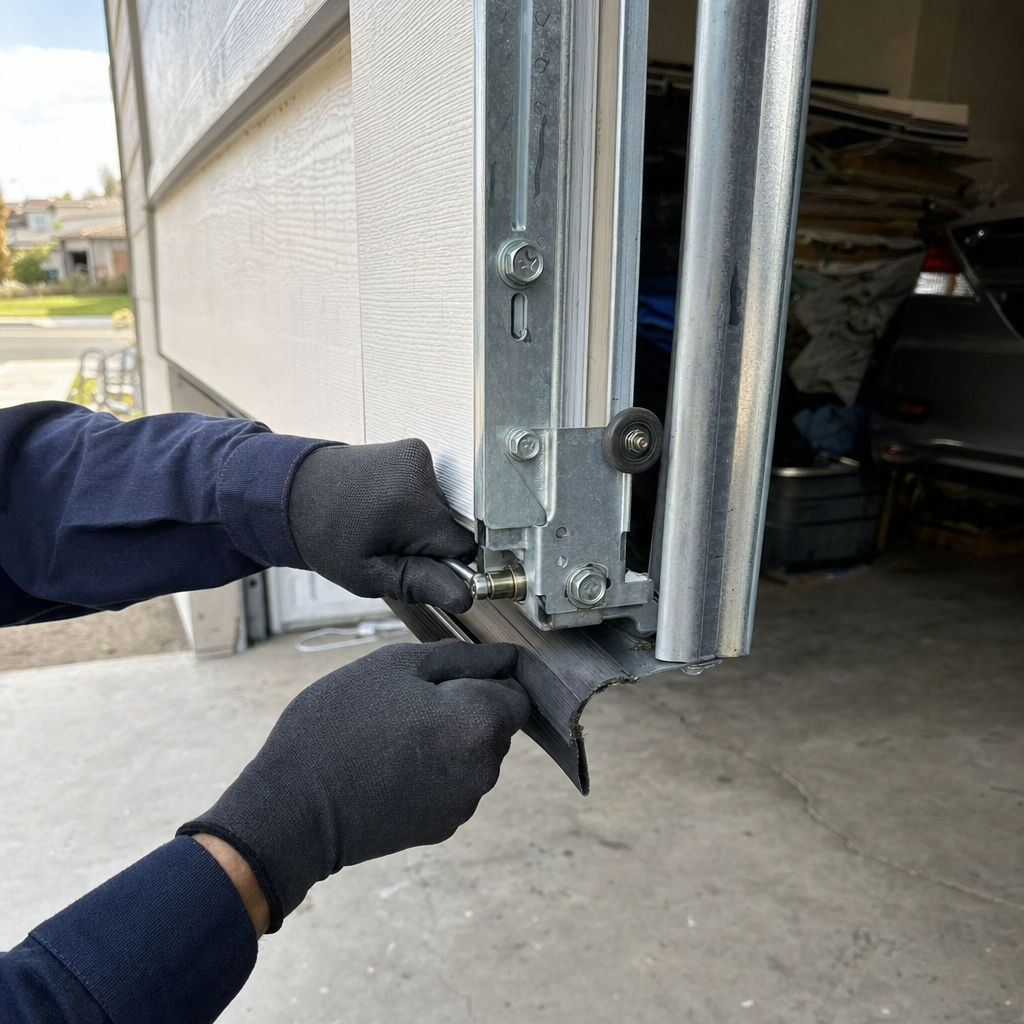
Rollers ride inside the tracks, carrying the door’s weight as it moves. Hinges connect the panels and guide the door around the curved portion of the track. These are the hardest-working, most-neglected parts on any door.
There are three roller types, and the difference matters in Los Angeles:
- Steel rollers: Durable but noisy. Bare steel rusts quickly near the coast - we’ve seen rollers frozen solid in Pacific Palisades homes after just two years. Galvanized or zinc-coated steel lasts longer but still needs lubrication.
- Nylon rollers: Quieter operation, no rust. The nylon wheel rides on a sealed steel bearing. In extreme Valley heat, cheap nylon can deform. We specify high-temperature nylon for Los Angeles installations.
- Sealed bearing rollers: Premium grade. The bearing is permanently lubricated and shielded from dust. For homes near construction zones or the 405 freeway corridor, where fine dust infiltrates everything, these pay for themselves in longevity.
Hinges are stamped steel, numbered by their position on the door. A 16-foot wide door typically has #1 hinges at the bottom, #2 at the next panel joint, and so on. The hinge number must match - substituting a #2 for a #3 stresses the panel and the track. In our experience, hinge failure in Los Angeles follows a pattern: the #1 and #2 hinges crack first because they carry the most dynamic load as the door starts moving.
Dust is the hidden enemy. The Santa Ana winds drive fine particulate into garage spaces across the region. Without annual cleaning and lubrication, grit acts as grinding paste in roller bearings and hinge pins. Our $89 Seasonal Tune-Up includes full roller and hinge service - cleaning, inspection, and proper lubrication with silicone-based compound that won’t attract more dust.
Tracks: The Guide Rails
Vertical tracks run from floor to ceiling on each side; horizontal tracks extend back into the garage. The radius where they meet - the curved “track curve” - determines how closely the door hugs the ceiling when open.
Track problems in Los Angeles usually stem from three causes:
- Impact damage: A vehicle bumper, bicycle handlebar, or storage bin bends the track. Even a 1/4-inch bend causes rollers to bind and jump.
- Mounting looseness: The lag bolts securing track brackets to the wall framing work loose from vibration. In older Los Angeles homes with soft Douglas fir framing, this happens faster than in new construction with engineered lumber.
- Corrosion: Galvanized steel tracks eventually rust, especially where the concrete slab meets the vertical track. Coastal homes see this earliest.
Track alignment is precise work. The vertical tracks must be plumb and parallel within 1/4 inch, or the door binds and the rollers wear unevenly. Never attempt to straighten a bent track with a hammer - the metal work-hardens and cracks. We replace damaged track sections with matching gauge steel and verify alignment with a laser level.
One Los Angeles-specific note: seismic retrofit requirements. After the 1994 Northridge earthquake, many garages were reinforced with additional framing or bracing. This sometimes encroaches on the track space, requiring low-headroom track hardware. If your garage has a finished ceiling or added structural bracing, standard tracks may not fit. We assess this on every installation quote.
Panels, Seals, and Weatherstripping: The Barrier
Panels form the visible face of your door. Steel panels dominate Los Angeles - they resist sun damage better than wood and cost less than aluminum or composite. Clopay and Amarr are common brands in Southern California subdivisions; Wayne Dalton appears frequently in 1980s and 1990s tract homes.
Panel damage is usually obvious: dents from vehicles, cracks from age, or delamination where the steel skin separates from the foam core. But panel replacement has a catch. Manufacturers change panel designs every few years, and color matching fades over time. A single panel replacement on a 10-year-old door often looks mismatched. In our experience, if two or more panels need replacement, a full door is the more economical choice - and we price both options honestly.
Bottom seals and weatherstripping are the silent casualties of Los Angeles climate:
- Bottom seal: A flexible rubber or vinyl strip that seals the gap between door and concrete. In the Valley’s 110°F summer garages, black rubber hardens and cracks in 2 to 3 years. We specify EPDM rubber or thermoplastic elastomer (TPE) seals for Los Angeles - they stay flexible to 150°F and resist UV degradation.
- Threshold seal: A supplemental strip mounted to the floor, not the door. Useful for driveways that slope toward the garage, common in hillside neighborhoods like Echo Park or Mount Washington. Stops water intrusion during winter storms.
- Side and top weatherstripping: Vinyl or rubber flaps that seal the perimeter. These degrade from sun exposure on south- and west-facing doors. A door in Venice with afternoon sun exposure needs new weatherstripping twice as often as a north-facing door in the same neighborhood.
Seals are consumables. Plan on replacement every 3 to 5 years in Los Angeles, sooner with extreme sun exposure or near the coast where salt accelerates rubber breakdown.
Struts and Bearings: The Reinforcement
Struts are steel reinforcement bars that span the width of the door, preventing panel bowing under wind load or opener strain. A standard 16-foot wide door needs at least one strut across the top panel; wider doors or wind-prone areas need multiple struts. Los Angeles building code requires wind-load-rated doors in specific zones, and struts are part of that rating.
Most homeowners never notice struts until one bends or a panel starts sagging. A sagging top panel strains the opener and the upper hinges. We’ve seen openers fail prematurely because a weakened strut allowed the door to flex every cycle.
End bearings and center bearings support the torsion spring shaft. The end bearings sit in brackets at each end; the center bearing supports the shaft midpoint on wider doors. These are simple sleeve bearings or ball bearings, but they carry the full spring torque. When a bearing seizes, the opener strains, the spring works unevenly, and the door can jam mid-cycle.
Bearing replacement is straightforward for a trained technician - 15 minutes with the door properly secured. For a homeowner, it’s inaccessible without releasing spring tension, which brings us back to the safety rule: this is not DIY work.
Opener System Parts: The Motor and Controls
The opener is not part of the door itself, but its components interact with door parts constantly. Understanding this system prevents mismatched repairs.
Key opener components:
- Motor unit: 1/2 HP for single doors, 3/4 HP for double doors or solid wood construction. Belt-drive motors run quietest - worth considering if the garage is beneath a bedroom, common in Los Angeles’s hillside homes with garage-under configurations.
- Drive system: Chain (durable, noisy), belt (quiet, slightly less durable in extreme heat), or screw (direct, moderate noise). In our experience, belt drives hold up well in Los Angeles if the garage stays below 120°F. Above that, the rubber belt degrades faster.
- Travel module and limit switches: Tell the opener when the door is fully open or closed. Misadjusted limits cause the door to reverse prematurely or slam against the floor.
- Safety sensors: Required by federal law since 1993. Two photo-eye sensors mount 4 to 6 inches above the floor, one each side. If the beam breaks, the door reverses. Sunlight streaming directly into a west-facing sensor at certain times of day can blind it - a common false-trigger in Los Angeles’s clear afternoon light.
- Wall control and remotes: Modern openers use rolling-code encryption. Genie and LiftMaster use incompatible protocols. Replacing a remote requires matching the opener’s frequency and security format.
Opener replacement is an opportunity to assess the entire door system. A new opener on a failing door is wasted money. We evaluate spring balance, track alignment, and roller condition before recommending any opener work. Our Garage Door Opener in Los Angeles service includes this full-system check.
Consumables vs. Lifetime Components
Not all parts wear at the same rate. Knowing the difference helps you budget and spot when a technician is pushing unnecessary work.
Consumables - plan on replacement:
- Bottom seal: 3-5 years in Los Angeles climate
- Weatherstripping: 4-6 years, sooner with sun exposure
- Rollers: 5-7 years for steel, 7-10 for sealed bearing nylon
- Hinges: 8-12 years, earlier if dust infiltration is severe
- Springs: 5-9 years by cycle count
- Cables: 8-12 years, inspect annually for fraying
Lifetime components - replace only when damaged:
- Tracks: 25+ years if not impacted or corroded
- Panels: 20+ years unless physically damaged
- Door frame and jambs: life of the structure
- Opener motor housing: 15-20 years, though internal electronics may need service
The critical insight: consumables are relatively inexpensive parts that protect expensive components. A $12 bottom seal prevents water damage to panels and the concrete slab. A $25 roller prevents track wear and opener strain. Deferred maintenance on consumables always costs more later.
Common Mistakes to Avoid
- Buying springs by length alone. Torsion springs must match wire gauge, inner diameter, and wind direction - not just length. A spring that fits but is wound for the wrong direction will fail catastrophically. We see this with online parts ordered by homeowners in North Hollywood and Sherman Oaks.
- Mixing roller types on the same door. Steel and nylon rollers have different diameters and ride at slightly different heights. Mixing them causes binding and uneven wear.
- Ignoring the bottom seal until water enters. By the time you notice water, the seal has been cracked for months and may have allowed corrosion of the bottom panel’s internal reinforcement.
- Assuming all Genie parts fit all Genie openers. Genie has used three distinct rail systems and multiple sensor formats over 30 years. A “Genie-compatible” part from a big-box store often isn’t.
- DIY spring replacement after watching a video. The videos never show the emergency room visits. In 42 years, we’ve known three homeowners in Los Angeles who attempted this; two required hospitalization. The third damaged his door beyond repair.
- Neglecting seismic bracing interaction with tracks. Post-Northridge retrofit bracing sometimes blocks standard track curves. Forcing installation without assessment causes immediate binding.
- Choosing the cheapest bid on panel replacement. Mismatched panel gauge or insulation type creates thermal bowing and noise. We quote the correct part, even when it’s not the lowest price.
When to Call a Professional
Call a technician when you notice uneven movement, unusual noise, visible cable fraying, or any spring-related issue - or consult The Complete Garage Door Repair Guide for Los Angeles Homeowners to understand what you’re seeing. Call immediately if the door is stuck open - it’s a security exposure, and Los Angeles’s variable weather can damage interior contents. If your opener reverses unpredictably or sensors flash without obstruction, the safety system needs professional diagnosis.
Mainspring Garage Door Co. offers free estimates in Los Angeles - call (844) 755-5838. Our trucks carry springs, cables, rollers, hinges, and opener parts for all major brands. Most repairs finish in a single visit, and every job carries our 90-Day Done Right Promise in writing. If you’re considering a new door, our Garage Door Installation in Los Angeles service includes full measurement, brand guidance, and permit handling where required.
Frequently Asked Questions
Standard torsion springs last 5 to 9 years in Los Angeles, depending on daily use and garage temperature. Valley homes with uninsulated garages that exceed 110°F in summer typically see shorter life - sometimes 4 years. Coastal homes face salt-air corrosion that penetrates spring coatings. We inspect spring condition during every service call and can estimate remaining life based on cycle count and visible wear. Call (844) 755-5838 for a free spring inspection - estimates are free.
Homeowners can safely replace weatherstripping, bottom seals, and remote batteries. Springs, cables, and any component under tension require professional service. California does not prohibit homeowner spring work, but the injury risk is severe - the stored energy in a torsion spring can cause traumatic injury or death. Our technicians are trained to release tension safely and carry the specialized winding bars that prevent slippage. For your safety and the door’s proper balance, call a professional for any spring or cable work.
Noise usually indicates worn rollers, dry hinges, or a loose chain or belt. Steel rollers on bare metal tracks are inherently noisy; upgrading to nylon or sealed-bearing rollers typically reduces noise by 60 percent or more. In Los Angeles, dust accumulation in hinge pins and roller bearings creates grinding sounds that lubrication resolves. If noise persists after lubrication, the opener’s drive gear may be worn. We diagnose noise sources systematically and quote the specific fix - never a generic “service package.”
Some parts are universal; others are brand-specific. Bottom seals, weatherstripping, and standard steel hinges follow dimensional standards and often cross brands. Springs must match exact specifications - wire size, inner diameter, length, and wind direction - regardless of brand. Opener remotes, safety sensors, and circuit boards are typically brand- and model-specific. Drums must match door height and lift type. Using an incorrect part stresses the system and voids warranties. We stock factory-authorized parts for Clopay, Amarr, Wayne Dalton, and all major opener brands.
Bottom seal replacement runs $85-$150 installed. Roller sets range $120-$280 depending on type and quantity. Cable replacement is $150-$250 per pair. Torsion spring replacement, including both springs, hardware, and labor, typically costs $280-$480 for standard residential doors. Panel replacement varies widely - $250-$600 per panel if the design is still available, though color matching is often imperfect on older doors. We state every price upfront before work begins, with no surprises on the bill. Senior and veteran customers receive our permanent 5% discount. Call (844) 755-5838 for an exact quote - estimates are free.
Every 12 to 18 months for most Los Angeles homes. Increase to annually if you’re in the Valley with extreme heat, near the coast with salt exposure, or in a dusty area near construction or freeways. Our $89 Seasonal Tune-Up includes full inspection, lubrication, safety sensor testing, and spring tension verification. Catching a fraying cable or cracked hinge early prevents the cascading damage that turns a $150 repair into a $1,200 door replacement. We schedule tune-ups at your convenience, with no pressure for additional work.
The Bottom Line
Your garage door has twelve core parts, each with a specific function and wear pattern. Springs, cables, rollers, hinges, and seals are consumables that need periodic replacement - faster in Los Angeles’s heat, dust, and coastal air. Tracks, panels, and structural components last decades with proper care. The key is matching the right part to your specific door, climate exposure, and usage pattern, then installing it correctly the first time. Deferred maintenance on inexpensive consumables always costs more later. Know what you’re looking at, ask specific questions, and demand upfront pricing from any technician you hire. For ongoing education, see our more guides & resources.
If you’re unsure what your door needs, call Mainspring Garage Door Co. at (844) 755-5838. We’ve served Los Angeles since 2016, our phones are answered by a live person 24/7, and we back every job with our 90-Day Done Right Promise in writing. Most repairs are completed in a single visit because our trucks arrive stocked with the parts your door actually needs.
Written by the team at Mainspring Garage Door Co., serving Los Angeles since 2016.