
Last updated July 26, 2026
The Complete Garage Door Repair Guide for Los Angeles Homeowners
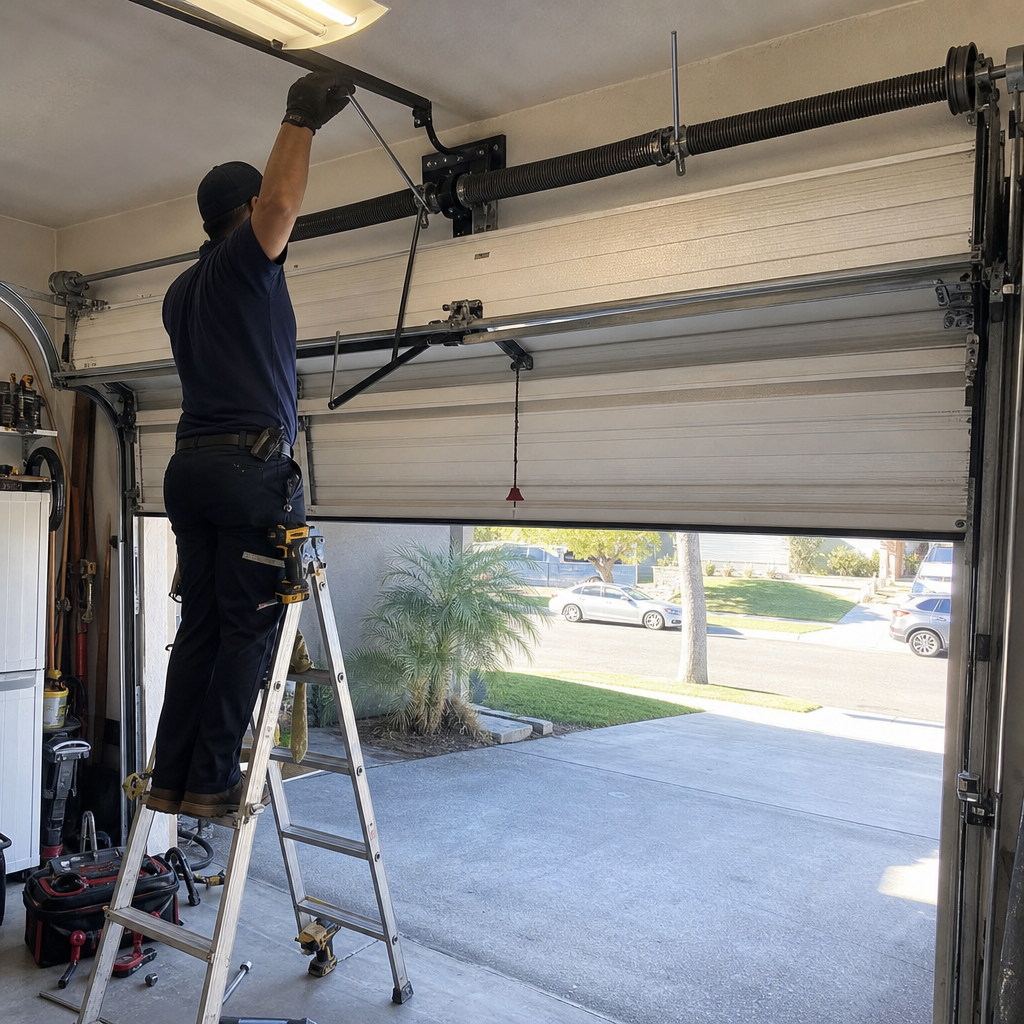
A torsion spring rated for 10,000 cycles in Minneapolis may fail in half that time on a garage three blocks from the ocean in Playa del Rey. The climate is doing work your door’s hardware wasn’t sized for. Los Angeles homeowners face a repair environment that national guides simply don’t address: salt air eating steel from the inside out, earthquake micro-settlement warping door frames, and UV exposure that turns rubber seals to crumbles in three years instead of ten. In The Complete Guide to Garage Door in Los Angeles, we’ll walk through how LA’s specific conditions affect every component of your garage door, what repair quotes should actually include in this market, and how to spot problems before they strand your car on a Monday morning.
Quick Answer
Most garage door repairs in Los Angeles cost between $150 and $650 depending on the component, with torsion spring replacement running $200-$400 and opener repairs at $150-$350. Coastal salt air, seismic settling, and extreme UV exposure shorten component lifespans by 30-50% compared to national averages, making proactive maintenance and corrosion-resistant hardware upgrades particularly valuable for LA homeowners.
Table of Contents
- How Los Angeles Climate Stresses Garage Door Components
- The Most Common Garage Door Problems in LA
- What Garage Door Repair Costs in Los Angeles
- How to Read a Repair Quote in LA’s Low-Bid Market
- When LADBS Requires a Permit for Garage Door Work
- A Maintenance Schedule Built for LA Conditions
- What to Know About Major Brands in This Climate
- Common Mistakes to Avoid
- When to Call a Professional
- Frequently Asked Questions
How Los Angeles Climate Stresses Garage Door Components
Los Angeles is not one climate. It’s six or seven microclimates stacked on top of each other, and your garage door feels every one of them.
Coastal salt air is the silent killer. In Venice, Santa Monica, and Playa del Rey, marine layer moisture carries sodium chloride inland every morning. That salt deposits on torsion springs, cables, and bottom brackets. Steel that should last 15 years develops pit corrosion in 7. We’ve replaced springs in Marina del Rey homes that looked like they’d been underwater. The rust isn’t just cosmetic. It creates stress risers that turn a 10,000-cycle spring into a 5,000-cycle spring without warning.
Seismic micro-movement is the problem nobody talks about. Los Angeles sits on dozens of fault systems, and even minor tremors you don’t feel cause your foundation to settle in microscopic increments. Over five years, that settlement shifts your garage door frame out of plumb by a quarter-inch. The door still opens. But now the rollers bind in the tracks. The opener strains. The safety sensors misalign. We’ve seen this pattern in homes from the Hollywood Hills to the flats of the San Fernando Valley. The fix isn’t replacing the opener. It’s re-leveling the frame and replacing the worn rollers that took the abuse.
UV exposure hits differently depending on your elevation and orientation. A south-facing garage door in Woodland Hills or Granada Hills absorbs enough ultraviolet radiation to degrade PVC weatherstripping in 18 months. The same door in Palos Verdes, protected by persistent marine cloud cover, might get four years. UV also fades and embrittles paint and vinyl overlays on doors from manufacturers like Clopay and Amarr. Once the surface layer cracks, moisture penetrates and the panel delaminates from the inside.
Here’s what this means practically: a repair strategy that works in Phoenix or Seattle will underperform in Los Angeles. You need hardware rated for corrosion resistance, weatherstripping specified for high-UV environments, and a maintenance schedule that accounts for faster wear.
The Most Common Garage Door Problems in LA
After 42 years of calls across Los Angeles County, we see the same failure patterns repeat. They cluster by geography and housing stock.
Broken Torsion Springs
The loud bang from your garage at 6 a.m. is almost always a torsion spring snapping. In LA, this happens earlier in a spring’s life than national averages predict. The culprit is usually corrosion fatigue: microscopic rust pits concentrate stress until the wire fractures.
Warning signs before the break:
- A 2-inch gap in the coiled spring when the door is closed
- The door feels “heavy” when lifted manually
- The opener strains or reverses unexpectedly
- A squeal that lubrication doesn’t fix (metal-on-metal where coils have separated)
Safety note: Torsion springs store massive mechanical energy. A standard 16×7 door spring holds enough force to cause serious injury or death if handled improperly. We do not recommend DIY replacement-read our breakdown of DIY vs Professional Emergency Garage Door: What’s Safe to Do Yourself to understand why. The winding bars must seat fully in the cones, and the set screws require precise torque. A slipping bar or miscounted quarter-turn can release stored energy without warning.
Opener Failure After Heat Waves
Los Angeles heat waves push garage temperatures past 110°F in inland valleys. Older opener motors, especially pre-2018 units without thermal protection, cook their circuit boards. We see a surge of these calls in August and September, concentrated in the San Fernando Valley, Pasadena, and the Inland Empire-adjacent communities.
Track Misalignment From Settlement
The vertical tracks on either side of your door must be parallel within 1/4 inch and plumb within 1/8 inch. After minor seismic events or seasonal soil expansion, LA homes shift. The door starts rubbing one track. The rollers flatten on one side. Eventually the door jumps the track entirely.
Weatherstripping Deterioration
That rubber seal at the bottom of your door? In high-UV zones it’s often cracked and useless within two years. Once it fails, dust, pollen, and occasional rainwater enter. In coastal areas, the failed seal lets salt air circulate, accelerating corrosion on everything metal inside the garage.
What Garage Door Repair Costs in Los Angeles
Los Angeles pricing runs 15-25% above national averages due to higher labor costs, traffic time between calls, and the prevalence of corrosion-resistant hardware upgrades that standard quotes don’t include. Here’s what we see in the current market:
| Repair Type | Typical Range | Notes |
|---|---|---|
| Torsion spring replacement (single) | $200 - $340 | Includes springs, winding, and balance check |
| Torsion spring replacement (pair) | $280 - $450 | Standard for double-car doors |
| Cable replacement | $150 - $250 | Per pair; often paired with spring work |
| Opener repair (circuit board, gear) | $150 - $350 | Replacement often more economical for units 10+ years |
| Opener replacement | $400 - $850 | Includes rail, motor, remotes, safety sensors |
| Roller replacement (full set, 10-12 rollers) | $180 - $320 | Nylon rollers recommended for noise reduction |
| Track realignment or section replacement | $200 - $450 | Seismic damage may require structural repair first |
| Weatherstripping replacement | $120 - $220 | UV-resistant silicone rubber recommended in LA |
| Panel replacement (single, standard steel) | $350 - $650 | Color matching varies by age and manufacturer |
| Full door replacement | $1,200 - $3,500 | Insulated, wind-rated, or custom finishes at higher end |
These ranges reflect quality work with proper hardware. Quotes below these thresholds often omit necessary components: new cables with spring replacement, proper spring sizing by door weight, or disposal of old materials. Our Garage Door Repair services include $50 Off Any Repair Over $250 that applies to work meeting these standards, not stripped-down alternatives.
How to Read a Repair Quote in LA’s Low-Bid Market
Los Angeles has no shortage of garage door companies advertising “$99 spring special” or “$79 service call.” We’ve cleaned up after enough of them to know what those numbers actually buy you.
Here’s how to evaluate any quote:
- Does it specify spring type and cycle rating? A cheap quote installs oil-tempered springs rated for 5,000-7,500 cycles. A proper quote specifies galvanized or powder-coated springs at 10,000-15,000 cycles. In coastal LA, the upgrade pays for itself in longevity.
- Are cables included? Springs and cables wear together. A quote that replaces springs but reuses old cables is incomplete. The cables have been flexing against the same corrosion, and their failure follows within months.
- Is balancing and safety testing itemized? After spring replacement, the door must be tested for proper balance (it should stay put at any height when disconnected from the opener) and safety reverse function. This takes 10-15 minutes and separates professional work from parts-swapping.
- Does it include a written warranty? Verbal promises evaporate. Our 90-Day Done Right Promise is stated in writing on every invoice. If the work is not right, we return at no charge. No dispute process, no paperwork to file.
- Is the technician an employee or subcontractor? Subcontractor models dominate the low-bid market. The “company” takes a booking fee and dispatches whoever accepts the job. Background checks, training consistency, and accountability are minimal. Our technicians are employees, uniformed, and trained under our K.E.Y.S. values code.
The honest operator states the flat price before any work begins. We do. The price does not change because the job took longer than expected or because we discovered “additional problems.” If we missed something in our diagnosis, that is our cost to absorb, not yours.
When LADBS Requires a Permit for Garage Door Work
The Los Angeles Department of Building and Safety (LADBS) regulates garage door work, but not all repairs trigger permit requirements. Understanding the line saves you from unpermitted work that complicates home sales or insurance claims.
No permit required:
- Spring, cable, roller, or opener replacement on existing doors
- Track realignment or repair
- Weatherstripping or hardware replacement
- Panel replacement (same size, same opening, no structural change)
Permit required:
- New door installation in a new or enlarged opening
- Conversion from manual to automatic operation (electrical work permit may also apply)
- Structural modification to the garage header or framing
- Work in designated hillside or earthquake zones requiring engineering review
Reputable contractors handle permit filing as part of the project. If a company suggests skipping a required permit to “save money,” that savings evaporates when the unpermitted work is flagged in a pre-sale inspection. We’ve seen this delay Los Angeles home sales by weeks.
For permit verification, contact LADBS at (213) 482-0000 or check their online permit history tool. Any contractor pulling permits in your name should provide the permit number before work begins.
A Maintenance Schedule Built for LA Conditions
National maintenance guides suggest annual service. For most of Los Angeles, that’s insufficient. Here’s what we recommend based on microclimate:
Coastal Zone (Santa Monica to San Pedro, Malibu to Playa del Rey)
Every 6 months. Salt air accelerates everything. Inspect springs and cables for rust. Lubricate with silicone-based product, not WD-40 (it attracts moisture). Check bottom seal integrity monthly during marine layer season (May through October).
Inland Valleys (San Fernando Valley, Pasadena, Glendale)
Every 8 months. UV and heat are the primary stressors. Inspect weatherstripping for cracking. Test thermal protection on opener motor. Clear photo-eye sensors of dust more frequently during Santa Ana wind events.
Hillside Areas (Hollywood Hills, Bel Air, Pacific Palisades canyons)
Every 6 months, with structural check. Seismic movement is more pronounced. Verify door frame remains plumb. Check for new cracks in surrounding drywall that may indicate settling.
Basic homeowner checklist (safe to perform):
- Disconnect opener and lift door manually. It should move smoothly and stay open at waist height.
- Visually inspect cables for fraying, especially near bottom brackets.
- Check spring coils for gaps, rust, or binding.
- Test safety reverse: place a 2×4 flat on the threshold; door must reverse on contact.
- Verify photo-eyes are aligned (LED indicators on both units).
- Lubricate rollers, hinges, and spring coils with silicone spray. Avoid the track itself; lubricant there collects grit.
Our $89 Seasonal Tune-Up covers all of this plus spring tension verification, opener force setting check, and written condition report. For most Los Angeles homes, twice-yearly professional service pays for itself in avoided emergency calls.
What to Know About Major Brands in This Climate
We service all major brands, and each has strengths and vulnerabilities in Southern California conditions.
Clopay offers the widest range of insulated steel and composite doors. Their Intellicore insulation performs well in LA’s temperature swings, but the exterior paint system requires UV protection in inland installations. We’ve had good results with their coastal-grade hardware packages, available by special order.
Amarr steel doors are common in Los Angeles tract housing from the 1980s and 1990s. Their standard-grade weatherstripping is adequate for temperate climates but degrades quickly in high-UV zones. Upgrading to silicone rubber seals during maintenance extends service life significantly.
Wayne Dalton TorqueMaster spring systems are found in many LA homes built 1995-2010. These enclosed springs resist coastal corrosion better than exposed torsion systems, but they require brand-specific tools and knowledge for safe service. Not every technician carries these. Our trucks do.
Genie openers have reliable screw-drive systems that handle dust well, an advantage during Santa Ana events. Their chain-drive units are workhorses but louder than belt-drive alternatives from other manufacturers. For homes with living space above the garage, belt-drive is worth the upgrade.
Factory familiarity matters. A technician who knows the specific failure modes of your brand diagnoses faster and stocks the right parts. That’s why we carry components for all major manufacturers on every truck.
Common Mistakes to Avoid
- Ignoring the first squeak. That noise is metal fatigue announcing itself. In Los Angeles, with salt air and seismic stress, a squeaking spring has weeks, not months, before failure. The repair costs the same whether we catch it early or respond to a 2 a.m. bang.
- Using standard hardware in coastal zones. Zinc-plated hardware from the big-box store rusts in 18 months near the beach. Galvanized or stainless components cost 30% more and last 3x longer. The math is simple.
- DIY spring replacement after watching a video. We’ve seen homeowners with broken wrists, damaged cars, and doors pulled off their tracks. The videos never show the close calls. Torsion springs are genuinely dangerous. This is not gatekeeping. This is emergency room data.
- Accepting a phone quote without inspection. No ethical company can price a spring replacement accurately without knowing door weight, spring dimensions, and cable condition. The “$99 special” becomes $400 on arrival because your door requires two springs, not one.
- Neglecting the opener after spring replacement. A door that was opening with broken or weak springs forced the opener to work overtime. The motor and gears have accumulated wear. Testing opener force limits after spring work is standard practice for us, but many companies skip it.
- Forgetting permit requirements on installations. Unpermitted door replacements surface in real estate transactions and can trigger retroactive permit fees plus penalties. Verify permit status before any structural work begins.
- Choosing price over accountability. The lowest bid rarely includes written warranty, employee technicians, or callback support. When the same problem returns in 60 days, you’ll pay again or live with it. We answer our own phones, 24/7, including the call at 10 p.m. when something isn’t right.
When to Call a Professional
Call when the door won’t open, makes loud noises, reverses unexpectedly, or shows visible damage to springs or cables. Call before the emergency if your door is approaching 15 years old, if you’ve noticed gradual slowing or straining, or if you’re preparing a home for sale and want documentation of condition.
Specific scenarios that warrant immediate professional attention: a broken spring (door is deadweight and dangerous to lift), a door off its tracks (do not force it), opener motor smoking or smelling electrical, or any damage after a seismic event that may have shifted the frame.
Garage Door Repair in Los Angeles is our core service, and we’ve built our operation to respond same-day to most calls. Mainspring Garage Door Co. home base is here in Los Angeles, and we offer free estimates with upfront pricing stated before any work begins. Call (844) 755-5838. A live person answers, including nights, weekends, and holidays.
Frequently Asked Questions
Single torsion spring replacement typically runs $200-$340 in Los Angeles, while a pair for a double-car door costs $280-$450. Coastal homes may need corrosion-resistant springs that add $40-$60 to the base price but last significantly longer. Call (844) 755-5838 for an exact quote on your door - estimates are free.
Yes, most repairs are completed in a single visit because our technicians arrive with springs, cables, openers, and hardware already on the truck. Same-day service is standard for Los Angeles calls placed before 2 p.m. Emergency response is available 24/7. Call (844) 755-5838 to check current availability.
Repair is more economical when the door structure is sound and the problem is isolated to springs, cables, opener, or a single panel. Replacement becomes the better value when the door is over 20 years old, has multiple failing components, suffers from widespread panel damage, or lacks modern safety features-see our guide to DIY vs Professional Garage Door Installation: What’s Safe to Do Yourself before deciding. We offer free second opinions on any written estimate to help you decide. We offer free second opinions on any written estimate to help you decide.
Marine layer moisture deposits salt on steel components, accelerating corrosion that weakens springs, cables, and bottom brackets. In beach communities, standard hardware may fail in 5-7 years instead of 12-15. Galvanized or stainless steel upgrades, more frequent lubrication, and intact weatherstripping are essential protections.
Repairs to existing doors (springs, cables, openers, panels) do not require LADBS permits. New installations, structural modifications, or conversions from manual to automatic operation do require permits. A reputable contractor handles filing. Unpermitted work can delay home sales and trigger penalties.
Coastal homes need professional service every 6 months due to salt air. Inland valley homes can go 8 months between visits. All homeowners should perform basic monthly checks: manual lift test, visual cable inspection, safety reverse verification, and photo-eye alignment. Our $89 Seasonal Tune-Up covers comprehensive service with written condition report.
The Bottom Line
Los Angeles garage doors live harder lives than their owners realize. Salt air, seismic micro-movement, and intense UV create a repair environment that generic advice fails to address. The homeowners who fare best treat their garage door as climate-stressed equipment requiring proactive maintenance, corrosion-resistant hardware, and technicians who understand local conditions - see more guides & resources for year-round care.
Get multiple quotes, but read them carefully. The lowest price often omits cables, proper spring sizing, or written warranty. The square deal states everything upfront, arrives with the right parts, and stands behind the work without argument.
We’ve been serving Los Angeles since 2016, and our 90-Day Done Right Promise applies to every job. If you’re unsure about a noise, a slow door, or a quote you’ve received, call us. We’ll give you a straight answer and a fair price.
Call Mainspring Garage Door Co. at (844) 755-5838 for a free estimate. A live person answers 24/7.
Written by the team at Mainspring Garage Door Co., serving Los Angeles since 2016.