
Last updated July 26, 2026
DIY vs Professional Garage Door Parts: What’s Safe to Do Yourself
A torsion spring stores roughly 100 ft-lbs of torque when wound. That is not a warning label. It is a physics fact that defines every DIY boundary on this list. In 42 years of opening garage doors across Los Angeles, we have seen the difference between a job that ends with a working door and one that ends in the emergency room. The dividing line is not skill, tools, or online tutorial hours. It is stored energy. Parts under tension can kill you. Parts that hold no tension are safe to handle. This guide sorts every common garage door component into one of those two categories, with a middle ground that requires honest self-assessment.
Quick Answer
Homeowners can safely replace weather stripping, bottom seals, light bulbs, safety sensors, and exterior handles on their own. Torsion springs, extension springs, cables, and drum hardware should always be handled by a trained technician because they store lethal mechanical energy. If you’re unsure whether to tackle a repair yourself, read our guide on DIY vs Professional Garage Door Repair: What’s Safe to Do Yourself. Track alignment and roller replacement fall in between: possible for a careful DIYer, but only if you know exactly when to stop and call a professional.
Table of Contents
- The One Rule That Decides Everything
- Parts You Can Safely Replace Yourself
- Professional-Only: Springs, Cables, and Drums
- The Middle Ground: Tracks and Rollers
- Why Replacing One Spring Is a Mistake
- Tools Worth Having vs. Tools That Signal Danger
- How Los Angeles Climate Affects Your Door
- Common Mistakes to Avoid
- When to Call a Professional
- Frequently Asked Questions
The One Rule That Decides Everything
Every garage door component fits into one of three categories. The first holds stored mechanical energy. The second holds none. The third could hold energy depending on how far you take the repair.
Stored energy means the part is actively resisting a force. A wound torsion spring wants to unwind. A stretched cable wants to retract. If your hand, face, or torso is in the path when that energy releases, the injury is not a cut or bruise. It is a fracture, amputation, or worse. We have responded to emergency calls in Sherman Oaks and Echo Park where a homeowner’s weekend project ended with a trip to Cedars-Sinai. The mechanics are not forgiving.
Parts with no stored energy are passive. They seal, they cover, they guide. You can remove them with basic hand tools and no special tensioning procedure. The risk is dropping a screwdriver, not losing fingers.
The middle category is where honest self-assessment matters. Track alignment and roller replacement do not require winding springs, but they do require understanding when a track is bent beyond adjustment or when a roller is seized in a way that changes the door’s balance. Misjudging that transition point is how DIYers create the conditions for a future cable snap or off-track collapse.
This rule is not about intelligence or capability. It is about which forces are present in the system. Respect that distinction and you will stay safe. Ignore it and the most careful homeowner becomes a statistic.
Parts You Can Safely Replace Yourself
These components hold no stored energy. Basic hand tools and a ladder are sufficient. No special training required.
Weather Stripping and Bottom Seal
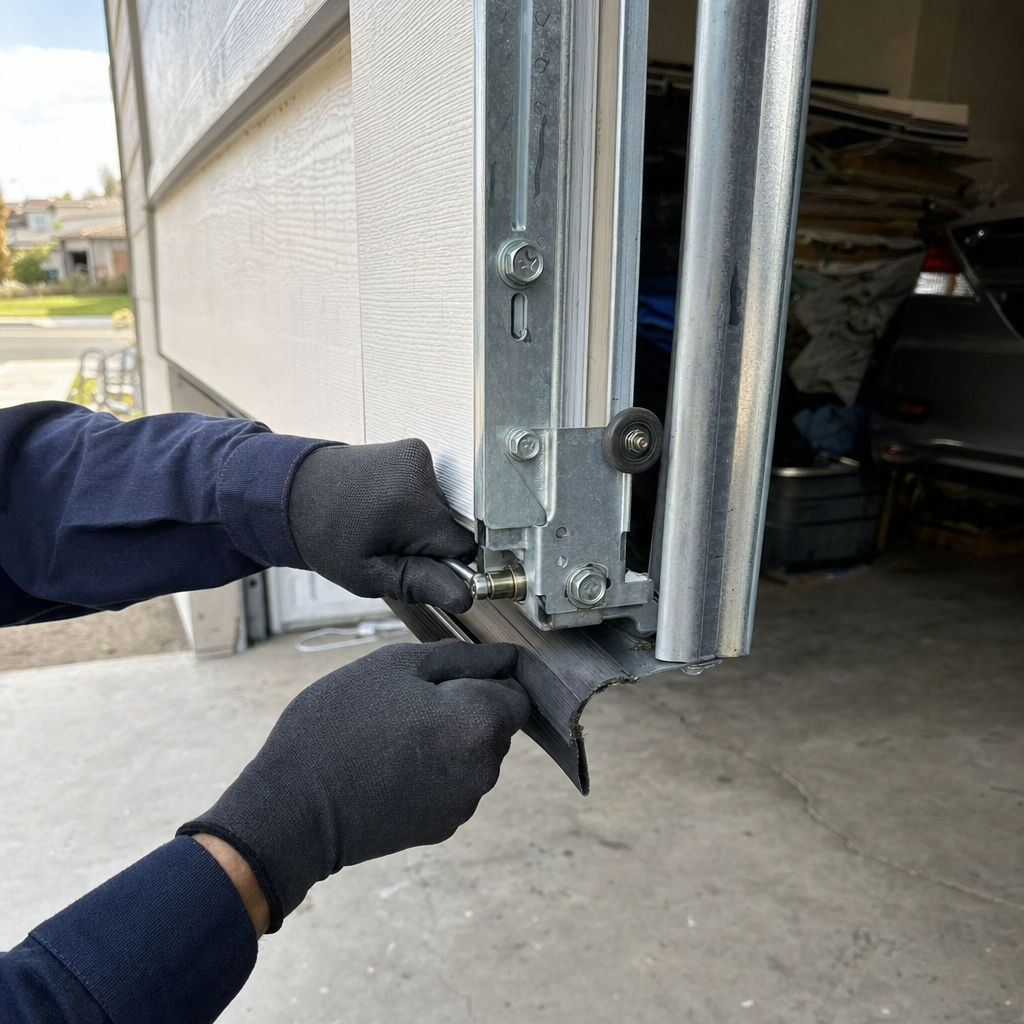
The rubber or vinyl seal along the door’s bottom edge and the flexible stripping on the sides and top are friction-fit or screw-attached. Over time, Los Angeles sun hardens the rubber. Santa Ana winds drive dust into the gaps. Replacement is straightforward: pull the old seal from its retainer, measure the width of your door panel, and install the new piece. Most Clopay and Amarr doors use a T-style or bulb-style seal that slides into an aluminum retainer. Cost runs $15-$40 for the seal itself.
Light Bulbs in the Opener
Most openers, including Chamberlain and Genie units, use a standard LED bulb in a protective housing. Check your manual for wattage limits. LED bulbs are required now; incandescent heat can damage the logic board. This is a 30-second job.
Safety Sensors (Photo Eyes)
The infrared sensors near the floor on each side of the door are low-voltage, plug-connected devices. If your door reverses for no reason or refuses to close, first clean the lenses. If that fails, replacement means unscrewing the bracket, disconnecting the wire clip, and installing the new unit. The critical step is alignment: both sensors must face each other squarely so the LED indicators glow steady. No tension. No stored energy. Just patience.
Exterior Handles and Decorative Hardware
Strap hinges, handles, and faux carriage-house hardware bolt through the door face. These are cosmetic and non-structural. Use a drill with the correct bit size to avoid dimpled steel on raised-panel doors.
Remote Controls and Keypads
Programming a new remote or wireless keypad is a software task, not a mechanical one. Every major brand publishes the button-sequence in the manual or on the motor unit’s label. Chamberlain’s Learn button, Genie’s Intellicode, and LiftMaster’s Security+ systems each have their own pairing procedure. No tools needed.
Battery Backup Units
California law requires battery backup on new opener installations. The battery itself is a plug-in module, usually accessible by removing a cover on the motor head. If your opener beeps every 30 seconds, the battery is failing. Replacement takes two minutes and requires no electrical knowledge beyond unplugging the old unit and inserting the new one.
Professional-Only: Springs, Cables, and Drums
This section is not about liability or legal caution. It is about mechanical reality. These parts store energy in quantities that exceed human reaction time.
Torsion Springs
The torsion spring sits horizontally above the door, wound tight around a steel shaft. A standard 16-foot wide door in a two-car Los Angeles garage uses a spring rated for 10,000-15,000 cycles. Each cycle is one open and close. When the spring breaks, you hear a gunshot. When it is wound for installation, it holds enough torque to launch a winding bar across the room with lethal force.
Winding or unwinding requires two solid steel winding bars inserted into the cogs of the winding cone. These bars must be the correct diameter, typically 1/2-inch or 7/16-inch solid steel. Using a screwdriver, pliers, or the wrong bar size is how serious injuries happen. The cone can slip, the bar can eject, and the spring can unwind in a fraction of a second.
We carry every common spring wire size on our trucks because Los Angeles garages run the full range: from compact single-car doors in Venice bungalows to oversized custom wood doors in Hancock Park. The spring must be matched precisely to door weight, track radius, and cable drum diameter. Guess wrong and the door is either too heavy to lift manually or so overpowered that it slams shut.
Extension Springs
Older Los Angeles homes, particularly in neighborhoods like Silver Lake and Los Feliz with garages built before 1980, often have extension springs mounted along the horizontal tracks. These stretch and contract with each door movement. They are safer than torsion springs only in the sense that they are smaller. A broken extension spring can still whip through the air with enough force to break bone. The safety cable running through the spring is there to contain it, but that cable is itself a tensioned component requiring proper installation.
Cables and Cable Drums
The lift cables wrap around grooved drums at each end of the torsion shaft. The grooves are engineered to maintain consistent cable tension as the door rises. If a cable frays or slips off its drum, the door loses balance. Attempting to reseat a cable with the spring still wound means working within inches of a loaded component. The correct procedure requires unwinding the spring first, which returns us to the torsion spring problem.
Bottom Brackets and Anchor Plates
These fixtures attach the lift cables to the bottom corners of the door. They are under constant tension from the spring system. Removing a bottom bracket without releasing spring tension causes immediate, uncontrolled door drop. We have seen this damage cars, crush storage items, and injure homeowners who assumed the door was “just sitting there.”
The Middle Ground: Tracks and Rollers
Track alignment and roller replacement occupy a gray zone. They are not inherently dangerous. They can become dangerous if approached without clear stopping criteria.
When Track Adjustment Is Reasonable
A door that rubs on one side, creates a gap at the header, or pops out of the track intermittently may need track realignment. The vertical tracks are held by brackets with slotted holes. Loosening a bracket bolt, tapping the track into position with a rubber mallet, and retightening is within reach of a methodical homeowner.
The stopping criteria are specific. Stop and call a professional if:
- The track is visibly bent or dented, not merely shifted. Bent track cannot be straightened to factory specification in the field.
- The door has come completely off both tracks. This indicates a balance or spring problem, not just track position.
- You loosen a bracket and the track moves on its own, suggesting the door is pulling unevenly due to spring imbalance.
- The horizontal track is not parallel to the door in the fully open position. This requires measuring door-to-track clearance at multiple points and adjusting the rear track hangers.
When Roller Replacement Is Reasonable
Steel rollers with worn bearings create noise and drag. Nylon rollers are quieter and require less maintenance. Replacement involves angling the roller stem out of the track hinge while the door is in a position that releases pressure on that specific roller.
The danger emerges with the bottom roller. It sits in the bottom bracket, which is under cable tension. Never remove the bottom roller without first releasing spring tension. This is the most common DIY-to-emergency-call transition we see in the San Fernando Valley.
Also stop if rollers are seized in their hinges. Forcing them out with a pry bar bends the hinge plate, which changes door panel alignment and creates new binding points. The correct tool is a roller removal tool or a carefully used claw hammer with a wood block for protection.
Why Replacing One Spring Is a Mistake
This deserves its own section because it is the most persistent and costly shortcut we encounter.
Most residential garage doors use either one torsion spring or two. Double-spring setups are standard on wider or heavier doors. When one spring breaks, the door feels heavier, the opener strains, and the homeowner notices. The temptation is to replace only the broken spring and save half the cost.
Here is why that fails. Springs are manufactured in matched pairs with identical wire gauge, inner diameter, and length. They share the door’s weight equally through thousands of cycles. When one spring is new and the other has 8,000 cycles of metal fatigue, their torque curves diverge. The new spring carries more load. The old spring fatigues faster. Within months, often weeks, the second spring breaks.
Worse, the imbalance creates asymmetric wear across the entire system. The door pulls to one side. Cables wear unevenly. Rollers bind in their tracks. The opener’s drive gear takes excess load. What began as a spring replacement becomes a multi-component repair.
We see this pattern repeatedly in older Los Angeles neighborhoods where homeowners have maintained their property for decades and naturally prefer to minimize expense. The intention is sound. The physics are not. Replacing both springs together is not upselling. It is the only way the system was engineered to function.
The same logic applies to extension spring pairs. Always replace both, always check pulley condition, and always verify that safety cables are intact and properly routed.
Tools Worth Having vs. Tools That Signal Danger
Your home toolbox is sufficient for every safe-DIY task on this list. When a repair requires tools you do not own and would not use for other projects, that is a signal.
Tools for Safe DIY Tasks
- Phillips and flat-head screwdrivers
- Adjustable wrench and socket set
- Rubber mallet
- Step ladder rated for your weight plus materials
- Tape measure
- Level (for sensor alignment)
Tools That Indicate Professional Territory
- Torsion spring winding bars (solid steel, specific diameter)
- Vice grips rated for spring winding
- Winding cone tools
- Cable pullers or come-alongs
- Torque-measuring devices for spring calibration
If you find yourself researching where to buy winding bars, you have already crossed the line where a professional’s training and insurance matter more than the cost savings. A single spring replacement by Mainspring Garage Door Co. in Los Angeles includes proper winding, balance testing, and the 90-Day Done Right Promise. The price is stated before any work begins. Compare that to an ER visit or a door replacement after a failed DIY attempt.
How Los Angeles Climate Affects Your Door
Local conditions change maintenance priorities and part lifespan. This is not generic advice with a city name inserted. These are the conditions we work in daily.
Sun Exposure and Heat
South- and west-facing garage doors in neighborhoods like Studio City, Encino, and Pasadena absorb intense afternoon sun. Steel panels expand. Vinyl weather stripping dries and cracks faster than manufacturer specifications suggest. If your door faces direct sun, inspect the bottom seal annually rather than biennially. Consider lighter paint colors or factory-applied reflective coatings on custom wood doors.
Salt Air Near the Coast
Homes in Marina del Rey, Playa del Rey, and San Pedro experience accelerated corrosion on steel hardware. Springs, cables, and bottom brackets show rust earlier. Galvanized components help, but the most effective protection is regular inspection and proactive replacement before corrosion compromises strength. We stock stainless steel hardware for coastal installations when requested.
Earthquake Considerations
Los Angeles building codes require garage door bracing in new construction, but older homes often lack reinforcement. A door that is already off-balance or has weakened springs is more likely to fail or jam during seismic activity, potentially trapping vehicles inside when evacuation matters most. This is not a reason to attempt spring repair yourself. It is a reason to maintain the door professionally so it functions when you need it.
Seasonal Temperature Swings
Desert-adjacent communities like Woodland Hills and Calabasas see wider temperature ranges than coastal areas. Metal springs expand and contract. Lubricant viscosity changes. The $89 Seasonal Tune-Up we offer includes spring tension verification, hardware torque-checking, and lubrication with products rated for local temperature extremes.
Common Mistakes to Avoid
- Using a screwdriver as a winding bar. A screwdriver is not solid steel, not the correct diameter, and not designed to withstand torsion. It will bend, slip, or shatter. We have found screwdriver fragments embedded in garage ceiling drywall.
- Disconnecting the opener with the door open. The opener arm holds the door in position when the spring is broken or unbalanced. Disconnecting it with the door raised causes immediate, uncontrolled descent. Always close the door fully before disengaging the opener carriage.
- Ignoring a single broken spring on a two-spring door. The remaining spring is now overloaded. The door is unbalanced. The opener’s logic board and drive gear absorb forces they were not designed for. Address both springs immediately.
- Lubricating the track. Tracks are not supposed to be lubricated. Grease attracts dust and grit, which accelerates roller wear and creates sticky residue. Lubricate the hinges, rollers bearings (if steel), and spring coils only. Use a silicone-based or lithium-based garage door lubricant, not WD-40.
- Adjusting track position without checking door balance first. If the door is pulling to one side because of spring imbalance, moving the track masks the problem and creates new binding points. Verify balance by disconnecting the opener and lifting the door manually. It should stay at mid-height without drifting.
- Installing incompatible parts. A spring with the wrong wire size or inner diameter will not match the door’s weight. A cable with incorrect strand count will fray faster. We specify every part by door model, weight, and track configuration because generic replacement fails.
When to Call a Professional
Call when stored energy is present. Call when the door is off both tracks. Call when you have started a repair and encountered resistance that does not make sense. Call when you need a second opinion on another company’s estimate - we provide those free, in writing, with no obligation. For more guides & resources on garage door care, visit our blog.
Mainspring Garage Door Co. offers free estimates in Los Angeles. A trained technician arrives with the correct parts on the truck, states the flat price before beginning work, and completes most repairs in a single visit. The 90-Day Done Right Promise covers every job in writing. If it is not right, we return at no charge. No paperwork to file, no dispute process, no arguing. That is how we have operated since 1984.
Phone: (844) 755-5838. A live person answers, 24 hours a day, including nights, weekends, and holidays.
Frequently Asked Questions
Professional torsion spring replacement in Los Angeles typically ranges from $180 to $340 for a standard residential door, including both springs, labor, and balance adjustment. Extension spring repairs run slightly lower, $150 to $280, depending on whether safety cables and pulleys also need replacement. Call (844) 755-5838 for an exact quote - estimates are free, and the price is stated before any work begins.
Yes, if they are not the bottom rollers and not seized in their hinges. Upper and middle rollers can be replaced by angling the stem out of the hinge while the door is positioned to relieve pressure on that roller. Bottom rollers sit in brackets under cable tension and should never be removed without first releasing spring tension. If rollers are seized, forcing them damages the hinge plate and changes door alignment.
This almost always indicates a broken spring or disconnected cable. The opener motor runs, but the door has no counterbalance assistance. Attempting to operate the opener in this condition strains the drive gear and can destroy the motor unit. Disconnect the opener, try to lift the door manually, and if it is impossibly heavy or slams shut, the spring system has failed. This is a professional repair.
Repair is cheaper when the door panels are intact, the track system is straight, and the failure is limited to springs, cables, or an opener. Replacement becomes cost-effective when panels are dented or rusted, the track is bent, or the door is more than 25 years old and lacks modern safety features. For a door in good cosmetic condition, a spring replacement plus tune-up often extends service life by a decade. We provide both repair estimates and replacement quotes for garage door installation in Los Angeles so you can compare directly.
Standard springs are rated for 10,000 cycles. At four cycles per day, that is roughly seven years. High-cycle springs rated for 25,000 or 50,000 cycles last proportionally longer. In Los Angeles, coastal corrosion and intense sun exposure can shorten actual lifespan. Annual inspection catches fatigue before failure. Our $89 Seasonal Tune-Up includes spring condition assessment.
Yes, provided the door is properly balanced and the new opener is compatible with door weight and height. Modern openers include safety sensors, force-limiting logic, and battery backup (required in California). We are factory-familiar with Chamberlain, Genie, LiftMaster, and all major brands. A mismatched opener strains the motor and creates safety gaps. Professional opener installation in Los Angeles includes balance verification and safety system testing.
The Bottom Line
The DIY boundary on garage doors is not about your skill with tools. It is about stored mechanical energy. Weather stripping, sensors, light bulbs, and handles hold none. Replace them freely. Springs, cables, and drum hardware hold lethal tension. Leave them to trained technicians with the correct tools and insurance. Track and roller work sits between: possible for careful homeowners, but only with clear stopping criteria and no tolerance for forcing components that resist.
In 42 years serving Los Angeles, we have learned that the homeowners who call us after a failed DIY attempt rarely regret the initial attempt to save money. They regret not calling sooner, after the injury or the compounded damage. There is no shame in knowing your limits. There is wisdom in it. A square deal from people who answer the phone, arrive when promised, and stand behind the work in writing - that is the standard we set at Mainspring Garage Door Co.
Written by the team at Mainspring Garage Door Co., serving Los Angeles since 2016.