
Last updated July 26, 2026
DIY vs Professional Garage Door Repair: What’s Safe to Do Yourself
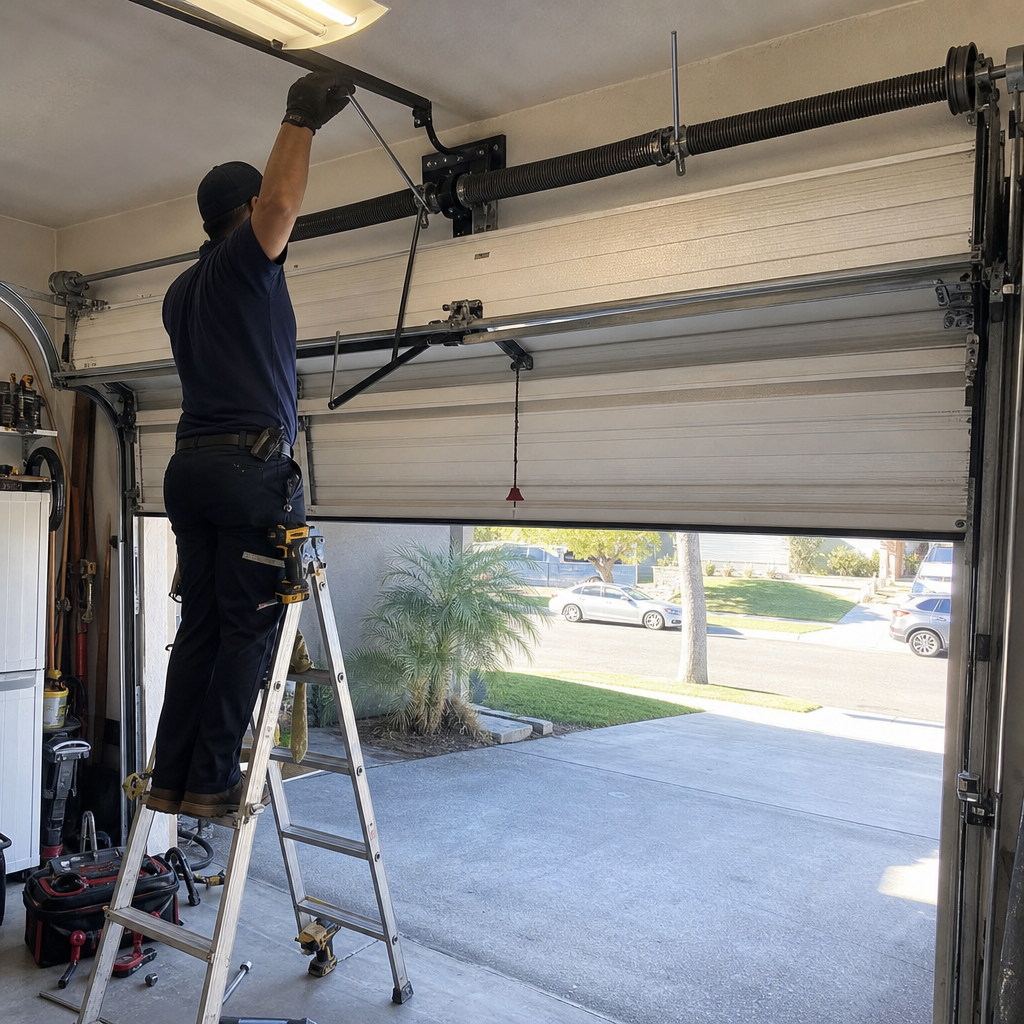
A wound torsion spring on a standard two-car garage stores roughly the same kinetic energy as a car traveling at 30 mph. The task of adjusting or replacing it is not difficult. It is dangerous in a very specific and unforgiving way. In 42 years of serving Los Angeles homeowners, we have seen the aftermath of well-intentioned DIY attempts that ended in emergency rooms from Westwood to Whittier-exactly the kind of situation our Emergency Garage Door Troubleshooting: Common Problems and How to Fix Them guide helps homeowners avoid. This guide draws the line at physics, not price. You will learn which repairs are genuinely within reach of a prepared homeowner, which ones carry catastrophic injury risk regardless of your skill level, and how to evaluate the “DIY spring kit” videos that make dangerous work look routine.
Quick Answer
Homeowners can safely handle lubrication, sensor alignment, remote reprogramming, weatherstripping replacement, and manual release operation. Any task involving springs, cables, or bottom brackets requires a trained professional because the stored energy in a wound torsion spring can cause severe injury or death even with proper tools. The DIY-versus-pro debate is usually framed around cost, but the real dividing line is stored energy.
Table of Contents
- Why Stored Energy Changes Everything
- Repairs You Can Safely Do Yourself
- Repairs That Require a Professional
- The Hidden Safety Shortcuts in DIY Videos
- What Professional Repair Actually Costs
- Common Mistakes to Avoid
- When to Call a Professional
- Frequently Asked Questions
Why Stored Energy Changes Everything
Most home repairs carry predictable risks. A ladder might tip. A pipe might spray water. These are linear, visible hazards. A garage door spring is different. It stores mechanical energy in a compressed or wound state, then releases it instantaneously when a winding bar slips, a cable breaks, or a component fails.
A standard 16-foot by 7-foot steel garage door weighs between 150 and 250 pounds. The torsion spring above the header carries that entire weight so the opener only needs to supply guidance, not muscle. When fully wound, a typical torsion spring holds approximately 10,000 inch-pounds of torque. If the winding cone fractures or a bar pulls free, that energy converts to motion in roughly one-tenth of a second. The bar becomes a projectile. The spring unwinds with enough force to break bones or cause traumatic head injury.
This is not theoretical. We have replaced doors in Los Angeles neighborhoods where a homeowner’s winding bar slipped and punched through the drywall of the garage ceiling. In one case in the San Fernando Valley, a DIYer suffered a compound wrist fracture when a cable snapped during adjustment. The work itself is mechanically simple. The physics are unforgiving.
The distinction matters because many capable homeowners have successfully replaced water heaters, rewired outlets, or rebuilt fences. Those tasks reward care and preparation. Spring work punishes a single moment of inattention with permanent injury. That is why we draw the line where we do.
Repairs You Can Safely Do Yourself
These five tasks involve no stored energy, require no special tools beyond what most homeowners own, and can be reversed if something goes wrong. We encourage homeowners to handle these themselves and explore more guides & resources for ongoing care. A well-maintained door lasts longer and performs better.
1. Lubrication
Apply silicone-based spray lubricant to the hinges, rollers, and bearing plates every six months. Do not lubricate the track itself; the rollers need friction to roll rather than slide. In Los Angeles, where coastal salt air affects Marina del Rey and Playa del Rey homes and valley dust accumulates in Pasadena and Glendale, lubrication prevents corrosion and noise. For a complete seasonal approach, see our Emergency Garage Door Maintenance Schedule: What to Do and When. Ten minutes twice a year extends component life significantly.
2. Safety Sensor Alignment
Photo-eye sensors sit four to six inches above the floor on each side of the door. When the door reverses for no apparent reason or refuses to close, check that both sensors show steady indicator lights. Clean the lenses with a soft cloth, verify that sunlight is not hitting the receiver directly, and adjust the brackets by hand until both lights match. No tools required. Test by waving a broomstick through the beam while the door closes; it should reverse immediately.
3. Remote and Keypad Reprogramming
Most openers manufactured after 1993 use rolling-code technology. The process varies by brand. For Chamberlain and LiftMaster units, press the “Learn” button on the motor housing, then press the remote button within 30 seconds. For Genie systems, press and hold the “Learn” button until the LED blinks, then enter your PIN on the keypad. Consult your owner’s manual for the specific sequence. If you have lost all remotes, the motor housing usually has a physical button for manual operation until you can reprogram.
4. Weatherstripping Replacement
The rubber or vinyl seal at the bottom of the door and the vinyl stop molding along the sides deteriorate in Los Angeles sun within three to five years. Measure the width of your door, purchase replacement seal from any hardware store, and slide the T-shaped end into the retainer channel. For side seals, remove the old vinyl with a putty knife and nail the new strip in place. This prevents water intrusion during winter storms and keeps dust and pests out year-round.
5. Manual Release Operation
Every opener has a red handle on a rope hanging from the trolley. Pulling it disengages the door so you can lift it by hand. Practice this when the door is closed and the opener is unplugged. If you cannot lift the door smoothly with one hand, the spring balance is off and you need professional service. Re-engagement is usually automatic when you run the opener, or you can pull the handle toward the motor unit and listen for the click.
Repairs That Require a Professional
These three categories involve stored energy, specialized tools, or structural load paths that make DIY attempts dangerous regardless of mechanical aptitude.
Torsion Spring Replacement
We will say this plainly: winding a torsion spring demands two solid steel winding bars inserted into the cogs of the winding cone, proper tension calculation based on door weight and drum size, and a controlled release of tension that cannot be improvised. The winding bars must be the exact diameter of the cone holes. A screwdriver, pipe, or smaller bar will slip. The bars must be held firmly while tension is added or released. A single incomplete turn left in the spring can cause the door to slam shut unexpectedly.
In Los Angeles, where many homes built between 1950 and 1990 have original one-spring systems that were never upgraded to the safer two-spring configuration, we frequently encounter springs that have been over-wound by previous owners trying to compensate for weakening. The correct repair is not more tension. It is proper spring sizing, which requires weighing the door and calculating IPPT (inch-pounds per turn).
Cable Replacement
Cables run from the bottom brackets up to the drums at each end of the torsion shaft. They are under full spring tension whenever the door is closed. A frayed or snapped cable must be replaced with the door in the open position, properly clamped, and with the spring fully unwound. Attempting to thread a new cable with any residual tension risks the cable whipping free. Bottom brackets are also under extreme load; removing the bolts without supporting the door can cause the bracket to fly upward.
Bottom Bracket and Track Work
The bottom brackets attach to the lowest panel and anchor the lifting cables. They are stamped with a warning label for good reason. Because they connect directly to the cable system, any work on them requires the same safety protocol as cable replacement. Track alignment, roller replacement in loaded positions, and hinge replacement on lower panels also fall into this category.
The Hidden Safety Shortcuts in DIY Videos
Online tutorials make spring replacement look straightforward. We have reviewed dozens of them, and most contain at least one of these concealed shortcuts that the viewer cannot see or replicate.
- Pre-wound springs. Many videos use springs that have already been partially tensioned off-camera, or they demonstrate on a door with no panels installed, which weighs a fraction of a real door. The technique looks identical. The forces are not.
- Missing safety equipment. Proper spring work requires safety glasses, thick gloves, and positioning that keeps the body out of the winding bar’s path if it slips. Few videos mention this. Fewer show it consistently.
- Incorrect bar material. The videos specify “winding bars” but do not explain that these must be solid steel of precise diameter, not galvanized pipe, not rebar, not screwdriver handles. A pipe flexes under load and can deform the cone. Rebar is often undersized and will spin in the hole.
- Skipped door weighing. Spring selection requires knowing the door’s actual weight with all hardware attached. Videos often skip to “this is a standard door” and select a spring by guess. An undersized spring overworks the opener. An oversized spring is dangerous to wind and causes aggressive door movement.
- No mention of cone set screws. The set screws that lock the winding cone to the shaft must be tightened against the flat of the shaft, not the corner, and must be checked after the first 25 cycles. Videos rarely show this critical detail, and a loose cone unwinds explosively.
- Edited-out near-misses. A bar that slips slightly, a cable that jumps the drum, a panel that shifts in the tracks. These happen constantly in real work. They are edited out. The viewer sees only smooth success and assumes that is normal.
If you are evaluating a DIY tutorial, look for these specific elements: a calibrated scale weighing the door, solid steel bars with diameter callouts, safety glasses worn throughout, and explicit discussion of set screw orientation. Absence of any one is reason to close the video.
What Professional Repair Actually Costs
The DIY savings calculation is often optimistic because it compares a $30 spring from a hardware store against a professional quote without accounting for tools, risk, or the cost of fixing a failed attempt. Here are the actual price ranges we see in the Los Angeles market for professional service, with the factors that move the needle.
| Repair Type | Typical Range | What Affects Price |
|---|---|---|
| Single torsion spring replacement | $220 - $380 | Door size, spring type (standard vs. high-cycle), one-spring vs. two-spring system |
| Dual torsion spring replacement | $320 - $520 | Spring wire gauge, cycle rating (10,000 vs. 25,000 cycles), hardware condition |
| Cable replacement (pair) | $160 - $280 | Cable diameter, bottom bracket condition, whether drums need replacement |
| Opener repair (gear, circuit, chain) | $140 - $320 | Brand availability of parts, motor vs. drive component failure |
| Panel replacement (single) | $280 - $600 | Material (steel, aluminum, wood composite), insulation rating, color match |
| Full door replacement | $1,200 - $3,800 | Size, material, insulation, window configuration, track hardware |
| Sensor alignment or replacement | $85 - $160 | Wiring condition, universal vs. brand-specific sensors |
| Seasonal tune-up | $89 | Fixed price; includes lubrication, balance test, safety check, hardware inspection |
These prices include the part, the labor, the warranty, and the liability coverage. A DIY spring replacement requires winding bars ($40-$80 for proper solid steel), a vise grip or two, and the willingness to absorb the full cost if the spring is wrong or the installation fails. We have been called to homes in Silver Lake and Torrance where the homeowner spent $180 on parts and tools, then paid our full rate to fix the resulting damage.
Our standing offer is straightforward: $50 off any repair over $250, free second opinion on any written estimate, and a permanent 5% discount for seniors and veterans. The price we state before any work begins is the price on the bill.
Common Mistakes to Avoid
- Using the door opener to force a stuck door. When a spring has failed, the opener strains against the full weight of the door. Running it repeatedly burns out the motor or strips the drive gear. Disconnect the opener and call for service.
- Adjusting spring tension with the door open. Some homeowners attempt to add tension to compensate for a weakening spring. With the door in the open position, the spring is partially unwound but still dangerous. The correct position for adjustment is with the door closed and the spring fully wound, which is precisely when it is most hazardous.
- Replacing only one spring in a two-spring system. Matched springs wear at similar rates. Installing one new spring with one old spring creates imbalance, strains the opener, and causes the door to track unevenly. We replace both, every time.
- Ignoring coastal corrosion in beach-adjacent neighborhoods. Homes in Venice, Santa Monica, and San Pedro see accelerated rust on springs and cables from salt air. Surface rust that looks cosmetic can hide pitting that weakens the wire. Professional inspection catches this before failure.
- Buying springs by door size alone. A 16-foot door could weigh 180 pounds or 240 pounds depending on panel gauge, insulation, and window configuration. The correct spring is selected by weight and drum size, not door width. Wrong springs fail prematurely or create dangerous dynamics.
- Working alone. Even professionals do not work on tensioned systems without someone nearby. A phone within reach, not in the other room. In a city the size of Los Angeles, emergency response is fast, but only if someone can make the call.
- Assuming a slow-moving door is an opener problem. Most slow operation traces to spring tension loss or track obstruction. Replacing a $300 opener to fix a $220 spring issue is expensive misdiagnosis. Test the door balance manually first.
When to Call a Professional
Call when the door will not stay open at waist height, when you hear a loud bang from the garage, when cables hang loose or frayed, when the door tracks visibly, or when any repair involves the spring system, cables, or bottom brackets. These are not judgment calls. The stored energy in these components does not care about your experience level or confidence. When any of these signs appear, call our Garage Door Repair services immediately.
For everything else, the repairs listed in this guide are genuinely within reach. We want homeowners to handle maintenance. We also want them to stay safe.
Garage Door Repair in Los Angeles is what we have done since 1984. Mainspring Garage Door Co. offers free estimates throughout Los Angeles. Our technicians arrive with springs, cables, and openers on the truck, and most jobs are completed in a single visit. The flat price is stated before any work begins. Call (844) 755-5838.
Frequently Asked Questions
Single torsion spring replacement typically runs $220 to $380, and dual spring replacement ranges from $320 to $520 depending on door size and spring specifications. Coastal neighborhoods like Venice and Santa Monica may see slightly higher rates due to corrosion-related hardware needs. Call (844) 755-5838 for an exact quote on your door. Estimates are free.
No. Even if only one spring has failed, replacing it yourself exposes you to lethal stored energy. Additionally, matched springs in a two-spring system should always be replaced as a pair to maintain balance and prevent opener strain. The risk is not proportional to the number of springs being changed.
Repair is less expensive for isolated component failures under ten years of age. Full replacement becomes the better value when multiple panels are damaged, the track system is corroded, or the door lacks modern safety features. For a typical Los Angeles home, repair makes sense for spring, cable, or opener issues. Replacement is warranted when insulation, security, or curb appeal are priorities. We provide free second opinions on any written estimate to help you decide.
Listen for a loud bang from the garage, often mistaken for a car backfire. Look for a gap in the torsion spring coils, a door that feels heavy to lift manually, or an opener that struggles or stalls. In Los Angeles heat, springs in uninsulated garages fatigue faster. Our $89 Seasonal Tune-Up includes spring condition assessment.
Yes. Mainspring Garage Door Co. stocks springs, cables, openers, and hardware on every service truck. Most repairs are completed in a single visit. Calls are answered by a live person 24/7, including nights, weekends, and holidays. Same-day service is standard, not premium.
We are factory-familiar with all major brands including Chamberlain, Genie, Clopay, and Amarr, plus LiftMaster, Wayne Dalton, Craftsman, and Raynor. Our trucks carry common parts for these manufacturers, which is why most jobs finish in one trip. For older or discontinued models, we source compatible hardware rather than pushing unnecessary full replacement.
The Bottom Line
The line between safe DIY and professional-only work is not about your skill or your budget. It is about stored energy. Lubrication, sensor alignment, remote programming, weatherstripping, and manual release operation are genuinely safe for prepared homeowners. Spring replacement, cable work, and bottom bracket service carry injury risk that no amount of preparation eliminates. When the physics are unforgiving, the right choice is to call someone who handles these forces daily, with the proper tools and training. That is the square deal. That is how the work gets done right.
Mainspring Garage Door Co. home | Garage Door Installation in Los Angeles | Garage Door Opener in Los Angeles
Ready for an honest assessment? Call (844) 755-5838 for a free estimate. Our 90-Day Done Right Promise covers every job in writing. No paperwork, no arguing. If it is not right, we come back. We have been serving Los Angeles since 1984, and we will be here when you need us.
Written by the team at Mainspring Garage Door Co., serving Los Angeles since 2016.