
Last updated July 26, 2026
Emergency Garage Door Warning Signs Every Homeowner Should Know
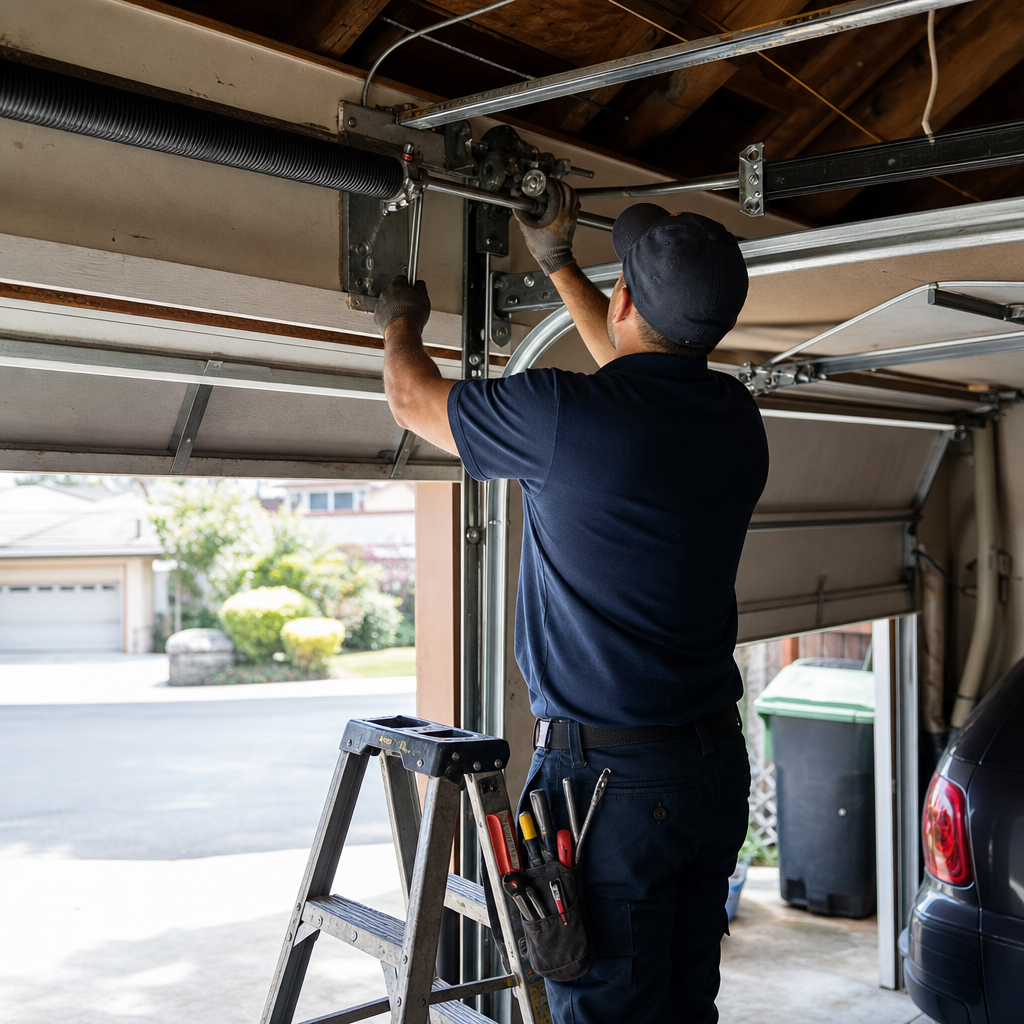
A torsion spring doesn’t snap without warning. In the two to four weeks before failure, it makes a faint creaking sound under load that’s easy to confuse with normal door noise - until you know what spring fatigue actually sounds like. We’ve been repairing garage doors across Los Angeles since 2016, and the calls that wake us at 2 a.m. are almost always from homeowners who missed the signals their door had been sending for days or weeks. This guide teaches you the specific sounds, movements, and visual cues that precede each major type of garage door emergency, how much time each warning sign typically gives you, and what to watch for after a repair to make sure the root cause was actually fixed.
Quick Answer
The four critical warning signs before a garage door emergency are: a rhythmic creak or pop from the spring area during opening (2-4 weeks before spring failure), a slack or frayed cable visible on either side of the door (days to hours before snap), a door that hesitates or reverses intermittently (1-3 weeks before opener seizure or track derailment), and gaps or bends in the horizontal tracks (immediate risk of derailment). Intermittent problems that resolve on their own are not “fine” - they are pre-failure conditions that will become permanent at the worst possible moment.
Table of Contents
- The Sounds That Predict a Spring Failure
- Visual Cues Before a Cable Snaps
- Track Problems That Lead to Derailment
- Opener Warning Signs Before Seizure
- The Danger of “It Works Fine Most of the Time”
- What to Watch for 30 Days After a Repair
- How Los Angeles Climate and Codes Affect Your Door
- Common Mistakes to Avoid
- When to Call a Professional
- Frequently Asked Questions
The Sounds That Predict a Spring Failure
Torsion springs carry the full weight of your garage door - typically 150 to 400 pounds depending on width and material. When a spring begins to fatigue, it doesn’t go quietly. The sound is specific, and once you know it, you’ll never mistake it for normal operation again.
What spring fatigue sounds like: A rhythmic creaking or light popping noise that occurs only during the first three feet of door travel, when the spring is under maximum torque load. It will be synchronized with the door’s movement - one sound per rotation segment of the spring. Normal door noise is random and continuous. Spring fatigue noise is patterned and load-dependent.
The timing window: This sound typically appears 2 to 4 weeks before failure. In coastal Los Angeles neighborhoods like Venice or Santa Monica, where salt air accelerates corrosion, we’ve seen springs fail faster after the warning sound begins - sometimes within 10 to 14 days. Inland areas like Pasadena or the San Fernando Valley tend toward the longer end of that range.
What to do: Stop using the door immediately and call for inspection. A broken torsion spring is not a DIY repair. The stored energy in a wound spring can cause serious injury or death if released improperly. This is why garage door repair in Los Angeles should be handled by technicians trained in spring handling specifically.
Secondary signs that confirm spring fatigue:
- The door feels heavier to lift manually (the spring is no longer assisting fully)
- The opener strains or slows during the first third of opening
- A visible gap appears between coils in the spring body (this means immediate failure risk - hours, not days)
- The door begins to close faster than normal, indicating the spring is losing its ability to counterbalance
We replace springs in Los Angeles homes every day, and the homeowners who catch the creaking sound early avoid the inconvenience of a door stuck open or closed, plus the potential security risk of an unsecured garage.
Visual Cues Before a Cable Snaps
Lift cables run vertically along each side of your door, winding and unwinding on drums as the door moves. They are under constant tension, and when they fray or unseat, they fail suddenly and violently.
The primary warning sign: A visible fray, kink, or “birdcaging” (strands separating outward) anywhere along the cable length. This is not wear you can monitor - it’s a countdown. Once fraying is visible, failure typically occurs within days to hours, not weeks.
The secondary warning sign: Cable slack on one side of the door. When you close the door fully, both cables should be taut with equal tension. If one hangs loose or has visible droop, the cable has slipped on its drum or the drum setscrew has loosened. The door is now lifting unevenly, which strains the good cable and the entire door system.
What uneven lifting looks like: Stand inside your garage with the door closed. Look at the bottom section - is it parallel to the floor, or does one corner sit lower? A corner drop of even half an inch means the door is torquing on every cycle, accelerating wear on rollers, hinges, and the good cable.
Los Angeles-specific consideration: In hillside neighborhoods like Laurel Canyon or the Hollywood Hills, where garages are often built into slopes with limited headroom, cable drums are sometimes installed with tighter angles than ideal. This increases wear on the cable where it contacts the drum flange. We’ve replaced more cables in these configurations than in flat-grade installations, and the warning signs appear sooner.
Never operate a door with a frayed or slack cable. The sudden release of a snapped cable can damage the door, the opener, or anything in its path. Our trucks carry replacement cables for all standard door sizes, so most cable replacements are completed in a single visit.
Track Problems That Lead to Derailment
Horizontal tracks guide your door from vertical to horizontal as it opens. When they fail, the door can jump the track entirely - a dangerous situation that often damages multiple door sections and can trap vehicles inside.
Warning sign 1: Visible gaps between rollers and track. With the door partially open, each roller should sit firmly in the track channel with no visible daylight above or below. A gap means the track has bent, the roller is worn, or the mounting brackets have loosened. This gap will grow until the roller exits the track.
Warning sign 2: Bent or dented track sections. Even a small dent from a bicycle handlebar or storage bin impact creates a catch point. The roller hits it on every cycle, gradually enlarging the damage and loosening the track mounting. In Los Angeles, where many garages double as workshops or storage for outdoor gear, track impacts are more common than homeowners realize.
Warning sign 3: Loose or missing track mounting bolts. The horizontal track attaches to the wall or ceiling with angle iron and lag bolts. Vibration from daily operation loosens these over years. A track that visibly flexes or shifts when the door moves is imminent derailment risk.
Warning sign 4: Door binds or requires extra force at a specific point. This is often the first symptom homeowners notice. The door moves normally for most of its travel, then sticks or requires a push at one spot. That spot is where the track problem lives.
The timing window: Track problems that have reached the point of visible binding typically fail within 1 to 2 weeks of regular use. The failure is often sudden - one normal opening, one catch, one jump.
Track alignment requires precision within 1/4 inch over the full door width. This is not an adjustable-by-eye repair. Our technicians use laser levels and specific bracket gauges to restore factory geometry.
Opener Warning Signs Before Seizure
Garage door openers don’t usually die quietly - they announce their decline with specific behaviors that many homeowners normalize until the unit fails completely, often with the door in an inconvenient position.
Warning sign 1: Intermittent response to remote or wall button. The opener works on the third try, or only from certain angles, or only when you stand closer to the door. Homeowners often blame the remote battery first. But if a fresh battery doesn’t solve it, the logic board or receiver is failing. Typical window: 2 to 4 weeks before total non-response.
Warning sign 2: Grinding or straining during operation. A healthy opener produces steady motor hum. A failing gear set or drive mechanism produces irregular grinding, especially under load (the first third of opening). The motor runs but the door moves slowly or hesitates. This is mechanical failure inside the opener, not a door balance problem.
Warning sign 3: Reversal without obstruction. The door travels partway down, then reverses. You check the safety sensors - they’re aligned, the LED is solid. The door still reverses. This often indicates the opener’s force settings are at maximum and the internal force sensor is failing, or the drive mechanism is binding internally. The opener is working overtime to compensate for its own mechanical decline.
Warning sign 4: Excessive travel distance. The door closes fully, then the opener continues running for 2-3 seconds, or the trolley bumps the stop bolt. The limit switches are drifting. This is common in older ChainLift and ScrewDrive units, and it precedes complete limit failure where the door won’t stop at the correct position.
Brand-specific note: We service all major opener brands including LiftMaster, Chamberlain, and Craftsman. Each has characteristic failure patterns. LiftMaster belt-drive units often show belt skipping before motor failure. Chamberlain chain-drive units typically announce gear wear with a characteristic clicking before the grinding stage. Knowing the brand helps us arrive with the right parts.
Opener replacement is often the most cost-effective path when internal mechanical failure begins, as gear and logic board repairs on aged units rarely restore full reliability. Garage door opener service in Los Angeles from Mainspring includes upfront pricing for both repair and replacement options, so you can choose based on your situation.
The Danger of “It Works Fine Most of the Time”
This is the warning sign category that costs homeowners the most money and the most sleep. A door that hesitates once a week, reverses on Tuesdays but not Thursdays, or makes a noise “sometimes” is not a door with a minor quirk. It is a door in a pre-failure state where the underlying problem is progressing while the symptoms remain intermittent.
Why intermittent problems are actually worse:
- The root cause is accelerating. A spring with three fatigued coils doesn’t fatigue evenly - it weakens progressively. The door operates normally until the load angle or temperature shifts slightly, then the weak point gives and the symptom appears. Each episode weakens the spring further.
- They train you to ignore them. Human pattern recognition works against you here. Three normal operations after one abnormal one creates a false sense of resolution. The problem hasn’t gone away - you’ve just had a lucky streak.
- They fail at maximum inconvenience. Intermittent electrical problems fail when the circuit is under stress: cold mornings, hot afternoons, or when the door has been idle longest. These are exactly the times you need the door to work.
- They mask secondary damage. A door that reverses intermittently due to opener force problems is also hammering its hinges and rollers with excess force on every cycle. By the time the opener fails completely, the door hardware may also need replacement.
Our rule of thumb: Any symptom that repeats, even irregularly, deserves inspection. The $89 Seasonal Tune-Up we offer includes full system diagnostics that catch intermittent problems before they become emergencies. For a door you depend on daily, that’s a square deal.
What to Watch for 30 Days After a Repair
A quality repair should restore normal, quiet, predictable operation. But sometimes the symptom was fixed without addressing the cause - like replacing a spring that failed due to a binding door, without fixing the binding. The new spring then fails prematurely, and the homeowner blames the repair.
Watch for these post-repair warning signs:
- Return of any pre-repair sound or behavior within 30 days. A door that starts creaking again after spring replacement likely has a balance or hardware issue that overloaded the new spring.
- New noises that weren’t present before. A grinding sound after cable replacement may indicate the drum or bearing is damaged and wasn’t replaced.
- Uneven door travel that wasn’t there previously. This suggests the repair affected door balance or track alignment.
- Opener straining that wasn’t present before. A new spring with incorrect tension can overload the opener. The door may move, but the opener is working too hard.
This is why our 90-Day Done Right Promise exists. If anything about your door’s operation doesn’t feel right in the month after our visit, we come back. No paperwork, no arguing, no charge. The promise is in writing on every job. A repair that doesn’t feel right isn’t done right, and we stand behind that.
We’ve also seen cases where a previous repair used mismatched springs (different wire sizes or lengths on left and right) or incorrect cables. These doors operate, but with subtle unevenness that accelerates wear. If your door was repaired by another company and you’re seeing post-repair symptoms, our Free Second Opinion on any written estimate lets you know exactly what’s happening without cost or obligation.
How Los Angeles Climate and Codes Affect Your Door
Los Angeles presents specific conditions that influence garage door wear patterns and warning sign timing. Understanding these helps you calibrate urgency correctly.
Coastal corrosion: Homes within three miles of the Pacific - Santa Monica, Venice, Marina del Rey, San Pedro - experience accelerated corrosion on springs, cables, and hardware from salt air infiltration. Galvanized springs that last 10 years inland may show fatigue in 6 to 7 years coastally. The warning sounds appear sooner, and the failure window after first symptom is shorter.
Thermal cycling: Los Angeles can see 30-degree temperature swings between morning and afternoon, especially in valley areas like Woodland Hills or Northridge. Metal components expand and contract through this range daily. Thermal fatigue shows up as loosened fasteners, cracked bearing plates, and accelerated spring cycle wear. The warning sign is often a seasonal pattern - problems that appear in spring and fall when temperature swings are largest.
Seismic considerations: Los Angeles building codes require garage door tracks and mounting to withstand lateral forces. Older homes, especially pre-1990 construction in neighborhoods like Los Feliz or Echo Park, may have track mounting that predates current standards. After any significant seismic event, even a door that appears to operate normally should be inspected for shifted mounting or track geometry changes.
Fire zone requirements: Properties in Very High Fire Severity Zones - parts of Topanga, Malibu, the Santa Monica Mountains - face additional code requirements for garage door materials and sealing. A door that has been modified for fire compliance but not rebalanced will show warning signs: opener strain, uneven travel, or premature spring fatigue.
For homeowners considering full replacement, garage door installation in Los Angeles from Mainspring includes code compliance verification and climate-appropriate hardware specification as standard practice, not upsells.
Common Mistakes to Avoid
- WD-40 on springs or tracks. This is perhaps the most common DIY error we encounter. WD-40 is a solvent, not a lubricant. On torsion springs, it strips the protective coating and accelerates corrosion. On tracks, it attracts dust that forms an abrasive paste. Use lithium-based garage door lubricant only, or call us for the $89 Seasonal Tune-Up that includes proper lubrication of all moving parts.
- Ignoring a door that “just needs a little help.” If you find yourself lifting the door manually to assist the opener, or guiding it past a sticky spot, you are compensating for a failure in progress. The door system is designed to operate without human assistance. Any need for help means a component has failed or is failing.
- Replacing the opener without checking door balance. A door that is poorly balanced overloads any opener, new or old. We’ve been called to “failed” new openers that were actually fine - the door was binding and the opener couldn’t overcome it. Always verify door balance and hardware condition before investing in a new opener.
- Assuming a quiet door is a healthy door. Some failures are silent. A spring with a broken inner coil can appear to function normally while progressively damaging the door and opener. Annual professional inspection catches these hidden problems.
- Waiting for “both springs” to fail. Many doors use two torsion springs. When one breaks, the door may still operate with opener assistance. But the remaining spring is now carrying double load and will fail soon, often with more damage because the door is traveling unevenly. Replace springs in matched pairs.
- Accepting “that’s just how this door is.” No properly functioning garage door should require ritual or technique to operate. If you’ve developed a specific sequence - “press the button twice, then lift slightly” - your door is broken, not quirky.
When to Call a Professional
Call for same-day inspection if you observe any of the following: visible spring gap or coil separation, frayed or slack cable, door binding or jumping in its tracks, opener grinding or straining, or any intermittent symptom that has occurred more than twice. These are not “watch and wait” conditions - they are active failure states with defined, short timelines.
For Los Angeles homeowners, same-day service matters. A door stuck open overnight creates a security exposure. A door stuck closed traps vehicles and blocks access. Our phones are answered by a live person 24 hours a day, including nights, weekends, and holidays. No phone trees, no voicemail, no after-hours answering service. Mainspring Garage Door Co. home service includes free estimates, and most repairs are completed in a single visit because our trucks carry springs, cables, and openers for all major brands.
Frequently Asked Questions
Emergency garage door repair in Los Angeles typically ranges from $180 for a basic cable replacement to $340 for standard torsion spring replacement, with opener repairs or replacements running higher depending on the unit. We provide upfront flat pricing before any work begins, so there are no surprises on the bill. Call (844) 755-5838 for an exact quote - estimates are free.
Yes. A standard torsion spring stores enough torque to cause serious injury or death if released improperly. The winding bars can strike with lethal force, and the spring itself can unwind violently. This is not a DIY repair under any circumstances. Our technicians are trained in spring handling as journeymen, and we carry the specialized tools that make this work safe.
This pattern usually indicates thermal expansion affecting a component that’s already at its wear limit. A slightly bent track, a binding roller, or a spring with uneven fatigue may operate normally at cooler temperatures but bind when metal expands in afternoon heat. In Los Angeles, where 30-degree daily swings are common, this pattern is a reliable predictor of imminent failure. Don’t wait for it to become constant.
For openers under 8 years old with isolated failures like a worn gear or failed logic board, repair is usually cost-effective. For openers over 12 years old, or units showing multiple warning signs, replacement typically provides better long-term value. We quote both options upfront with flat pricing, so you can choose based on your situation. Our standing offer of $50 Off Any Repair Over $250 applies to qualifying opener repairs.
Annual inspection is appropriate for most Los Angeles homes. For coastal properties where salt air accelerates corrosion, or doors with daily use exceeding four cycles, semi-annual inspection is prudent. Our $89 Seasonal Tune-Up includes full system inspection, lubrication, safety sensor testing, and balance verification. Seniors and veterans receive a permanent 5% discount on all services.
Secure the opening as best you can without attempting repair - disconnect the opener using the red emergency release cord if the door is partially open, then lower it manually if it is safe to do so. Do not force a door that resists. Call (844) 755-5838; our phones are answered by a live person at all hours, and we provide 24/7 emergency response throughout Los Angeles.
The Bottom Line
Every garage door emergency sends advance signals. The creaking spring, the frayed cable, the binding track, the straining opener - these are not quirks to accommodate but countdowns to address. The homeowner who learns these specific warning signs gains weeks of warning for some failures, hours for others, and the ability to schedule repair on their terms rather than reacting to a midnight breakdown. In our experience serving Los Angeles since 2016, the most satisfied customers are those who called at the first sign, not the last. We’re here when you need us, with upfront pricing, the right parts on the truck, and a 90-Day Done Right Promise that means what it says.
Written by the team at Mainspring Garage Door Co., serving Los Angeles since 2016.