
Last updated July 26, 2026
Garage Door Parts Maintenance Schedule: What to Do and When
The average garage door in Los Angeles opens and closes 1,500 times a year. Springs do not rust out on a calendar date. Cables do not fray because it is March. They fail by cycle count, and a maintenance schedule that ignores this fact will always miss the warning signs. Most guides tell you to “lube everything in spring” as if rollers, hinges, and torsion springs wear at identical rates. They do not. In 42 years of running Mainspring Garage Door Co. home, we have seen the same pattern: the homeowner who followed a date-based checklist still got surprised by a snapped spring, while the homeowner who tracked cycles caught it early. This guide breaks down what to maintain, when to maintain it, and why the interval matters for each part.
Quick Answer
Garage door maintenance should follow two schedules: a cycle-based schedule for high-wear parts (springs, cables, rollers every 500 cycles) and a calendar schedule for structural and safety components (tracks, sensors, weather seals annually). In Los Angeles, UV exposure and dust accelerate rubber seal and photo-eye degradation beyond what national guides assume, so inspect these quarterly.
Table of Contents
- Why Cycles Beat Calendar Dates
- Torsion and Extension Springs: Every 500 Cycles
- Cables and Cable Drums: Every 500 Cycles
- Rollers and Hinges: Every 1,000 Cycles
- Opener, Safety Sensors, and Force Settings: Annually
- Tracks, Weather Seals, and Hardware: Annually
- How Los Angeles Climate Changes the Schedule
- A Simple Way to Count Cycles at Home
Why Cycles Beat Calendar Dates
A cycle is one complete open-and-close. The standard garage door spring is rated for 10,000 cycles. At four uses per day, that is roughly seven years. At eight uses per day, it is three and a half. The spring does not know what year it is. It knows how many times it has coiled and uncoiled.
This distinction matters because maintenance intervals should match wear patterns, not seasons. Lubricating a spring that has seen 2,000 cycles since its last service is different from lubricating one that has seen 50. The former has distributed its grease; the latter has not. Over-lubricating attracts dust and grit, which is a real problem in Los Angeles where Santa Ana winds deposit fine particulate that acts like sandpaper on moving parts.
We separate maintenance into two tracks:
- Cycle-based: Springs, cables, rollers, hinges. These move with every operation and wear proportionally to use.
- Calendar-based: Safety sensors, opener force settings, weather seals, track alignment. These degrade from environment, vibration, and time regardless of use.
The mistake most homeowners make is combining everything into one annual or seasonal task. They grease the rollers and springs on the same Saturday in April, then ignore the door until next April. Meanwhile, the spring has logged another 1,500 cycles with no inspection, and the safety sensors have drifted out of alignment from garage temperature swings.
In our experience servicing homes from Pasadena to Pacific Palisades, the doors that fail unexpectedly almost always belong to owners who treated maintenance as a calendar event. The doors that last 15 to 20 years belong to owners who tracked cycles and inspected environment-sensitive parts on their own schedule.
Torsion and Extension Springs: Every 500 Cycles
Springs are the only part that carries the full weight of the door. When a torsion spring breaks, it releases stored energy with enough force to damage property or cause serious injury. This is not a maintenance task for the homeowner. It is an inspection interval that tells you when to call a professional.
What to check every 500 cycles:
- Look for a gap in the coils of a torsion spring. A broken spring often separates by a quarter-inch or more.
- Check for rust, pitting, or flaking on the spring surface. Los Angeles humidity is low, but coastal moisture in neighborhoods like Marina del Rey and San Pedro accelerates surface corrosion.
- Listen for a creaking or popping sound during operation. This indicates the spring is binding against itself.
- Test door balance: disconnect the opener and lift the door manually. It should stay at waist height without drifting up or down. If it falls, the spring has lost tension.
What never to do: Do not lubricate a spring with standard WD-40. It is a solvent, not a lubricant, and it strips the protective coating. Do not attempt to adjust or wind a torsion spring. The torque stored in a standard residential spring can cause severe laceration or amputation. We have replaced springs in Los Angeles homes where a homeowner used a winding bar from a hardware store and the bar slipped. The resulting damage to the door and wall exceeded the cost of professional service several times over.
At Garage Door Repair in Los Angeles, we inspect spring condition, test balance, and apply the correct lithium-based lubricant if needed. Most spring adjustments or replacements are completed in a single visit because our trucks carry the full range of wire sizes and lengths.
Cables and Cable Drums: Every 500 Cycles
Cables work in tension with every cycle, wrapping and unwrapping from the drum at the end of the torsion tube. They fray from the inside out, which means visible wear is already advanced damage.
Inspection points every 500 cycles:
- Run a cloth along the cable length. Snags indicate broken strands.
- Check the cable drum for grooves or sharp edges that will cut new cable.
- Verify cable is seated properly in the drum grooves. A cable that has jumped a groove will operate unevenly and fail prematurely.
- Look at the bottom bracket where cable attaches. Corrosion here is common in Los Angeles garages where lawn equipment or stored items trap moisture against the metal.
Cable replacement requires releasing spring tension. This is not a homeowner task. A frayed cable should be treated as an imminent failure. We have responded to emergency calls in the Hollywood Hills and Silver Lake where a cable snapped during morning departure, leaving a car trapped inside with a door too heavy to lift manually.
The 90-Day Done Right Promise covers all spring and cable work. If the door does not balance correctly after our visit, we return at no charge. That promise is in writing on every job, with no dispute process.
Rollers and Hinges: Every 1,000 Cycles
Rollers and hinges are the most commonly over-lubricated parts. Homeowners spray them on the same schedule as everything else, creating a grime trap that accelerates wear. These parts need less frequent attention, and the type of attention differs.
Steel rollers with ball bearings: Every 1,000 cycles, apply a small amount of silicone or lithium lubricant to the bearing race. Wipe excess immediately. Do not lubricate the wheel tread that contacts the track. It needs friction to roll.
Nylon rollers: These are self-lubricating and should not be greased at all. Lubricant attracts dust and turns into an abrasive paste. Inspect for cracked wheels or loose stems. Replace when worn.
Hinges: Apply lubricant to the pivot pin only. The hinge knuckle does not need coating. In Los Angeles, dust from construction and hillside erosion is particularly abrasive. Excess lubricant becomes a grinding compound.
Why the 1,000-cycle interval: Rollers and hinges wear slowly. Over-maintenance causes more damage than under-maintenance. We see this regularly in older Los Angeles neighborhoods like Los Feliz and Hancock Park, where original hardware on vintage doors has been greased into premature failure by well-meaning homeowners.
If rollers are noisy after lubrication, they are likely worn, not dry. Replacement is the correct response. Our technicians carry steel and nylon rollers for all major brands, including Wayne Dalton and Craftsman systems common in 1980s and 1990s Los Angeles construction.
Opener, Safety Sensors, and Force Settings: Annually
Opener maintenance is calendar-based because electronic components and safety systems degrade from power fluctuation, temperature cycling, and vibration, not from door cycles.
Annual opener checklist:
- Test force settings. Place a 2×4 flat on the ground where the door closes. The door should reverse on contact. If it does not, the down-force is set too high.
- Clean photo-eye lenses with a dry cloth. In Los Angeles, dust and spider webs obscure the beam. Alignment should show steady indicator lights on both sensors.
- Check the emergency release cord. It should pull smoothly and disengage the trolley.
- Listen to the motor. Grinding or straining indicates the door is out of balance or the opener is undersized for the door weight.
- Inspect the rail for loosened mounting bolts. Garage temperature swings, even mild ones, expand and contract hardware over time.
Force settings are a legal safety requirement under federal law, not a preference. An opener that does not reverse on obstruction is a liability. In our 42 years, we have seen two serious injuries from improperly set force limits. Both were preventable with annual testing.
Garage Door Opener in Los Angeles service includes force calibration, safety sensor alignment, and travel limit verification. We are factory-familiar with LiftMaster, Chamberlain, Genie, and Raynor systems.
Tracks, Weather Seals, and Hardware: Annually
These are structural and environmental components. They do not move with every cycle, but they affect every cycle.
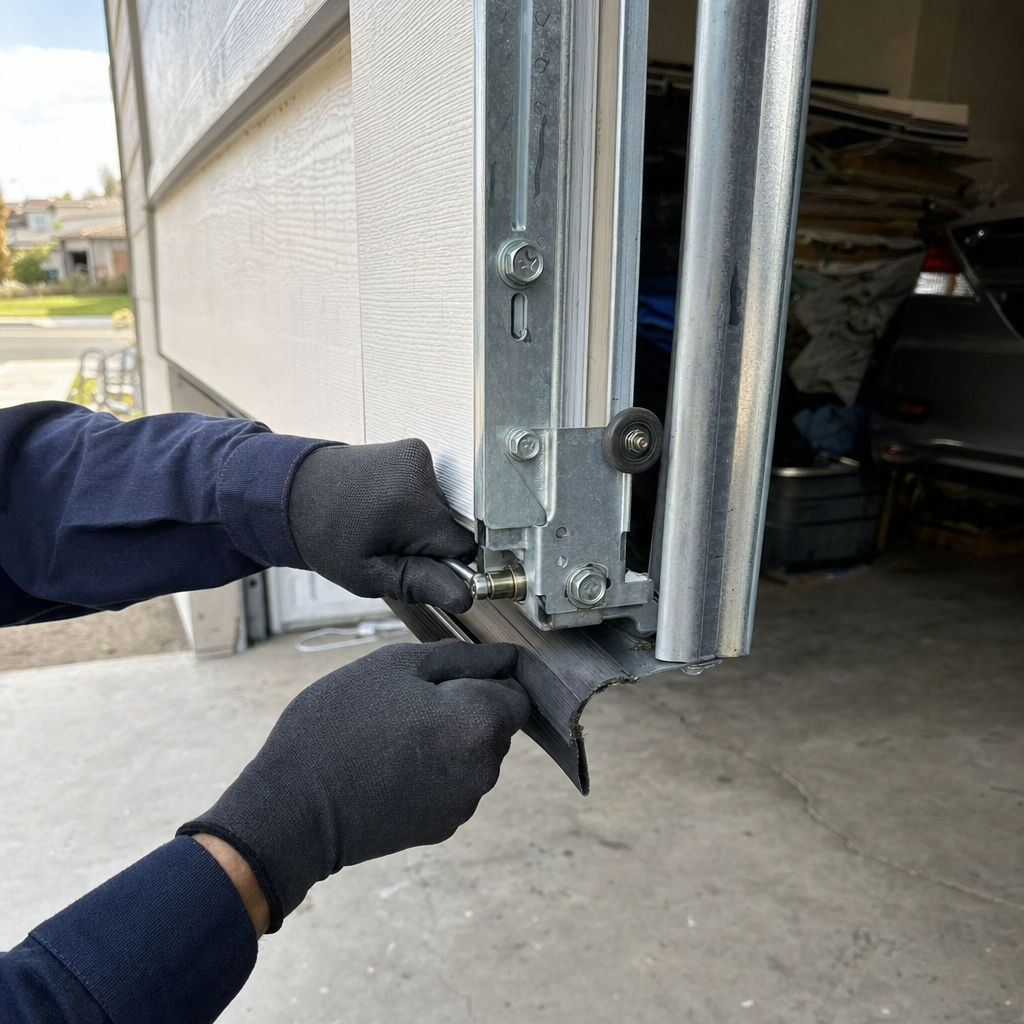
Tracks: Check for dents, gaps at wall brackets, and horizontal track angle. The track should be plumb and parallel. A gap at the bracket means the lag screw has stripped the wood or the bracket has bent. Either condition causes roller binding and premature wear.
Weather seal: Inspect the bottom seal and perimeter stop molding. Los Angeles UV exposure is more severe than most national guides account for. Rubber seals on south-facing doors can harden and crack in three to four years, not the seven to ten expected in cooler climates. A failed seal allows dust, rodents, and water intrusion during rare heavy rains. Replace when the seal no longer compresses against the floor.
Hardware: Tighten lag screws at track brackets and jamb brackets. Check roller bracket bolts. Do not over-tighten; stripped wood framing is harder to repair than a loose bolt.
Annual inspection is sufficient for these parts unless you notice operational changes. A door that has begun to rub or bind likely has track or hardware issues that need immediate attention.
How Los Angeles Climate Changes the Schedule
National maintenance guides assume freeze-thaw cycles and moderate humidity. Los Angeles has neither. What we have instead shifts the risk profile.
UV exposure: Intense and prolonged. South and west-facing garage doors see rubber seals, vinyl trim, and even some plastic opener components degrade faster than manufacturer specifications predict. Inspect seals every six months, not annually, on these exposures.
Dust and particulate: Santa Ana winds carry fine mineral dust from the desert and construction debris from continuous development. This grit infiltrates roller bearings and settles on lubricated surfaces. More frequent cleaning and less frequent lubrication is the correct response. We advise Los Angeles homeowners to wipe tracks with a dry cloth monthly and to resist the urge to lubricate more often.
Coastal moisture: Homes within two miles of the Pacific in neighborhoods like Venice, Playa del Rey, and San Pedro see salt air corrosion on bottom brackets, cable fittings, and track hardware. These homes benefit from quarterly visual inspection of metal components, even if full maintenance follows the standard cycle schedule.
Temperature stability: Unlike Midwest or Northeast garages, Los Angeles garages rarely drop below 40 degrees. This is an advantage: grease does not thicken, and metal does not contract dramatically. Opener strain from cold-start conditions is minimal. The trade-off is that homeowners forget to check anything because the door “always works.”
For new Garage Door Installation in Los Angeles, we specify UV-resistant seals and corrosion-resistant hardware for coastal applications. The right material selection extends maintenance intervals significantly.
A Simple Way to Count Cycles at Home
Most openers do not display cycle counts. You can estimate accurately with a simple proxy method.
The light-flash method:
- Most garage door openers activate the work light for 4.5 minutes per cycle.
- Count how many times the light comes on in a typical week. Each activation equals one cycle (or close enough for maintenance purposes; some lights activate with safety sensor interruption, but this is uncommon in normal use).
- Multiply weekly activations by 13 for a quarterly cycle count. Multiply by 52 for annual.
- Mark your calendar at 500-cycle intervals from your last professional service.
Alternative for households with regular schedules: If your door opens morning and evening on weekdays, that is 10 cycles per week, 520 per quarter. A 500-cycle service interval means calling for inspection roughly every three months. Heavy-use households with teenagers, home businesses, or multiple drivers may see 20 to 30 cycles per week, requiring service every six to eight weeks for high-wear components.
Keep a log. A small notebook or phone note with dates and cycle estimates takes 30 seconds and prevents the surprise failure that strands you late for an appointment.
Common Mistakes to Avoid
- Lubricating everything on the same day. Springs and rollers need different intervals. Combining them wastes lubricant on low-wear parts and under-serves high-wear ones.
- Using WD-40 on springs or bearings. It is a water displacer and solvent, not a lubricant. It strips protective coatings and attracts dust.
- Ignoring the door after a new opener installation. The opener does not eliminate spring or cable wear. We see this in Los Angeles condo conversions where a new LiftMaster was installed on 15-year-old springs that failed six months later.
- Testing force settings with a hand or foot instead of a solid object. This is dangerous and gives false confidence. Use a 2×4 or similar rigid item.
- Assuming silence means health. A door that runs quietly may have a cracked spring that has not yet separated. Visual inspection catches what sound does not.
- Skipping maintenance on a “backup” door. Side garage doors and carriage house doors that see light use still have calendar-based degradation. Annual inspection prevents the failure that happens the one day you need that door.
When to Call a Professional
Call when you see a gap in a spring, frayed cable, door that will not stay open manually, or opener that fails the force reversal test. Call if the door has shifted in its tracks, if hardware is loose and you cannot identify the source, or if you are unsure of the age and condition of any component. The three parts that should never be maintained by a homeowner under any interval are torsion springs, cables under tension, and bottom brackets. These store lethal energy and require proper tools and training.
Mainspring Garage Door Co. offers free estimates in Los Angeles. A technician will inspect your door, report condition by component, and quote a flat price before any work begins. Call (844) 755-5838. The 90-Day Done Right Promise applies to every repair.
Frequently Asked Questions
For typical use, schedule professional inspection of springs and cables every 500 cycles, roughly quarterly for most households. Annual service covers opener safety systems, track alignment, and weather seals. In Los Angeles, add quarterly visual checks for UV-damaged seals if your door faces south or west. Call (844) 755-5838 to schedule; estimates are free.
You can apply lubricant to a torsion spring from a safe distance using the correct product, but we do not recommend it. The risk of hand placement near a spring under tension outweighs the minor cost of professional application. Most importantly, lubrication is not the primary need; tension balance and coil condition are, and these require training to assess. A technician handles both inspection and lubrication in one visit.
Noise after lubrication usually indicates worn rollers, loose hardware, or a door out of balance, not insufficient grease. Excess lubricant can actually increase noise by attracting grit. In Los Angeles, dust accumulation in over-lubricated tracks is a common cause. Have a technician identify the source rather than adding more lubricant.
Maintenance costs a fraction of emergency repair or premature replacement. A snapped spring can damage the door panel, opener, or both. A failed cable can bend the track. The $89 Seasonal Tune-Up catches these conditions before they cascade. The senior and veteran 5% discount applies to this service as well.
Spring size is determined by door weight, height, and track radius, not by visual matching. An undersized spring works the opener harder and fails early. An oversized spring creates dangerous snap force. We calculate spring specifications on every replacement. If you are unsure of your spring history, call for inspection. The Free Second Opinion applies to any written estimate you want verified.
Yes. Minimal freeze-thaw means less contraction damage, but UV exposure degrades seals and plastic components faster than in cloudy climates. Dust and Santa Ana winds create abrasive conditions that national guides do not address. Coastal salt air corrodes hardware more aggressively than inland humidity. A maintenance schedule written for Chicago or Seattle will mislead a Los Angeles homeowner.
The Bottom Line
Garage door maintenance is not one task done once a year. It is two schedules running in parallel: cycle-based for moving parts that wear with use, calendar-based for safety and environmental components that degrade with time. In Los Angeles, UV and dust shift the calendar schedule earlier for seals and photo-eyes. Track your cycles with the light-flash method, inspect springs and cables every 500 cycles, and test safety systems annually. Leave springs, cables, and bottom brackets to trained technicians. The small effort of a part-specific schedule prevents the large cost and inconvenience of unexpected failure.
Call (844) 755-5838 for a free estimate. A live person answers, 24/7, including nights, weekends, and holidays. Most jobs are completed in a single visit because our trucks carry the parts. The price is stated upfront, in writing, with no surprises on the bill.
Written by the team at Mainspring Garage Door Co., serving Los Angeles since 2016.