
Last updated July 26, 2026
Garage Door Parts Troubleshooting: Common Problems and How to Fix Them
Here’s the truth most Los Angeles homeowners learn the hard way: the cable that snapped is almost never the real problem. In our 42 years, we’ve replaced thousands of cables that failed because a spring broke first and no one checked. The symptom looks obvious. The cause hides behind it. This guide shows you how to trace symptoms to their source, run three safe diagnostics yourself, and describe problems accurately so the right parts reach your door on the first trip. You’ll save time, avoid repeat failures, and know when a repair is a square deal versus a shortcut.
Quick Answer
Most garage door part failures trace back to one of three root causes: a broken spring (causing cables to snap and openers to strain), worn rollers (causing track misalignment that looks like a track problem), or a failing opener motor (causing intermittent operation blamed on sensors). The fixes are rarely single-part replacements. Springs, cables, and rollers work in matched pairs, and replacing one side without the other guarantees premature failure.
Table of Contents
- How Spring Failure Becomes a Cable Problem
- Track, Roller, or Panel Warp: Three Symptoms That Look Identical
- The Gap Test, Balance Test, and Manual-Lift Test
- Which Part Failures Are Always a Pair
- How to Describe a Problem So the Right Parts Show Up
- Opener Parts: Motor, Gear, and Sensor Failures
- Weather Seals, Bottom Rubber, and Hardware Corrosion
- Common Mistakes to Avoid
- When to Call a Professional
- Frequently Asked Questions
How Spring Failure Becomes a Cable Problem
The phone call starts the same way. “My cable broke. Can you replace just the cable?” We understand the logic. The cable is lying on the garage floor. It looks like the culprit. But in ninety percent of cases we see across Los Angeles, from Pasadena to the South Bay, the cable broke because the torsion spring failed first and the door’s full weight shifted onto a single cable designed to carry half.
Here’s the sequence. A standard residential door weighs between 150 and 250 pounds. Torsion springs above the door carry that weight so the opener only needs to manage 10 to 15 pounds of friction and momentum. When one spring breaks, the remaining spring takes the entire load. The cables, wound around drums at each end of the torsion tube, now carry uneven tension. One cable is overloaded. It frays, then snaps, often within days or weeks of the spring failure.
The homeowner replaces the cable. The door works for a month. Then the second spring breaks, the replacement cable snaps again, and now there’s damage to the cable drum where the sudden slack caused the cable to overlap and jam. What started as a single spring replacement has become springs, cables, and drums.
What to check: Before assuming a cable is a simple swap, look up. Is the torsion spring in two pieces? Is there a visible gap in the coil? Does the door feel heavy when you try to lift it manually? A broken spring often leaves a quarter-inch gap where the coil separated. If you see that gap, the cable is a secondary failure. Both springs need replacement, and both cables should be inspected for fraying even if only one snapped.
In Los Angeles, the marine layer moisture and occasional Santa Ana heat cycles accelerate spring corrosion. We’ve found springs in coastal neighborhoods like Venice and San Pedro fail two to three years earlier than identical springs in drier inland areas like Alhambra or Woodland Hills. The spring doesn’t look different. The failure pattern does.
Safety note: Torsion springs store lethal energy. A standard spring for a 16-foot door holds enough torque to cause serious injury or death if mishandled. Never attempt to wind, unwind, or remove a torsion spring. The diagnostic steps below are visual and manual only. Spring work requires specialized tools and training.
Track, Roller, or Panel Warp: Three Symptoms That Look Identical
The door shudders on the way up. It binds at the same spot every time. From the driveway, it looks like the door is off the track. But “off the track” describes at least four distinct problems with different fixes and different costs. Misdiagnosing here means paying for track realignment when you need roller replacement, or replacing rollers when the panel itself has warped.
Track misalignment shows as a consistent rub mark on one side of the track, usually at a specific height. The door doesn’t wobble; it drags. The vertical tracks should be plumb within a quarter-inch. In older Los Angeles homes, especially pre-1960s construction in neighborhoods like Highland Park or Eagle Rock, settled foundations tilt tracks gradually. The fix is track adjustment or replacement, not rollers.
Worn rollers cause intermittent binding that changes with temperature. Steel rollers without ball bearings grind and squeal. Nylon rollers with sealed bearings run quiet until the bearing fails, then the roller wobbles visibly in the track. The door shakes side to side, especially at the transition from vertical to horizontal track. Replace rollers in full sets. We never replace fewer than all ten on a standard door. Mixed roller ages create uneven drag that stresses the opener.
Panel warp is the most commonly missed. Steel panels with internal insulation can delaminate, creating a bow that contacts the track. Aluminum panels dent and hold the deformation. Wood doors in Los Angeles humidity cycles, especially south-facing doors in neighborhoods like Silver Lake or Los Feliz, absorb moisture unevenly and twist over time. The symptom is a door that binds at the same panel location regardless of roller condition. The fix is panel replacement or full door replacement, not track or roller work.
The three-second test: With the door closed, stand inside the garage and sight down the door face. A warped panel shows as a visible bow. Then run the door halfway and watch each roller enter the horizontal track. A wobbling roller needs replacement. A straight roller in a straight door that still binds needs track measurement.
The Gap Test, Balance Test, and Manual-Lift Test
These three diagnostics take five minutes and require no tools. They tell you whether the problem is spring, opener, or mechanical binding. Run them in order. Record what you find. The results change what you tell the technician, and that changes what parts travel on the truck.
Test 1: The Gap Test (Spring Condition)
- Close the door fully.
- Stand on a sturdy step stool and examine the torsion spring above the door. Look for a visible gap between coils, rust flakes, or a stretched appearance where coils are farther apart than elsewhere.
- Check the lift cables where they wrap around the drums. Look for fraying, flat spots, or broken strands.
A visible gap in the spring means spring replacement is required. Frayed cables mean cable replacement. Both together mean both. In Los Angeles, we see cable fraying accelerated by coastal salt air, particularly in Marina del Rey and Redondo Beach, where the combination of moisture and airborne salinity corrodes cable strands from the inside out.
Test 2: The Balance Test (Spring Tension)
- Close the door.
- Pull the red emergency release cord to disconnect the opener.
- Lift the door manually to waist height and release it.
A properly balanced door stays in place or drifts slowly. A door that crashes down has broken or weakened springs. A door that rises on its own has excessive spring tension. Both conditions damage the opener over time. We find this test reveals spring problems six months before the homeowner notices opener strain.
Test 3: The Manual-Lift Test (Mechanical Binding)
- With the opener still disconnected, lift the door slowly through its full range.
- Note any point where resistance increases, the door hangs, or you need extra force.
- Listen for grinding, scraping, or clicking at specific heights.
Smooth manual operation with opener problems points to the motor, gear, or electronics. Binding during manual lift means rollers, track, or panel issues. This distinction saves you from an unnecessary opener service call when the real problem is mechanical.
Important: If the door will not stay open at any position during the balance test, do not leave it unattended. Lower it controlled and re-engage the opener. A door with failed springs can fall without warning.
Which Part Failures Are Always a Pair
Some parts work as matched systems. Replacing one side is not half the cost. It is a shortcut that costs more later. We see this mistake from budget outfits across Los Angeles who compete on the low bid and disappear when the callback comes.
Torsion springs: A two-spring door must have both springs replaced together, even if only one broke. Springs are matched for cycle life and wire size. A new spring paired with an old spring creates uneven lift. The door rises crooked, cables slip, and the new spring carries disproportionate load. The result: the new spring fails early, often within 18 months.
Lift cables: Cables stretch and seat into drums over their first hundred cycles. A new cable paired with a seated cable creates unequal drum winding. The door tracks to one side. In extreme cases, the cable slips off the drum entirely. We replace cables in pairs, period.
Rollers: Rollers wear at different rates based on track position and door weight distribution. The bottom rollers carry more load. Replacing only failed rollers creates uneven rolling resistance that strains the opener and wears remaining rollers faster. A full set costs more upfront. It costs less than two partial replacements.
Hinges: Number two hinges (center of most panels) carry the most stress. But replacing one hinge on a twenty-year door means the new hinge sits flush while adjacent hinges have settled wear patterns. The door flexes unevenly. We replace hinges in sequence, not singly.
The Garage Door Repair in Los Angeles market has no shortage of technicians who will do one spring, one cable, or three rollers. The 90-Day Done Right Promise exists because we have repaired those repairs. Our trucks carry matched spring sets, cable pairs, and full roller boxes because that is how the work is done right.
How to Describe a Problem So the Right Parts Show Up
Nothing wastes a homeowner’s afternoon like a technician who arrives without the correct spring wire size, the right drum diameter, or the proper opener gear kit. The truck goes back to the warehouse. You wait. The problem persists. Accurate description fixes this.
Before calling, gather four pieces of information:
- Door dimensions: Width and height, measured inside the frame. A 16-by-7 door uses different springs than a 16-by-8, even at the same weight.
- Spring type and location: Torsion springs above the door, or extension springs along the horizontal tracks? Torsion is standard for doors over 8 feet wide. Extension springs are older, riskier, and require safety cables.
- Opener brand and model: Located on the motor unit. A LiftMaster 8365W uses different logic boards and gear assemblies than a Chamberlain B970. Factory familiarity matters. We stock parts for all major brands including Amarr, Wayne Dalton, and Craftsman systems.
- Symptom sequence: What failed first, what failed next, and over what timeline. “The door started making a grinding noise two weeks ago, then yesterday the cable snapped” tells us to bring springs, cables, and possibly drums. “The opener runs but the door doesn’t move” suggests stripped gears or a disengaged trolley.
Describe sounds specifically. A grinding noise during opener operation usually means a stripped nylon gear in the opener head. A popping sound during door movement is often a spring coil breaking. A rhythmic squeak that speeds up as the door rises indicates dry rollers. “It just makes noise” requires a diagnostic trip. “It grinds for three seconds then the motor runs without moving the door” lets us bring the right gear kit.
For Los Angeles homeowners in hillside neighborhoods like the Hollywood Hills or Baldwin Hills, mention if the door is on a sloped driveway with a custom vertical lift or high-lift track configuration. These use different drums, cable lengths, and spring geometries. A standard residential setup assumption leads to wrong parts.
Opener Parts: Motor, Gear, and Sensor Failures
Opener symptoms often masquerade as door problems. The door reverses before closing. The opener clicks but doesn’t run. The remote works intermittently. Each symptom maps to specific components, and misdiagnosis leads to replacing a full opener when a $40 part would suffice.
Motor failure: The opener hums or clicks but the door doesn’t move. If the trolley is engaged and the door moves manually, the motor or start capacitor has failed. Capacitors are replaceable. Motors on openers over 12 years old usually mean full opener replacement. We stock replacement capacitors and motor assemblies for major brands including Genie and Raynor systems.
Gear and sprocket assembly: The motor runs, the chain or belt moves, but the door doesn’t. The nylon drive gear inside the opener head has stripped. This is a $30 to $60 part and two hours of labor on most units. A technician without the correct gear kit for your opener model schedules a return trip. Our trucks carry gear assemblies for LiftMaster, Chamberlain, and Craftsman chain-drive and belt-drive units.
Safety sensors: The door starts down then reverses, or the opener light flashes ten times. The photo-eye sensors at the door base are misaligned, dirty, or failed. In Los Angeles, dust from Santa Ana winds and spider webs in protected sensor housings are common causes. Clean the lenses with a dry cloth. Check that both sensor LEDs are lit steady, not blinking. If one LED is dark, the sensor or wiring has failed. Sensors are brand-specific and wired differently. A universal sensor kit often requires wire splicing that voids opener warranty. We carry factory-matched sensors.
Logic board: Intermittent operation, remote failure that isn’t battery-related, or opener response to one remote but not another suggests logic board issues. Lightning strikes, even distant ones, damage boards in Los Angeles during rare thunderstorms. Power surges from grid switching do the same. Boards are model-specific and often cost half the price of a new opener. We evaluate board replacement versus full opener replacement based on opener age and remaining component condition.
Weather Seals, Bottom Rubber, and Hardware Corrosion
Not every part failure prevents door operation. Some failures let pests, water, and dust into the garage. Others signal broader corrosion that will cause mechanical failure.
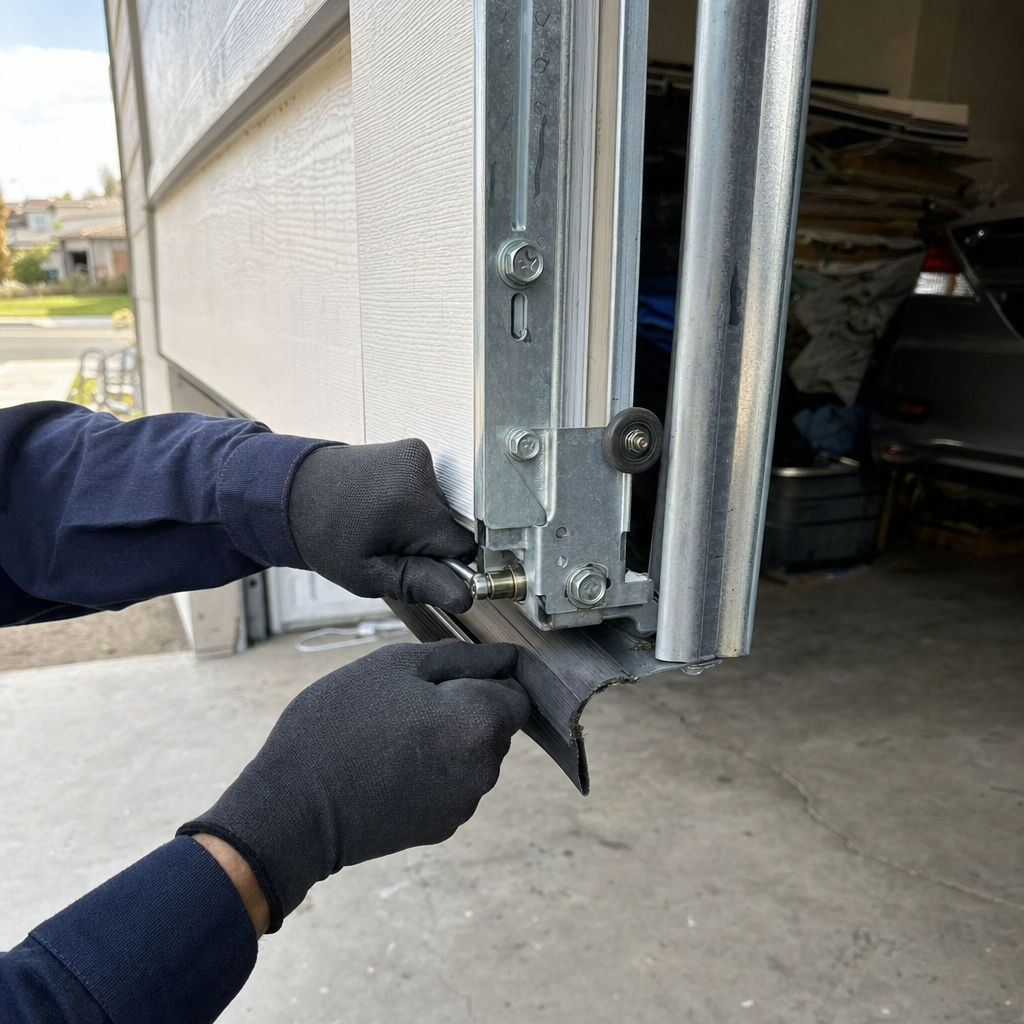
Bottom seal: The rubber or vinyl strip across the door bottom hardens, cracks, or separates from the retainer. In Los Angeles, UV exposure on south and west-facing doors degrades vinyl seals in three to four years. A failed seal lets water pool during rare heavy rains, which corrodes bottom hinges and lower panel edges. We replace seals with retainer-compatible EPDM rubber rated for UV and temperature cycling.
Track hardware: Lag bolts securing vertical tracks to the jamb loosen over decades of vibration. In the 1984 Northridge earthquake and smaller seismic events since, we’ve found track bolts sheared or backed out in garages throughout the San Fernando Valley. A wobbling track that isn’t bent may simply need bolt replacement and re-torquing to proper spec.
Hinge and roller stem corrosion: Coastal Los Angeles garages, particularly in older homes without sealed thresholds, develop hinge corrosion that isn’t visible until the hinge cracks during operation. We inspect hinge barrels and roller stems during every service call. Caught early, hinge replacement is preventive. Caught late, a failed hinge drops a panel, damages adjacent panels, and requires emergency repair.
Common Mistakes to Avoid
- Replacing the cable without inspecting the spring. The cable is the messenger. The spring is the message. We see this shortcut from handymen across Los Angeles who carry cables but not springs. The door works briefly. The real failure continues.
- Lubricating the track. Tracks are not lubricated surfaces. Oil on tracks collects dust and grit, creating abrasive paste that accelerates roller wear. Lubricate rollers, hinges, and spring bearings. Wipe tracks clean and dry.
- Ignoring a single loud pop. A torsion spring breaking sounds like a firecracker. Some homeowners don’t connect the sound to the door. They notice only that the opener strains. Running an opener with a broken spring burns out the motor. The repair bill doubles.
- Accepting a one-spring quote for a two-spring door. Any technician who proposes this is either untrained or cutting corners. Ask directly: “Are you replacing both springs?” If the answer is no, the answer is no.
- DIY spring replacement from online videos. The videos make winding bars look manageable. They don’t show the emergency room visits. In 42 years, we have seen two homeowners permanently injured attempting this. The savings are imaginary. The risk is real.
- Describing only the current symptom to the dispatcher. “The door won’t open” gets a standard repair truck. “The door won’t open, the opener hums, and I heard a loud pop yesterday” gets a truck with springs, cables, and opener gear kits. The second description saves a trip.
When to Call a Professional
Call when any diagnostic points to spring failure, when the door is off its tracks, when opener electrical components are suspect, or when you cannot identify the cause with confidence. Some problems are visible. Others hide behind symptoms that mislead even experienced homeowners.
We answer our phones personally, 24 hours a day. No voicemail, no phone tree, no after-hours service that routes to another state. A live person who knows garage doors will ask the right questions, note your description, and dispatch a technician with parts matched to what you described. Mainspring Garage Door Co. home offers free estimates throughout Los Angeles. Call (844) 755-5838. The price is stated before work begins. No surprises on the bill.
Frequently Asked Questions
Standard torsion spring replacement for a residential door in Los Angeles typically runs $200 to $400, including both springs, cables, and labor. Extension spring systems cost slightly less in parts but require additional safety cable installation. Call (844) 755-5838 for an exact quote on your door size and spring type. Estimates are free.
No. A two-spring door requires both springs replaced as a matched set. Uneven spring age creates uneven lift, premature cable wear, and opener strain. Any technician who offers a single-spring replacement is cutting corners at your expense.
The safety sensors are misaligned, obstructed, or failed. Check that both sensor LEDs glow steady. Clean the lenses. Remove any object blocking the beam path. If the problem persists, the sensors or wiring need replacement. This is not an opener motor problem.
Standard 10,000-cycle springs last 7 to 10 years with typical use. In coastal Los Angeles neighborhoods, salt air corrosion reduces lifespan by 20 to 30 percent. Inland areas with drier climate see longer service life. High-cycle springs rated for 25,000 or 50,000 cycles are available for doors with heavy use.
For openers under 10 years old with a single failed component, repair is usually economical. For openers over 12 years old, or with multiple component failures, replacement offers better long-term value. We evaluate both options and quote each. The decision is yours, with no pressure.
Door width and height, spring type (torsion or extension), opener brand and model number, and a clear symptom timeline. This lets us stock the truck correctly and complete most repairs in a single visit. Our standing offer of $50 off any repair over $250 applies to qualifying service calls.
The Bottom Line
Garage door troubleshooting is not about fixing what looks broken. It is about tracing symptoms to their source. A snapped cable means checking the spring. A binding door means distinguishing track, roller, and panel causes. A straining opener means testing door balance before blaming the motor. Run the three diagnostics. Describe problems with specifics. And when the repair involves stored energy, height, or electrical components, call a professional who arrives with the right parts, states the price upfront, and stands behind the work.
For homeowners in Los Angeles who want the job done right the first time, Garage Door Installation in Los Angeles and repair services from Mainspring Garage Door Co. come with the 90-Day Done Right Promise, live phone answering at any hour, and trucks stocked for same-visit completion. Garage Door Opener in Los Angeles service includes factory-familiar work on all major brands. Call (844) 755-5838 for a free estimate. We have been here since 1984. We will be here when you need us.
Written by the team at Mainspring Garage Door Co., serving Los Angeles since 2016.