
Last updated July 26, 2026
Garage Door Warning Signs: A Los Angeles Homeowner’s Reference Guide
A garage door that hesitates for half a second before closing is not “acting up.” It is telling you one of four specific things, three of which will cost under $150 to fix today and one of which will cost over $600 if you wait a month. After 42 years in this trade, we’ve learned that most garage door failures broadcast their arrival two to six weeks ahead of time. The problem is not that the signs are hidden. The problem is that Los Angeles homeowners misread them as annoyances rather than mechanical precursors. This guide will teach you to distinguish a cosmetic issue from a safety-critical one, so you call a technician before a spring snaps or a cable frays through.
Quick Answer
Most garage door failures in Los Angeles give two to six weeks of advance warning through specific sounds, movements, and visual changes. The critical warning signs are: grinding or squealing during operation, visible gaps in torsion springs, frayed or separated cables, a door that reverses before hitting the floor, and any sagging or uneven movement. A door showing any of these symptoms should be inspected immediately; continuing to operate it risks injury or sudden failure.
Table of Contents
- What Different Sounds Mean
- Visual Warning Signs Specific to Los Angeles Homes
- Movement and Reversal Problems
- How to Spot Cable Failure Before It Happens
- The Stop-Using-the-Door Threshold
- Seasonal Maintenance for LA’s Climate
- Common Mistakes to Avoid
- When to Call a Professional
- Frequently Asked Questions
What Different Sounds Mean
Your garage door is the largest moving object in your home. It is also one of the few mechanical systems that operates in plain sight and sound, which means it speaks plainly when something is wrong. The key is knowing what each sound points to.
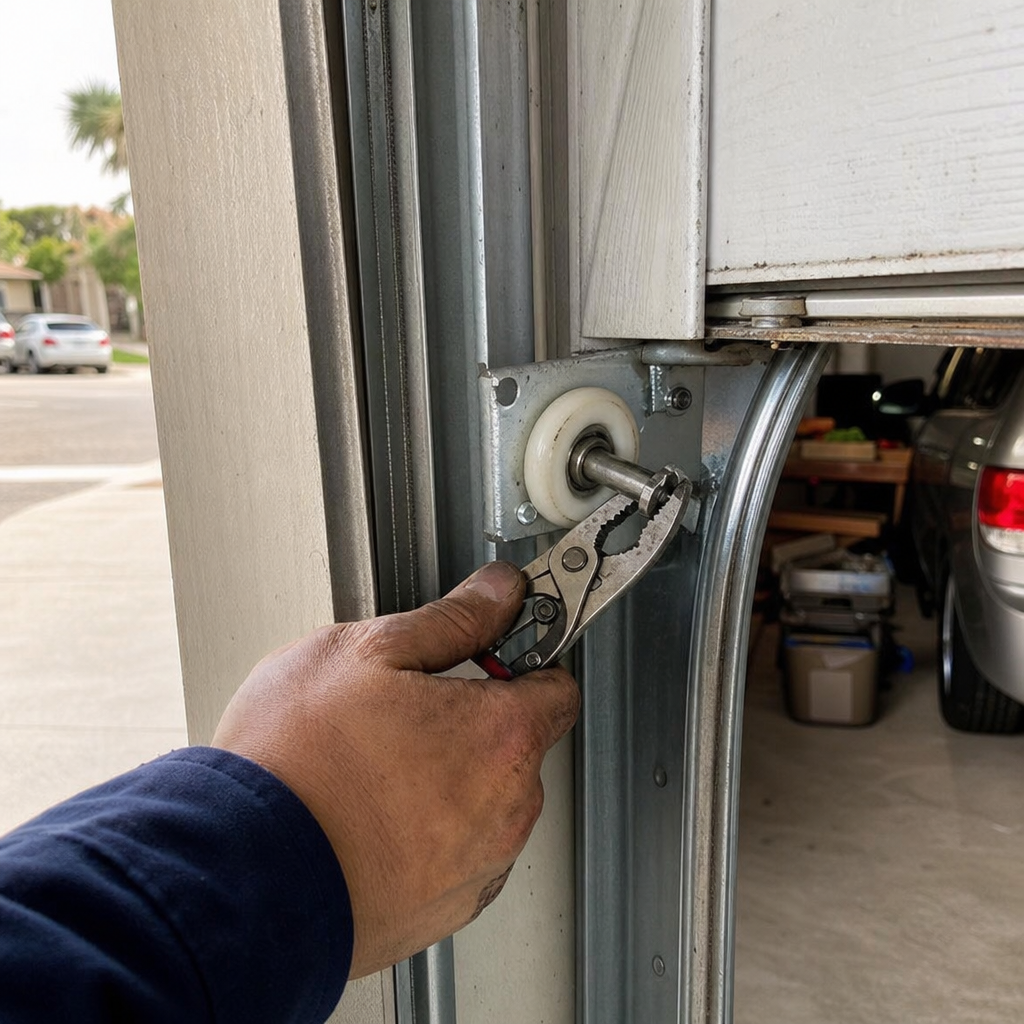
Grinding: A low, metallic grinding during opening or closing usually means the rollers are binding in the track or the opener’s drive gear is stripping. In Los Angeles, we see this most often in homes near the coast, where salt air accelerates track corrosion. Grinding that worsens over a week typically indicates metal-on-metal contact that will soon damage the track itself. A single visit to replace nylon rollers and clean the track runs $120-$180.
Squealing or screeching: High-pitched squealing almost always means dry rollers, dry hinges, or a dry torsion spring. It is the most common sound we hear on service calls, and it is the most commonly ignored. Homeowners in neighborhoods like Encino and Pasadena often tell us they have been hearing it for months. Squealing means friction is winning. Friction generates heat. Heat hardens nylon rollers and weakens spring steel. The fix is a $89 seasonal tune-up. The cost of waiting is replacement rollers at $15-$25 each plus premature spring failure at $180-$340.
Banging or popping: A single loud bang when the door opens or closes is often a broken spring winding cone slipping. A rhythmic popping as the door moves usually means a section hinge is failing or a roller is jumping the track. Both require stopping use immediately. A door with a compromised spring or derailed roller can drop without warning.
Clicking: Rapid clicking from the opener motor without door movement means the opener is receiving the command but cannot generate enough torque. This is frequently misdiagnosed as an opener problem when it is actually a door that has become too heavy due to a failing spring. We see this constantly in older Los Angeles homes with original single-spring setups. Replacing the opener without addressing the spring loads the new unit beyond its design capacity and voids the warranty on brands like LiftMaster and Chamberlain.
Silence where there used to be sound: A door that suddenly runs quieter is not a gift. It often means a spring has broken and the opener is now lifting the full weight of the door unassisted. The motor will overheat and fail within days or weeks.
| Sound | Likely Component | Typical Repair Cost in Los Angeles | Urgency |
|---|---|---|---|
| Grinding | Rollers, track, or drive gear | $120-$280 | Schedule within 1-2 weeks |
| Squealing | Dry rollers, hinges, or spring | $89 tune-up; $150-$250 if parts needed | Schedule within 2 weeks |
| Banging / popping | Spring winding cone or hinge failure | $180-$450 | Stop using; call same day |
| Clicking (opener only) | Opener overload due to spring failure | $180-$550 | Stop using; call same day |
| Sudden quiet | Broken spring overloading opener | $180-$340 | Stop using; call same day |
Visual Warning Signs Specific to Los Angeles Homes
Los Angeles presents a specific set of environmental stresses on garage doors. The combination of intense UV exposure, coastal salt air, occasional Santa Ana wind events, and the thermal cycling between 50°F winter mornings and 95°F summer afternoons creates failure patterns that differ from other markets.
Salt-air rust on torsion springs: Homes within three miles of the Pacific, from Malibu down through Playa del Rey and San Pedro, show a distinctive rust pattern on torsion springs. It begins as surface discoloration at the spring ends, where the coating is thinnest, and progresses to flaking that exposes bare steel. A spring with visible flaking rust has lost significant cross-sectional strength. We replace these proactively in coastal zones because the failure mode is sudden and violent. A standard torsion spring replacement in Los Angeles runs $180-$340 depending on door size and spring type.
UV-bleached nylon roller wheels: Nylon rollers exposed to direct afternoon sun through west-facing garage door windows or gaps turn from white or black to chalky gray. The UV degrades the polymer, and the wheels develop flat spots or cracks. A degraded roller increases drag on the opener and can shatter under load, dropping the door onto the track. In our experience, west-facing doors in the San Fernando Valley need roller inspection every three years, not the five-year interval that suffices for shaded installations.
Weatherstrip shrinkage and hardening: The bottom rubber seal and perimeter vinyl weatherstripping on Los Angeles garage doors hardens and shrinks faster than in milder climates. A gap of even 3/8 inch at the bottom corner admits dust, rodents, and during rare rain events, water that pools and rusts the bottom section from the inside. We stock replacement weatherstrip in common profiles and can replace it in a single visit for $85-$150.
Panel bowing from thermal stress: Steel doors in direct sun can reach 140°F surface temperature. Over years, this causes the top section to bow slightly outward, stressing the upper hinges and opener attachment. A bowed top section is visible when the door is closed and the top edge no longer meets the header seal evenly. This is not cosmetic. It indicates structural fatigue that will eventually crack the section at the hinge points.
Track mounting bracket loosening: The expansion and contraction of steel track against wood or stucco framing works fasteners loose over time. Look for gaps between the track bracket and the wall, or brackets that have rotated slightly. In hillside construction common to Los Feliz and the Hollywood Hills, foundation settling accelerates this. A loose track bracket allows the track to shift, and a shifted track causes the door to bind, which overloads the opener.
Movement and Reversal Problems
A properly functioning garage door moves smoothly and predictably. Any deviation from this pattern is a signal, and some signals are safety-critical.
Hesitation at the start of travel: When you press the button, the door should begin moving within one second. A hesitation of two seconds or more, or a stutter-start where the door moves an inch and stops, indicates one of four problems: opener force settings are mis-calibrated, a spring has lost tension, rollers are binding, or the opener’s capacitor is failing. Three of these are under $150 to address. A failing capacitor left unaddressed will burn out the motor, turning a $95 part into a $450-$650 opener replacement.
Reversal before reaching the floor: A door that reverses when it encounters no obstruction is not “sensitive.” It is mis-calibrated, and the mis-calibration is a UL 325 safety violation. The UL 325 standard, which governs all residential garage door openers sold in the United States, requires that the door stop and reverse within 2 seconds of contacting an obstruction. If the door reverses on its own, the close-force setting is too low, often because the door has become heavier due to spring degradation. The homeowner’s impulse is to increase the force setting. This is dangerous. It overrides the safety system and can crush an object or person without reversing. The correct response is to have the door’s balance and the opener’s force settings checked by a technician.
Uneven movement or sagging on one side: A door that appears lower on the left or right as it moves, or that shimmies side-to-side, has a problem with the cable system or a broken spring on one side of a dual-spring setup. This is one of the most dangerous conditions. The door is unsupported on one side and can twist in the track, jam completely, or fall. Stop using the door immediately.
Slow operation: A door that takes noticeably longer to open or close than it did when new is working harder. The opener’s motor is drawing more current and generating more heat. In Los Angeles, where garages often serve as workshops or storage for temperature-sensitive items, a slow door is also a sign that the thermal barrier (weatherstrip, insulation) may be compromised, forcing the opener to work against temperature differentials.
Steps to diagnose movement problems safely:
- Disconnect the opener by pulling the red emergency release cord with the door fully closed.
- Lift the door manually to waist height. It should stay in place with minimal effort. If it falls or feels heavy, the spring system is compromised. Do not reconnect the opener. Call a technician.
- If the door stays at waist height, raise and lower it slowly, listening for binding or rough spots.
- Inspect the cables for fraying or separation while the door is at waist height (see next section).
- Reconnect the opener only if the door passes all manual tests. If you are uncertain, leave it disconnected and call for service.
How to Spot Cable Failure Before It Happens
Garage door cables are the secondary safety system. If a spring breaks, the cables are supposed to catch the door and prevent it from crashing down. A cable that fails while the door is in motion drops hundreds of pounds without warning. The good news is that cables announce their deterioration clearly if you know what to look for.
Inspection from the couch: With the door fully closed, stand inside the garage and look at the cables that run vertically alongside the door. Healthy cable has a tight, uniform twist with no visible gaps between strands. What you are looking for is “meat-hooking” - individual strands that have broken and protrude outward from the cable body like the barbs on a meat hook. Even a single meat-hook indicates that the cable has begun to unlay internally. We replace cables at this stage. Waiting for visible fraying or separation risks sudden failure.
Inspection at waist height: When you perform the manual lift test described above, pause at waist height. The cables are under reduced tension at this position, which makes damage easier to see. Look for rust staining on the cable, which indicates internal corrosion, and for flat spots where the cable has kinked around a pulley. A kinked cable has lost structural integrity and will break at the kink under load.
The cable-drum check: At the top of the door frame, the cables wrap around drums that are keyed to the torsion bar. A cable that is not seated properly in the drum grooves, or that overlaps itself, has been installed incorrectly or has slipped due to improper tension. This is not a homeowner repair. The torsion bar stores lethal energy and requires proper winding bars and training.
Los Angeles-specific cable issues: In coastal zones, we see accelerated cable corrosion from salt air even on galvanized cables. In the hotter inland valleys, from the San Fernando Valley to the Inland Empire border, high garage temperatures degrade the lubricant on cable pulleys, causing the cables to saw back and forth against dry sheaves. This creates a distinctive sawing mark on the cable that precedes failure by weeks.
Cable replacement in Los Angeles typically costs $140-$220 including labor, and we complete it in a single visit with cables stocked on our trucks. A cable that fails and drops the door can damage the door sections, the track, and anything beneath it. The cost of proactive replacement is minor compared to the cost of reactive repair.
The Stop-Using-the-Door Threshold
There are three specific conditions where continuing to operate a garage door creates genuine injury risk. These are not suggestions. These are hard stops.
Condition one: visible gap in a torsion spring. A torsion spring with a visible gap, even a small one, has broken internally. The remaining intact coils are carrying double their designed load. The next operation of the door can cause the remaining spring to release catastrophically. The sound of a breaking torsion spring is often compared to a gunshot. The released energy can damage property and cause serious injury. If you see a gap, do not touch the spring, do not pull the release cord, and do not operate the door. Call a technician.
Condition two: frayed or separated cable with the door open. A cable that has begun to unlay or shows multiple meat-hooks is in countdown. If the door is open when this cable fails, the door falls. If you are beneath it or near it, you are in the fall zone. The only safe response is to leave the door where it is, clear the area, and call for emergency service. Do not attempt to lower the door manually. The uneven load distribution makes manual lowering unpredictable.
Condition three: door that has come out of the track. A door with even one roller out of the track is structurally unstable. The track is part of the load-bearing system. With a roller disengaged, the door can twist, fold, or drop. We have seen homeowners try to “guide” a derailed door back into operation by hand. This is how fingers and wrists get crushed. The correct response is to block the door from being used by others, disconnect the opener if it can be done safely from a distance, and call for service.
These three conditions are why garage door repair in Los Angeles includes 24/7 emergency response. A door in any of these states is not a tomorrow problem. It is a today problem.
Seasonal Maintenance for LA’s Climate
Los Angeles’s climate is forgiving in many ways, but the specific stresses of UV, salt air, and thermal cycling reward proactive maintenance. A $89 seasonal tune-up prevents the majority of the failures described in this guide.
What a proper tune-up includes:
- Spring tension balance test and adjustment
- Roller inspection and lubrication with silicone-based compound (not WD-40, which attracts dust)
- Track alignment check and debris removal
- Cable inspection for meat-hooking, kinking, and corrosion
- Opener force and limit setting verification against UL 325 standards
- Weatherstrip condition assessment and replacement if needed
- Hinge and hardware torque check
- Safety sensor alignment and obstruction test
Timing for Los Angeles: We recommend tune-ups in early October, before the Santa Ana wind season, and in early April, after the winter rain period. The October service ensures the door is ready for increased holiday use and any storm-related power cycling. The April service addresses any moisture intrusion from winter rains, which is particularly relevant for homes in canyon areas where drainage can back into garages.
DIY maintenance that is safe and useful: Homeowners can perform visual inspection of cables and springs monthly, test the safety reversal system by placing a 2×4 flat on the floor in the door’s path, and keep the track free of accumulated dust and debris. Do not attempt to adjust spring tension, replace cables, or modify opener force settings. These tasks involve stored energy and calibrated safety systems that require training and proper tools.
Mainspring’s $89 Seasonal Tune-Up includes all items listed above and is available year-round. We also offer a standing 5% discount for seniors and veterans.
Common Mistakes to Avoid
- Ignoring a change in sound because “it’s always done that.” A garage door does not develop new sounds without mechanical cause. The grinding you noticed last month is not character. It is wear.
- Adjusting opener force settings to compensate for a heavy door. This overrides UL 325 safety protection and creates crush hazard. The door is heavy because the spring system needs service, not because the opener needs recalibration.
- Using WD-40 on rollers and hinges. WD-40 is a solvent and light penetrant, not a lubricant. It evaporates and leaves a sticky residue that collects Los Angeles dust and grit, accelerating wear. Use silicone-based garage door lubricant only.
- Waiting for “both springs to go” before replacing. Dual-spring systems are designed with matched springs. When one fails, the remaining spring is overloaded and fatigued. Replace springs in pairs.
- Assuming a slow door is “just getting old.” Garage doors do not slow with age. They slow with increased friction, degraded rollers, or failing springs. Each of these is repairable and will cost less today than next month.
- Neglecting to test safety sensors after any landscaping or driveway work. In Los Angeles, where outdoor renovation is constant, bumped sensors are a leading cause of reversal problems. A simple alignment check takes 30 seconds.
- Choosing the lowest bid for spring replacement without verifying spring specification. An underspecified spring (wrong wire size, wrong length, wrong wind) will fail prematurely and can damage the door. We specify springs by door weight, cycle life, and wind direction, and we guarantee the specification in writing.
When to Call a Professional
Call a technician same-day if your door shows any of the three stop-use conditions above, if it reverses unpredictably, if it has come out of the track, or if you hear a loud bang during operation. Call within 48 hours for new grinding or squealing, visible rust on springs, slow operation, or any change in movement pattern.
When you call, describe the symptom specifically. “It makes a grinding sound when it starts moving” gets you a faster, more accurate diagnosis than “it’s acting weird.” A reputable company will ask follow-up questions and give you a rough sense of whether the issue is urgent.
Mainspring Garage Door Co. offers free estimates in Los Angeles. Our phones are staffed by a live person 24/7, including nights, weekends, and holidays. Most repairs are completed in a single visit because our trucks carry springs, cables, rollers, and openers from major brands including LiftMaster, Chamberlain, and Genie. Every job is covered by our 90-Day Done Right Promise: if it’s not right, we come back at no charge, in writing, with no dispute process. Call (844) 755-5838.
Frequently Asked Questions
Most common repairs in Los Angeles range from $120 for roller replacement to $340 for torsion spring replacement, with opener repairs typically falling between $150 and $450 depending on the issue. We provide upfront flat pricing before any work begins, and we offer $50 off any repair over $250. Call (844) 755-5838 for a free estimate.
No. Torsion springs store lethal amounts of energy and require specialized winding bars, training, and safety equipment. Attempting DIY spring replacement causes hundreds of serious injuries annually. We do not provide step-by-step instructions for this task because the risk is not proportional to the cost savings. A professional spring replacement in Los Angeles is typically completed in under 90 minutes.
The close-force setting on your opener is mis-calibrated, usually because the door has become heavier due to spring degradation. Increasing the force setting yourself overrides UL 325 safety protection and creates a crush hazard. The correct fix is to have a technician rebalance the door and recalibrate the opener. This typically costs $150-$250.
We recommend professional service every 12 months, with a second inspection before the Santa Ana wind season if your door faces west or is exposed to coastal air. The $89 Seasonal Tune-Up includes full inspection, lubrication, and safety testing. Homes within two miles of the Pacific may need cable and spring inspection every six months due to accelerated corrosion.
For doors under 15 years old with isolated component failure, repair is almost always more economical. A single spring replacement at $180-$340 or roller replacement at $120-$180 extends service life significantly. Replacement becomes the better value when the door has multiple failed components, structural damage to sections, or outdated safety features. We offer free second opinions on any written replacement estimate.
Yes. Mainspring stocks springs, cables, rollers, and openers on every service truck, and most repairs are completed in a single visit. For emergency conditions, a broken door, or a door that is stuck open or closed, we prioritize same-day response throughout Los Angeles. Call (844) 755-5838, and a live person will schedule you.
The Bottom Line
Your garage door speaks before it fails. The grinding, the hesitation, the visible rust, the slight sag, these are not annoyances. They are the vocabulary of a mechanical system under stress. Learning to read these signs correctly, distinguishing a $89 tune-up problem from a stop-using-the-door emergency, protects your safety and your wallet. In Los Angeles’s specific climate of UV, salt air, and thermal cycling, proactive attention pays particular dividends. The homeowners who call us at the first change in sound or movement are the ones who never experience a door crashing down or an opener burning out. The ones who wait are the ones who pay for the lesson.
If your door is showing any of the warning signs in this guide, or if you are uncertain whether a symptom is serious, call for a free estimate. A trained eye on the hardware takes five minutes and removes the doubt.
Mainspring Garage Door Co.
(844) 755-5838
Free estimates. Live person, 24/7. Most repairs in a single visit.
Written by the team at Mainspring Garage Door Co., serving Los Angeles since 2016.