
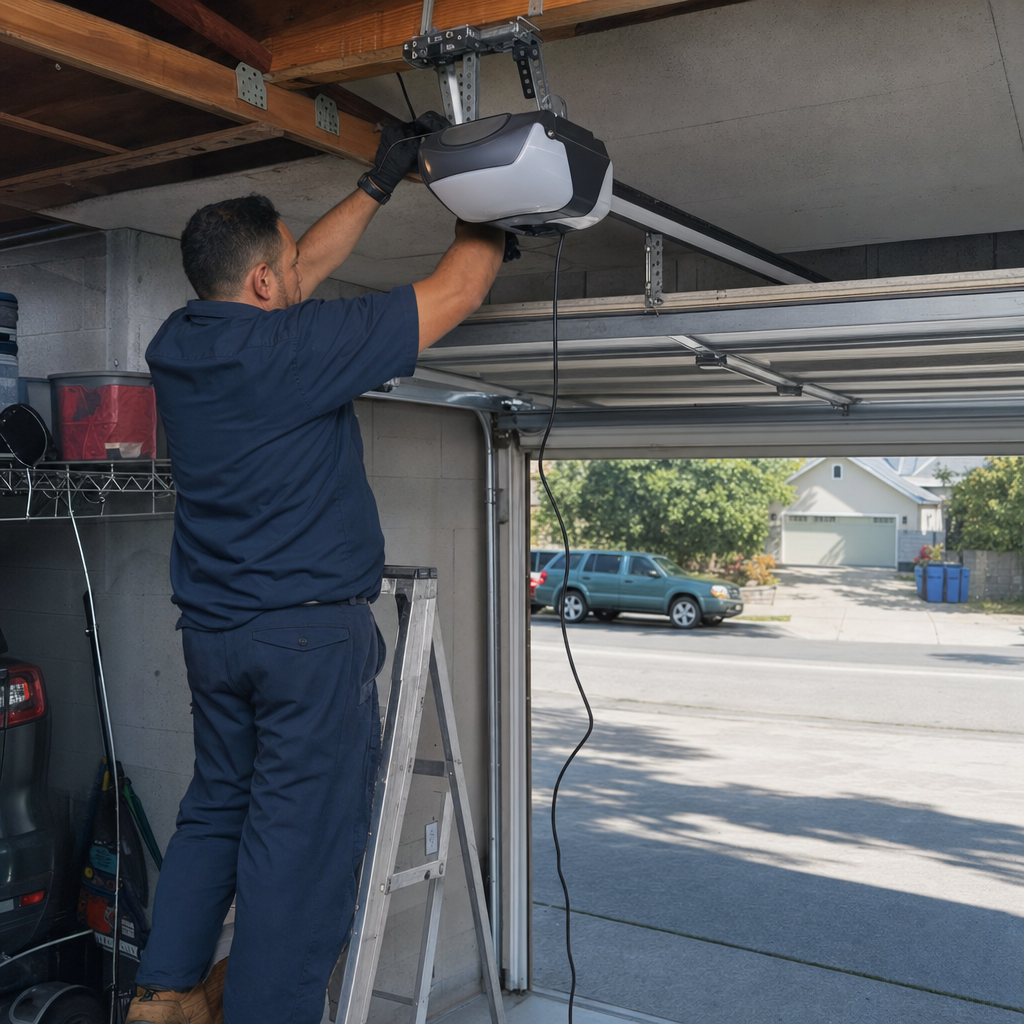
Last updated July 26, 2026
DIY vs Professional Garage Door: The Los Angeles Homeowner’s Decision Guide
Torsion springs on a standard double-car garage door store roughly 10,000 foot-pounds of mechanical energy. That’s enough force to launch a 15-pound weight across a room, or to break a wrist, dislocate a shoulder, or send a stepladder through the drywall behind you. We’ve responded to calls in Sherman Oaks and Silver Lake where a homeowner’s Saturday project turned into an emergency room visit by Sunday morning. This guide draws a clear line: which garage door tasks a competent Los Angeles homeowner can safely own, and which ones require a trained technician with the right tools and the right insurance. The decision isn’t about whether you’re handy. It’s about which jobs carry injury risk from stored energy, and which California code provisions make self-installation a liability when you eventually sell.
Quick Answer
Most Los Angeles homeowners can safely handle lubrication, photo-eye cleaning, remote programming, and cosmetic hardware tightening. Any work involving torsion springs, lift cables, door panels under load, or structural track modification should be done by a professional. Self-installation of a new door in California can void the manufacturer warranty and complicate permit inspection at resale, particularly in LA’s condo and shared-wall housing stock.
Table of Contents
- The Stored Energy Problem: What Makes Garage Doors Dangerous
- Tasks You Can Safely Do Yourself
- Tasks You Should Never Attempt Without Training
- Real Cost Comparison: Spring Replacement DIY vs. Professional
- Opener Installation: The One DIY Project With a Catch
- How LA’s Dense Housing Changes the Risk Calculus
- California Code, Permits, and Resale Liability
- Common Mistakes to Avoid
- When to Call a Professional
- Frequently Asked Questions
The Stored Energy Problem: What Makes Garage Doors Dangerous
A garage door is a counterweighted system. The springs do the heavy lifting, not the opener. The opener’s job is to nudge a balanced door along its tracks. The springs carry the full weight, and they do it under tension.
There are two spring types in Los Angeles homes. Extension springs run parallel to the horizontal tracks and stretch to store energy. Torsion springs mount on a steel shaft above the door and twist to store energy. Torsion systems are more common in newer LA construction and on heavier doors. Both are dangerous. Torsion springs are more dangerous.
When a spring breaks, it releases its stored energy instantly. A torsion spring can unwind with enough torque to snap a winding bar or send a tool flying. We’ve seen the aftermath in homes from Venice to Pasadena: bent tracks, cracked drywall, and injuries that happened in the split second someone thought the spring was “mostly” unwound.
The danger isn’t limited to springs. Lift cables are under the same tension. A frayed cable that snaps during adjustment can lash like a whip. A door panel removed without proper support can drop its full weight on hands or feet. The hardware itself, properly maintained, is safe. The hardware under tension, improperly handled, is not.
This is why we evaluate every task on two criteria: is stored energy involved, and is a mistake reversible? If the answer to the first is yes, or the answer to the second is no, the task belongs to a professional.
Tasks You Can Safely Do Yourself
These jobs involve no stored energy and no structural load. A mistake here is annoying, not dangerous.
Lubrication and Cleaning
Apply silicone-based spray lubricant to the rollers, hinges, and bearing plates every six months. In Los Angeles, the dry Santa Ana wind seasons pull moisture from metal surfaces and accelerate wear. We see more squeak complaints in October and March than any other months. Avoid WD-40 for this; it attracts dust and gums up the works. Use a product rated for garage door hardware.
Clean the photo-eye sensors with a soft cloth. These sit four to six inches off the ground on either side of the door and can misread when coated with dust or spiderwebs. In hillside neighborhoods like Laurel Canyon and Echo Park, where dust settles heavily, monthly cleaning prevents phantom reversals.
Remote and Keypad Programming
Programming a new remote or wireless keypad to your opener is a straightforward process that varies by manufacturer. For LiftMaster and Chamberlain units, the “Learn” button is typically on the motor housing. Press it, then press the remote button within 30 seconds. For Genie systems, the sequence differs slightly. Consult your owner’s manual; if you’ve lost it, manufacturer websites host PDFs by model number.
Cosmetic Hardware Tightening
Check visible bolts on the tracks and brackets with a socket wrench. Do not touch the spring anchor bracket, the cable drums, or the torsion hardware. Tighten only what is clearly decorative or structural but unloaded. If a bolt resists or the bracket moves, stop. That’s a sign of load-bearing hardware.
Visual Inspection
Look for these warning signs during your monthly check:
- Frayed or rusted lift cables
- Gaps in torsion or extension springs
- Bent or misaligned track sections
- Worn or cracked rollers
- Loose or separated door panels
If you spot any of these, call a professional. Do not attempt repair.
Tasks You Should Never Attempt Without Training
These jobs involve stored energy, structural load, or both. The cost of a mistake is injury or significant property damage.
Torsion Spring Replacement
This is the most dangerous routine job in residential maintenance. Winding a torsion spring requires two winding bars inserted into the cogs of the winding cone. The bars must be the correct diameter and inserted fully. A partial insertion, a slipping bar, or a miscounted turn can release the full spring torque instantly.
We carry four sizes of winding bars on every truck because using the wrong size, or substituting a screwdriver, is how most injuries happen. The correct spring must also be matched precisely by wire gauge, inside diameter, and length. An incorrect spring will fail prematurely or overstress the opener.
Lift Cable Replacement
Cables are under the full door weight when the door is open or partially open. Replacing a cable requires securing the door in the fully open position with locking pliers on the track, then releasing tension from the spring system. In our experience, most homeowners who attempt this either fail to secure the door adequately or release tension incorrectly.
Structural Panel Replacement
A steel or wood panel on a sectional door is held in place by the load of the entire door assembly. Removing a panel without supporting the remaining sections causes the door to rack, bind, or drop. In Los Angeles, where many homes have converted garages or custom doors with non-standard panel sizes, panel replacement often requires temporary bracing that homeowners don’t have on hand.
Track Modification or Realignment
Vertical and horizontal tracks must be parallel within a quarter-inch and plumb within precise tolerances. A misaligned track causes the door to bind, accelerates roller wear, and can throw the door off the track entirely. Track work requires a level, specific spacing tools, and the knowledge to shim without overconstraining the assembly.
Real Cost Comparison: Spring Replacement DIY vs. Professional
Homeowners often ask us whether spring replacement is worth the professional cost. Here’s the actual math for a standard torsion spring replacement on a double-car door in the Los Angeles market.
DIY path:
- Spring pair (correctly matched): $80-$140
- Winding bars (proper steel, correct diameter): $25-$40
- C-clamps or locking pliers: $15-$25
- Socket set if not owned: $30-$60
- Total outlay: $150-$265
Professional path in Los Angeles:
- Typical torsion spring replacement: $220-$380
- Includes correct spring, installation, balance test, safety reverse check, and written warranty
The nominal savings of DIY is $55-$230. But this ignores the probability-weighted cost of error. In our 42 years, we’ve been called to correct DIY spring jobs roughly three times per year. The typical correction costs $340-$520 because the homeowner damaged the cable drums, bent the shaft, or installed the wrong spring and burned out the opener.
More critically, a torsion spring injury in Los Angeles carries emergency room costs averaging $3,200-$8,500 before any surgical intervention. The probability of injury for an untrained person attempting their first torsion spring replacement is difficult to quantify precisely, but our field data and industry safety studies suggest it is not negligible. When we factor in the time value of learning the procedure, the tool acquisition, and the risk-adjusted cost of error, the professional route is the economical choice for nearly every homeowner.
Our Garage Door Repair in Los Angeles service includes spring replacement with the 90-Day Done Right Promise. If the balance is off or a noise develops, we return at no charge. No paperwork, no dispute.
Opener Installation: The One DIY Project With a Catch
Of all garage door work, opener installation is the most reasonable DIY project for a competent homeowner. The stored energy is minimal; the opener motor does not interact with the spring system directly. But there are two sub-tasks where DIY crosses into hazard territory.
What You Can Reasonably Do
Mounting the opener motor to the ceiling bracket, assembling the rail, attaching the trolley, and connecting the door arm are within reach of most homeowners with a drill, a ladder, and patience. Programming remotes and setting travel limits are straightforward for major brands like LiftMaster, Chamberlain, and Craftsman.
Where DIY Becomes Dangerous
Spring tension verification: Every opener installation manual requires verifying that the door is properly balanced before connecting the opener. A door that is too heavy for the springs will overwork and prematurely fail the opener. Testing balance requires disengaging the opener and lifting the door manually to the halfway point. If it drifts up or down, the springs need adjustment. Spring adjustment is not a DIY task.
Safety reverse calibration: Federal law since 1993 requires all automatic openers to reverse when encountering resistance and to have a secondary entrapment protection system, typically photo eyes. Calibrating the force sensitivity and verifying the photo-eye alignment requires specific testing procedures. An incorrectly calibrated opener can close on a person, pet, or vehicle. In California, an improperly calibrated opener is a liability issue and may fail inspection in a home sale.
Our Garage Door Opener in Los Angeles installation includes full spring balance verification, safety reverse testing, and written documentation for your records.
How LA’s Dense Housing Changes the Risk Calculus
Los Angeles has the highest percentage of renters and the densest housing stock of any major Western metro. This changes the garage door risk equation in three specific ways.
Shared-wall and condo construction: In buildings from Koreatown to Downtown LA, garage doors share structural walls with neighboring units. A door that comes off its track or drops a panel can damage not just your property but a neighbor’s. Liability for that damage falls to the person who performed the work. Professional technicians carry general liability and workers’ compensation insurance that covers this exposure. A homeowner’s policy may not cover DIY work that damages adjacent units.
Zero-lot-line homes: In neighborhoods like Mar Vista and Atwater Village, garages sit directly on property lines with inches of clearance. A door that binds or fails to close fully creates a security exposure that is immediately apparent to the street. We’ve responded to after-hours calls where a DIY track adjustment left a door that wouldn’t seal, and the homeowner couldn’t leave it overnight.
Hillside foundations and settling: LA’s expansive clay soils and seismic activity cause foundations to shift. A door that was properly aligned five years ago may now bind in its tracks. The correction often requires track modification, which in turn requires understanding whether the foundation shift is ongoing or stabilized. We assess this on every call in hillside areas from Pacific Palisades to Mount Washington.
California Code, Permits, and Resale Liability
California’s building code governs garage door installation more tightly than most homeowners realize. This matters most when you sell.
New garage door installations in California require compliance with Title 24 energy efficiency standards. Doors must meet specific insulation and air-sealing requirements, particularly if the garage is attached to conditioned living space. Most manufacturers label compliant doors clearly. A self-installed door without documentation may not pass the buyer’s inspection.
Permit requirements vary by municipality within Los Angeles County. The City of Los Angeles requires permits for new door installations and for structural modifications to the opening. Some smaller cities in the county defer to state code but require inspection on sale. A door installed without required permitting becomes a disclosure item and can delay or derail a transaction.
Manufacturer warranties are increasingly conditional on professional installation of garage door parts. Clopay, Amarr, and Wayne Dalton all specify that warranty coverage requires installation by a factory-authorized or trained technician. A homeowner-installed door carries no warranty protection against panel defects, hardware failures, or insulation degradation.
For new door installations, our Garage Door Installation in Los Angeles service handles permitting, inspection scheduling, and warranty registration. The work is documented and transferable to the next owner.
Common Mistakes to Avoid
- Using the wrong spring: A spring matched only by door weight, without considering cycle life rating and wire gauge, will fail in months rather than years. In Los Angeles, where doors cycle more frequently due to smaller lot sizes and alley access, cycle life matters.
- Disconnecting the opener without securing the door: The manual release cord disengages the trolley but does nothing to hold the door open. A door left unsecured will drop.
- Ignoring the photo-eye height requirement: California code requires photo eyes no higher than six inches from the floor. Homeowners who remount them higher to avoid damage from garage storage create a child-safety hazard and a code violation.
- Over-tightening track bolts: Tracks need slight float to accommodate door movement. Over-tightening binds the rollers and accelerates wear.
- Installing a new opener on an unbalanced door: This is the most common cause of premature opener failure we see. The opener strains, overheats, and burns out its motor or logic board.
- Working alone: Even for “safe” tasks, a second person provides stability on the ladder and can call for help. We’ve responded to calls in the Hollywood Hills where a homeowner was injured and unable to reach a phone.
When to Call a Professional
Call a professional when the job involves stored energy, structural load, code compliance, or warranty protection. Specifically: broken springs or cables, bent tracks, door off-track, panel replacement, new door installation, opener installation if spring balance is uncertain, and any situation where the door is stuck open or stuck closed.
In Los Angeles, same-day response matters. A door stuck open in a neighborhood with alley access creates immediate security exposure. A door stuck closed traps vehicles inside during fire season evacuation warnings. Mainspring Garage Door Co. answers every call with a live person, 24/7, including nights, weekends, and holidays. Most repairs are completed in a single visit because our trucks carry springs, cables, openers, and hardware for all major brands.
We offer free estimates, more guides & resources, a free second opinion on any written estimate from another company, and the 90-Day Done Right Promise on every completed job. If it’s not right, we make it right. No paperwork, no arguing, in writing. Call (844) 755-5838.
Frequently Asked Questions
Professional torsion spring replacement for a standard residential door in Los Angeles typically runs $220-$380, including parts, labor, balance testing, and a written warranty. Extension spring systems cost slightly less. Call (844) 755-5838 for an exact quote on your door; estimates are free.
Torsion springs should always be replaced as a matched pair. Even if only one is broken, the unbroken spring has cycled the same number of times and carries the same fatigue. Replacing one guarantees the second will fail soon after, likely at an inconvenient time. A matched pair ensures even lift and balanced wear.
DIY opener installation is legal for homeowners working on their own residence. However, the installation must comply with federal safety standards for force limitation and entrapment protection, and it must be disclosed to buyers at sale. Professional installation includes documentation that satisfies inspection and protects resale value.
Warning signs include a door that feels heavier to lift manually, visible gaps in the spring coils, a door that opens unevenly or jerks during travel, and an opener that strains or slows. In coastal Los Angeles neighborhoods like Santa Monica and Playa del Rey, salt air accelerates spring corrosion. Inspect monthly for rust.
Yes. Our technicians are factory-familiar with LiftMaster, Chamberlain, Genie, Clopay, Amarr, Wayne Dalton, Craftsman, and Raynor. We carry common parts for all major brands on our trucks and can source specialty components when needed.
If any completed repair or installation is not right, Mainspring returns at no charge to correct it. The promise is stated in writing on every job. There is no dispute process, no paperwork to file, and no expiration other than the 90-day term. We stand behind the work because we intend to do it correctly the first time.
The Bottom Line
The garage door DIY question is not about whether you are capable. It is about which tasks carry injury risk from stored mechanical energy, and which California provisions make self-work a liability. Lubrication, cleaning, remote programming, and cosmetic tightening are safe and sensible for homeowners. Spring replacement, cable work, panel replacement, and structural track modification are not. Opener installation sits in the middle: reasonable for the mechanical assembly, hazardous for the spring balance verification and safety calibration. When in doubt, the cost of a professional call is modest compared to the cost of an error. In a city where your garage door is both security barrier and daily access point, doing it right matters more than doing it yourself.
Written by the team at Mainspring Garage Door Co., serving Los Angeles since 2016.
Mainspring Garage Door Co. home | Call (844) 755-5838 for a free estimate.