
Last updated July 26, 2026
Garage Door Repair Troubleshooting: Common Problems and How to Fix Them
Here is a fact that saves most homeowners in Los Angeles an unnecessary service call: a door that reverses before it hits the floor is almost never a sensor problem. In our 42 years of running service calls across the San Fernando Valley to the South Bay, we have traced that symptom to a failing torsion spring nine times out of ten. The opener hits its force limit, assumes it hit an obstruction, and backs up. Replace the sensors and the reversal continues. This guide teaches you to work backward from symptom to root cause, the way our technicians actually diagnose a door on site. You will learn the mechanical chain that connects every part, the five problems homeowners misdiagnose most often, and how to tell a safety stop from a watch-and-wait situation before you pick up the phone.
Quick Answer
Most garage door problems stem from one of three systems: the spring assembly that carries the weight, the opener that provides motive force, or the track and roller hardware that guides the path. Start every diagnosis with a manual balance test: disconnect the opener, lift the door halfway, and release. If it drifts down, the springs are failing. If it stays put but the opener still struggles, the motor or drive system is suspect. If it binds or tilts, the tracks or rollers are out of alignment. This single test eliminates half of all guesswork.
Table of Contents
- How a Garage Door System Actually Works
- The Five Most Commonly Misdiagnosed Problems
- The Balance Test: Your First Diagnostic Tool
- Symptom-by-Symptom Troubleshooting Guide
- Safety Stops vs. Monitor-and-Schedule Situations
- How to Describe Symptoms When You Call a Technician
- Common Mistakes to Avoid
- When to Call a Professional
- Frequently Asked Questions
- The Bottom Line
How a Garage Door System Actually Works
A garage door is not a collection of independent parts. It is a mechanical chain where every link depends on the others. Understanding this chain is what separates a quick, permanent fix from a round of symptom-chasing that leaves the real failure in place.
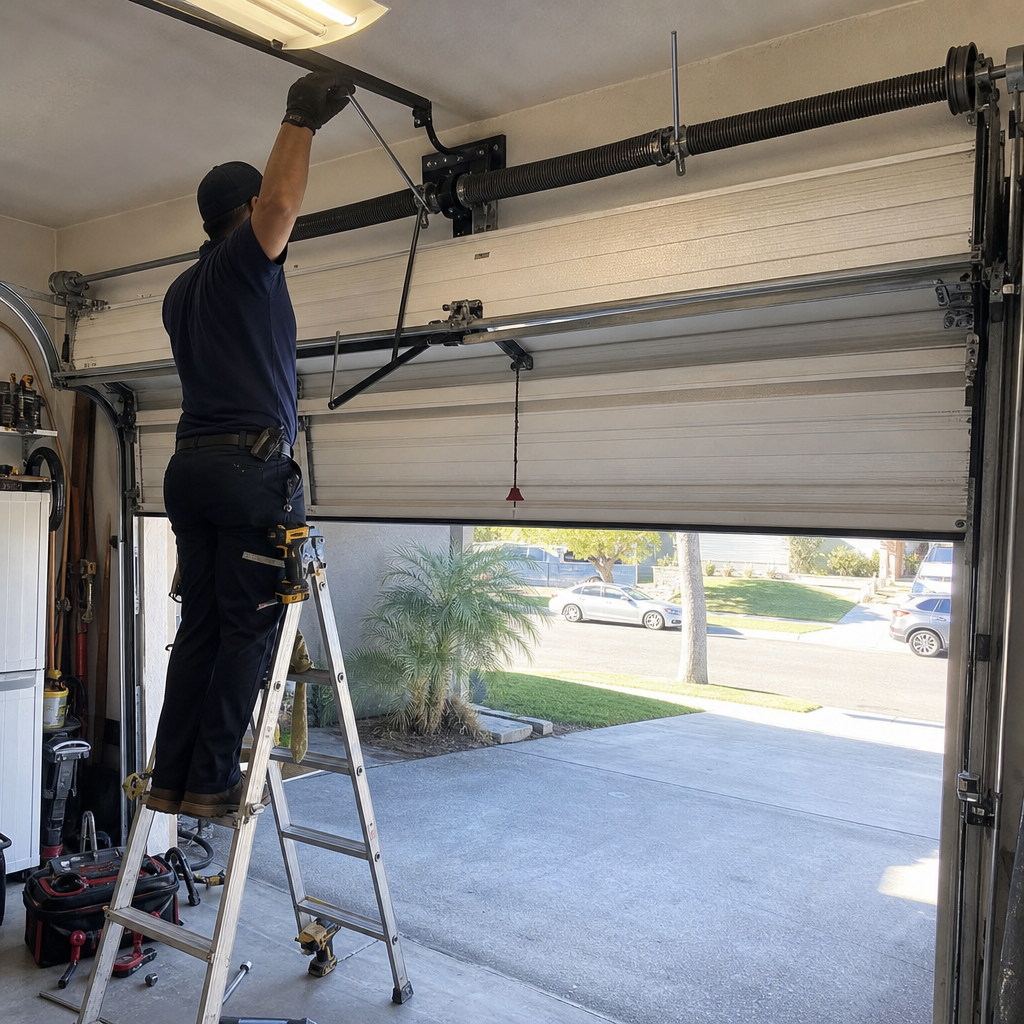
The weight-bearing link: Torsion springs mounted above the door, or extension springs running parallel to the horizontal tracks, carry the full weight of the door. A standard 16-foot steel panel door in a Los Angeles tract home weighs between 150 and 250 pounds. The springs, not the opener, hold that weight. When springs are properly tensioned, you should be able to lift the door with one hand. When they weaken, the opener strains, parts wear unevenly, and safety systems trigger false positives.
The motive link: The opener, whether a chain-drive Craftsman from the 1990s or a current belt-drive LiftMaster, adds controlled force to move the door along its path. It is designed to operate a balanced load, not to wrestle an overweight door. Opener force settings are calibrated in newtons or arbitrary force units, and they have hard limits. Exceed those limits, and the opener assumes an obstruction.
The guidance link: Tracks, rollers, hinges, and cables keep the door vertical and square as it travels. A single bent track section or seized roller increases friction enough to make a healthy opener struggle. In coastal Los Angeles neighborhoods like Venice or San Pedro, salt air accelerates roller bearing corrosion. In the hotter inland valleys, thermal expansion can subtly shift track alignment over seasons.
The safety link: Photo-eye sensors, edge sensors, and force-limiting logic exist to protect people and property. They are the last line of defense, not the first explanation for every malfunction. When a safety system triggers repeatedly, something upstream in the mechanical chain is usually asking too much of it.
Trace every symptom backward through these links. A noisy door is rarely “just” the opener. The noise is the opener working harder because a spring has lost tension, a roller has seized, or a track has shifted. Fix the noise without fixing the cause, and the real problem keeps degrading.
The Five Most Commonly Misdiagnosed Problems
These five misdiagnoses cost Los Angeles homeowners the most time, money, and repeated callbacks. Each pairs a visible symptom with the wrong culprit, and each has a correct diagnostic path.
1. Reversal Blamed on Sensors
The symptom: the door reaches knee height and reverses. The usual assumption: the photo-eye sensors are misaligned or dirty. The actual cause, most often: a torsion spring that has lost 20 to 30 percent of its tension. The opener must pull harder to lift the unbalanced load, hits its force limit, and interprets the strain as an obstruction. Clean the sensors, realign them, replace them, the reversal persists. Test the springs first. If the manual balance test shows drift, the springs are the problem.
2. Grinding Blamed on the Opener
The symptom: a grinding or rumbling sound during operation. The usual assumption: the opener motor or drive gear is failing. The actual cause, frequently: worn or unlubricated steel rollers, or a cable that has frayed and is catching in the drum. In older Los Angeles neighborhoods like Hancock Park or Eagle Rock, original Wayne Dalton doors with steel rollers still run daily. Those rollers wear flat spots that produce exactly the grinding sound homeowners attribute to the motor. Disconnect the opener and run the door by hand. If the grinding persists, the opener is innocent.
3. Slowness Blamed on the Motor
The symptom: the door moves noticeably slower than it once did. The usual assumption: the opener motor is weakening with age. The actual cause, usually: increased friction somewhere in the guidance system, or a spring that has lost tension and is forcing the motor to work against gravity for longer each cycle. Motors rarely slow gradually; they tend to fail outright. Slowness is a mechanical load problem, not a motor power problem.
4. Gaps Blamed on Weatherstripping
The symptom: light or water visible under the door when closed. The usual assumption: the bottom rubber seal has hardened or torn. The actual cause, often enough: a door that has settled on one side due to uneven spring tension or a twisted panel. The door is not closing flat against the floor. New weatherstripping on a crooked door still leaks. Check with a level across the bottom panel before buying seal material.
5. Remote Failure Blamed on Batteries
The symptom: the remote works intermittently or not at all. The usual assumption: dead batteries. The actual cause, sometimes: radio frequency interference from LED light bulbs installed in the opener housing, or from nearby solar inverters that have become common in Los Angeles rooftop installations since 2015. Swap the batteries first, but if the problem persists, test the wall button. If the wall button works reliably, the opener receives commands fine and the issue is signal path, not power source.
The Balance Test: Your First Diagnostic Tool
Every technician at Mainspring Garage Door Co. starts with this test. It takes 60 seconds and tells you whether your problem lives in the spring system, the opener, or the hardware. You need no tools.
- Close the door fully.
- Pull the red emergency release cord. This disengages the opener trolley from the door. The door is now free to move manually.
- Lift the door to waist height, about three to four feet off the ground.
- Release it smoothly and step back.
What the door does next determines your next step:
- Stays in place or drifts less than six inches: The springs are properly tensioned. Your problem is likely in the opener or the guidance hardware.
- Drifts down rapidly or slams closed: The springs have lost significant tension. This is a spring problem. Do not adjust torsion springs yourself; they store lethal energy. Call a professional.
- Drifts up or feels weightless: The springs are over-tensioned, which is less common but stresses cables and hardware. Also requires professional adjustment.
- Tilts to one side or binds in the tracks: Uneven spring tension or track misalignment. Check for visible track damage, but do not force the door.
In Los Angeles, where many homes built between 1950 and 1990 still run original spring hardware, we see the “drifts down” result on roughly half of all service calls. The homeowner reports an opener problem. The balance test reveals a spring that has been failing for months, gradually overworking every other component.
Run this test monthly. It is the single best early warning system for the most expensive failure a garage door can suffer.
Symptom-by-Symptom Troubleshooting Guide
Door Will Not Open at All
Check the opener power first. The LED on the motor unit should glow steady. If it is dark, verify the outlet, the breaker, and the GFCI if the opener shares a circuit with outdoor outlets. In older Los Angeles homes with original electrical panels, garage circuits sometimes share with backyard fountains or pool equipment that trips the ground fault.
If power is present but the opener clicks or hums without moving the door, the motor may be mechanically stalled. This often follows a spring failure. The motor tries to lift a 200-pound unbalanced load, overheats, and trips its thermal cutoff. Let it cool for 15 minutes, then run the balance test. If the door drops heavily, the spring has failed and the opener was not the original problem.
Door Opens Partway and Stops
Check for physical obstructions in the tracks: a broom handle, a child’s toy, a shifted storage box. Then inspect the torsion springs for a visible gap. A broken torsion spring often leaves a two-inch separation in the coil. The door may still open partially on the remaining spring, but the opener strain is severe. Stop using the door. This is a safety stop, not a monitor-and-schedule situation.
Door Is Noisy
Isolate the noise type. A squeak during travel usually indicates dry rollers or hinges. A rumble suggests worn steel rollers or a failing opener gear. A sharp bang or pop, especially in cold mornings, is often a cable slipping on a worn drum or a spring coil adjusting. In Los Angeles, where temperatures swing 30 degrees between coastal June gloom and inland valley heat, thermal contraction can make marginal hardware announce itself seasonally.
Lubricate hinges and rollers with a silicone-based garage door lubricant, not WD-40, which attracts grit. If the noise persists after lubrication, the wear is mechanical and requires part replacement.
Door Reverses Immediately on Contact with Floor
This is a travel limit problem, not a force problem. The opener’s down-travel limit is set too far, so the motor continues driving after the door is fully closed. The force sensor, correctly detecting resistance, reverses the door. Adjust the down-limit screw on the opener housing according to the manufacturer’s instructions. For Raynor and older Craftsman chain-drive units common in Los Angeles, this is a white plastic screw near the antenna wire.
Remote Works Intermittently
After checking batteries, test range and angle. If the remote works from the driveway but not from inside the car, the vehicle’s windshield or dash may be blocking the signal. If it fails only at certain times of day, consider whether solar panel inverters or neighborhood WiFi extenders are cycling. LED bulbs in the opener housing are a known source of radio frequency interference. Remove the bulb temporarily and test.
One Side of Door Hangs Lower Than the Other
This is almost always uneven spring tension or a frayed cable on the high side. The lower side is doing more work. Do not continue operating the door. A cable under unequal load can snap, and the released tension is dangerous. This is a safety stop.
Safety Stops vs. Monitor-and-Schedule Situations
Not every symptom demands an immediate halt, and not every anomaly can wait. Knowing the difference protects your safety and your budget.
Safety stops: discontinue use and call for service today.
- Visible gap in a torsion spring coil
- Frayed or unwinding cable
- Door that tilts or binds in the tracks
- Opener that strains, smells of burning, or trips breakers
- Door that falls freely when released at any height
- Panel separation or hinge failure that could allow the door to drop
Monitor-and-schedule: note the symptom, run the balance test weekly, and book service within two weeks.
- Gradual increase in operating noise
- Slight slowing of travel speed
- Weatherstripping gaps with no visible door tilt
- Remote range reduction that resolves with new batteries
- Minor rust on track surfaces with no binding
The Los Angeles climate creates a specific monitor-and-schedule pattern we see regularly: coastal moisture from marine layer fog accelerates surface rust on hardware, while inland heat cycles expand and contract aluminum tracks. Neither is an emergency in isolation. Combined with other symptoms, they point to systemic wear that merits attention before the next season of thermal stress.
How to Describe Symptoms When You Call a Technician
The details you provide before we arrive determine whether your technician brings the right springs, cables, and opener parts on the first truck. Vague descriptions lead to return trips. Specific descriptions cut diagnosis time by half.
Tell us these six things:
- Brand and approximate age of the door and opener. “Raynor door from around 2005, Craftsman chain-drive opener from 2012.”
- What the door does, not what you think is wrong. “The door opens six inches and stops” is more useful than “I think the motor is bad.”
- Results of the balance test. “I released it at waist height and it drifted down to the floor in about three seconds.”
- When the problem started and whether it is consistent. “Started two weeks ago, happens every time now” versus “happens only on hot afternoons.”
- Any recent changes. “We had solar panels installed last month” or “I changed the LED bulb in the opener last week.”
- Your neighborhood or cross-streets. For garage door repair in Los Angeles, this helps us route the right technician with the right parts. A 1980s Woodland Hills tract with original Wayne Dalton hardware needs different stock than a 2010s Playa Vista install.
When you call Mainspring Garage Door Co. at (844) 755-5838, a live person answers. No phone tree. Describe what you see, and we will tell you whether it sounds like a same-day safety stop or a schedule-at-convenience repair.
Common Mistakes to Avoid
- Adjusting torsion springs with a winding bar and online video. Torsion springs store enough torque to cause serious injury or death. This is not a homeowner repair. We have responded to emergency calls in Los Angeles after DIY spring adjustments failed catastrophically.
- Replacing the opener when the springs have failed. A new opener on a door with weak springs will strain, overheat, and fail prematurely. We see this mistake monthly. The balance test prevents it.
- Ignoring gradual slowing as “just getting old.” Doors do not slow with age; mechanical load increases as parts wear. Addressing slowness early prevents cascade failures.
- Using standard WD-40 on rollers and hinges. It is a solvent, not a lubricant, and attracts abrasive grit. Use silicone-based garage door lubricant or white lithium grease.
- Assuming all grinding comes from the motor. Run the door manually after disengaging the opener. If the noise persists, the source is in the door hardware, not the opener.
- Scheduling sensor replacement for a reversal problem without testing springs first. In our experience across Los Angeles, this is the single most expensive unnecessary repair homeowners authorize.
- Continuing to operate a door that tilts or binds. The next cycle may be the one that drops a panel or snaps a cable under unequal load.
When to Call a Professional
Call when the balance test shows spring failure, when cables show fraying, when the door tilts or binds, or when any safety system triggers repeatedly without an obvious cause. Call when you smell electrical burning, when the opener trips breakers, or when a panel or hinge has separated. These are not troubleshooting scenarios; they are stop-and-repair situations.
For everything else, a professional inspection provides certainty. Mainspring Garage Door Co. offers free estimates in Los Angeles. Our technicians arrive with springs, cables, rollers, and openers on the truck, so most jobs finish in a single visit. The flat price is stated before any work begins. Every repair carries our 90-Day Done Right Promise in writing. Call (844) 755-5838 and a live person will answer, 24 hours a day.
Frequently Asked Questions
Most standard repairs in the Los Angeles market range from $180 to $450, depending on the component. Spring replacement typically runs $220 to $380 for a standard two-car door. Opener repairs average $150 to $300; full opener replacement with a new LiftMaster or comparable unit ranges from $450 to $750 installed. We state the flat price before starting work, and our $50 Off Any Repair Over $250 applies automatically. Call (844) 755-5838 for an exact quote on your specific door.
You can safely perform lubrication, sensor cleaning, and travel limit adjustments on most openers. You should not attempt torsion spring adjustment, cable replacement, or track realignment. These components store lethal energy and require specialized tools and training. In 42 years, we have seen too many emergency calls that began as DIY attempts. The money saved is not worth the risk.
It is not for no reason. The opener’s force sensor has detected a load exceeding its calibrated limit. The most common cause is a torsion spring that has lost tension, forcing the opener to lift more weight than it was designed for. Run the balance test described above. If the door drifts down, the springs need professional attention. Sensor misalignment is the actual cause in fewer than ten percent of reversal cases.
Every 12 to 18 months for a door in normal residential use. In coastal Los Angeles neighborhoods where salt air accelerates corrosion, or in areas with heavy dust like the edges of the San Gabriel Valley, annual service is prudent. Our $89 Seasonal Tune-Up includes balance testing, hardware inspection, lubrication, and safety system verification. Seniors and veterans receive an additional 5% discount.
Standard torsion springs are rated for 10,000 cycles, which translates to roughly seven to ten years of typical use. High-cycle springs rated for 25,000 or 50,000 cycles are available and make sense for doors that cycle multiple times daily. In Los Angeles, where many homeowners converted garages to home offices or gyms during 2020 and now cycle their doors far more often, we are seeing springs reach their limit earlier than the original installation date would suggest.
Yes, for most standard repairs. Our trucks carry torsion springs, extension springs, cables, rollers, hinges, and openers from all major brands including LiftMaster, Chamberlain, Genie, Clopay, Amarr, Wayne Dalton, Craftsman, and Raynor. For garage door opener service in Los Angeles, same-day completion is typical. Specialty custom doors or rare older hardware may require a parts order, but we will tell you before we dispatch. Emergency calls receive priority routing.
The Bottom Line
Effective garage door troubleshooting means tracing symptoms backward through the mechanical chain, not forward from the most obvious guess. Start with the balance test. Distinguish spring problems from opener problems from hardware problems. Know which symptoms demand immediate cessation and which allow monitored scheduling. Document what you observe with specificity, and communicate it clearly when you call for service. The homeowners who get permanent fixes are the ones who understand that a grinding noise is rarely the motor, a reversal is rarely the sensor, and slowness is rarely age. The right diagnosis saves money, prevents callbacks, and keeps a 200-pound door moving safely above your car and your family.
Written by the team at Mainspring Garage Door Co., serving Los Angeles since 2016.