
Last updated July 26, 2026
Garage Door Repair Warning Signs Every Homeowner Should Know
Most warning sign lists fail homeowners in two ways. They either lump a squeaky roller in the same category as a frayed cable, or they bury the truly dangerous signals beneath ten paragraphs of generic advice. In 42 years of servicing homes across Los Angeles, from the canyon roads of Pacific Palisades to the older tract housing of the San Fernando Valley, we have learned that the wrong response to the wrong symptom can cost you a door, an opener, or worse. This guide ranks garage door warning signs by actual hazard level so you know when to stop using the door immediately, when to schedule service within the week, and when to simply monitor until your next tune-up. You will also learn the silent failures that happen before any noise begins, and the one check to make after any power outage, freeze, or minor bump that most homeowners skip entirely.
Quick Answer
The most critical garage door warning signs are: a door that hangs unevenly or drops suddenly (cable or spring failure risk, stop using immediately), visible gaps in torsion springs or rust streaks on the coils (spring fatigue, schedule within days), and a door that fails the manual balance test or reverses unexpectedly (safety system failure, same-day priority). Squeaks, cosmetic rust on hardware, and slow response from the opener are lower-tier concerns that can wait for scheduled maintenance. Sound is often the last warning sign, not the first.
Table of Contents
- A Three-Tier Warning System: Match the Response to the Risk
- Tier 1: Stop Using the Door Now
- Tier 2: Schedule Service Within the Week
- Tier 3: Monitor at Next Maintenance
- Silent Failures: What Happens Before the Noise Starts
- The Manual Balance Test: A 60-Second Check That Reveals Hidden Problems
- The One Check After Any Power Outage, Freeze, or Bump
- Common Mistakes to Avoid
- When to Call a Professional
- Frequently Asked Questions
A Three-Tier Warning System: Match the Response to the Risk
Not every warning sign demands the same urgency. Treating them equally leads to two costly errors: either you normalize a dangerous condition, or you pay emergency rates for a routine fix. We sort every symptom into one of three tiers based on what we have observed across thousands of Los Angeles homes.
The tier system works because garage doors are kinetic systems under tension. A 16-foot steel panel door can weigh 150 to 250 pounds. That weight is held entirely by springs, guided by cables, and balanced so a 1/2-horsepower opener can lift it with ease. When a single component fails, the load shifts instantly to whatever remains. The wrong component failing can mean an uncontrolled drop, a trapped vehicle, or a spring that releases stored energy without warning.
Los Angeles presents specific conditions that accelerate certain failures. Coastal moisture in Marina del Rey and San Pedro corrodes hardware faster than inland climates. The thermal cycling between 55-degree winter mornings and 85-degree afternoons in the Valley stresses metal fatigue patterns differently than steady cold. Earthquake settling shifts frame alignments over years in hillside communities like Echo Park and Los Feliz. These factors do not change the tier system, but they explain why a symptom might progress faster here than in a stable, temperate region.
Below, we assign specific symptoms to each tier. Read them in order. If you recognize a Tier 1 symptom, stop reading and secure the door. Tier 2 symptoms warrant prompt scheduling but do not require panic. Tier 3 symptoms are the domain of preventive maintenance.
Tier 1: Stop Using the Door Now
These symptoms indicate an active failure in progress. Continued operation risks property damage, personal injury, or catastrophic component destruction that turns a $200 repair into a full door replacement.
Uneven descent or visible sag on one side
A door that moves unevenly on the way down is not an annoyance. It is a cable under uneven load, and uneven cable load is one of the two conditions that precede a sudden, uncontrolled drop. The cable on the lower side is either slipping off its drum, fraying internally, or has already broken strands you cannot see. When the remaining cable cannot center the door, the panel twists, jams in the track, or free-falls the last several feet.
In Los Angeles, we see this frequently in homes built during the 1960s and 1970s with original wood-frame construction that has settled unevenly. The door frame is no longer square, so cables wear asymmetrically even when springs are balanced. If your door has ever scraped the frame on one side, the cables are already living on borrowed time.
Snapped spring or visible gap in a torsion coil
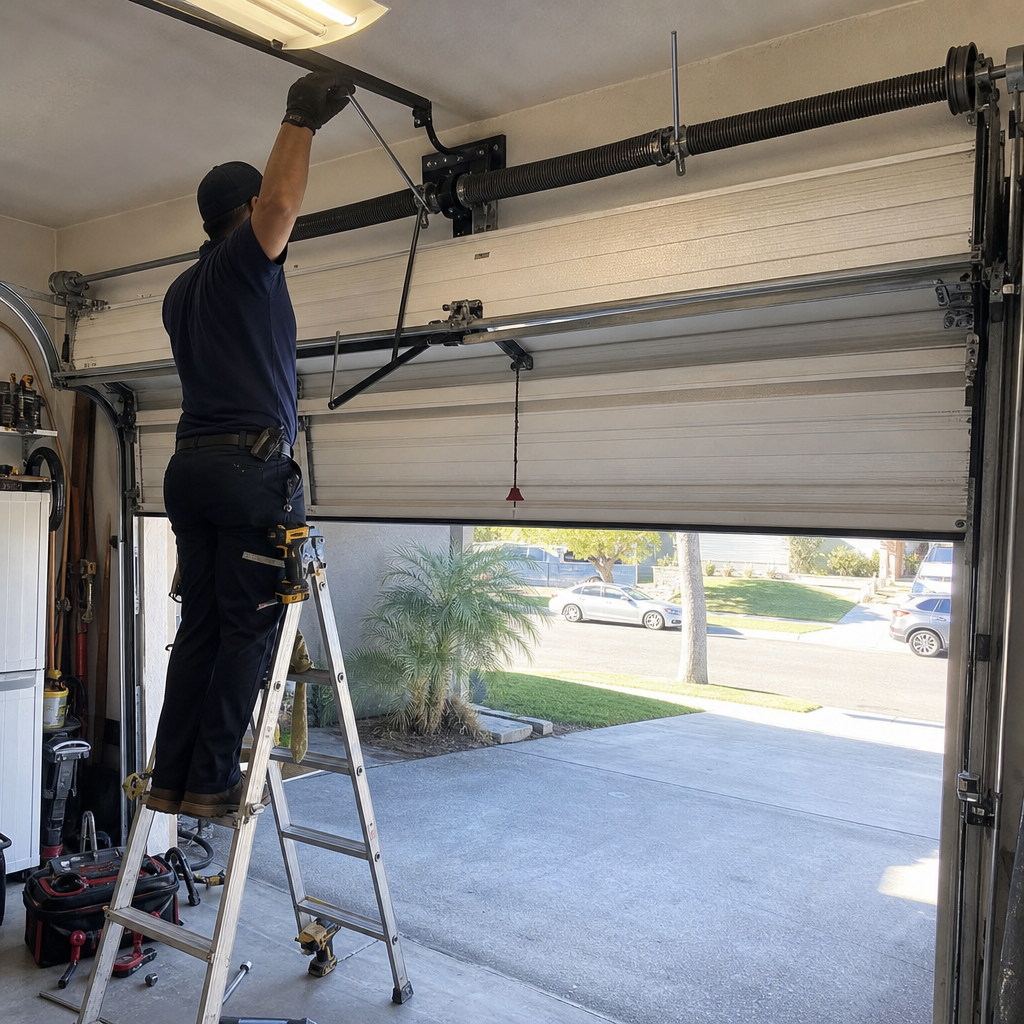
A broken torsion spring is unmistakable: a loud bang, a door that suddenly feels twice as heavy, or a visible separation in the coil. Do not attempt to open the door manually. The remaining spring is now carrying double its designed load and is at elevated risk of secondary failure. The opener, if engaged, will strain against a load it was never meant to lift unassisted and may burn out its motor or strip its drive gear.
Torsion springs store enormous energy. A standard 2-inch diameter spring on a 16-foot door holds roughly 10,000 foot-pounds of torque at full wound tension. This is not a DIY repair. The winding cones can slip, the winding bars can fail to seat, and the resulting release of energy causes severe injury. We have replaced springs in Los Angeles homes where a homeowner attempted the repair and ended up in the emergency room. Our technicians carry the correct spring for your door’s weight and height on every truck, and we match the wind, length, and inner diameter precisely.
Door that will not stay open or slams shut from any height
This indicates complete spring failure or a cable that has come off its drum entirely. The door is no longer a balanced weight; it is a falling object. Disconnect the opener if you can do so safely from outside the door’s path, and do not walk under the door for any reason.
Opener straining, smoking, or tripping its thermal overload
An opener that labors, smells hot, or stops mid-cycle to cool down is compensating for a mechanical failure elsewhere. Continuing to run it destroys a $300-$600 component to avoid a $180 spring repair. LiftMaster and Chamberlain openers have thermal protection circuits that will shut the motor down before fire risk, but repeated tripping degrades the motor windings permanently.
Track separation from the wall or visible bending
The vertical and horizontal tracks are not decorative. They are load-bearing guides that resist the lateral force of a descending door. A track pulling away from its jamb bracket means the fasteners have failed or the framing behind them has rotted. In either case, the door can jump the track. We see this in older Los Angeles homes with original garage conversions where the track was mounted to inadequate framing or where termite damage has hollowed the stud behind the bracket.
Tier 2: Schedule Service Within the Week
These symptoms indicate progressive wear or emerging imbalance. The door is still safe to operate with normal caution, but the underlying condition will worsen. Schedule service before the next weekend of heavy use.
Visible rust patterns or surface pitting on torsion springs
Rust is not merely cosmetic on a spring. It creates stress risers, microscopic notches where the metal flexes repeatedly. Each cycle of opening and closing bends the spring wire slightly. The rust pit becomes the initiation point for a fatigue crack. A spring with visible orange streaking or flaking has lost an unpredictable percentage of its cycle life. In coastal Los Angeles neighborhoods, we replace springs with surface rust at roughly 60% of their rated cycle count because the corrosion accelerates failure unpredictably.
Frayed cable strands or flattened cable sections
Cables are woven from 19 to 37 individual wires. When outer strands fray, the remaining cross-section carries more load per wire. A cable that has lost 10% of its strands is not 90% strong; stress concentrates at the damage point, and the effective strength reduction is nonlinear. Flattened sections indicate the cable has been crushed against the drum flange, usually from a prior imbalance. Replace before the next season of temperature swings, which expand and contract the remaining metal.
Door reverses before fully closing or hesitates at the same point
Modern openers have force-limiting sensors and infrared safety eyes. A reversal before contact with an obstruction usually means the close-force setting is detecting excess resistance, or the safety eyes are misaligned by 1/8 inch or less. Both conditions can worsen with vibration. In Los Angeles, the minor seismic activity that residents barely notice is enough to shift door hardware by small increments over months. A door that reversed twice last month and three times this week is trending toward complete failure to close.
Remote or wall button requiring multiple presses
This is often dismissed as a battery issue. If fresh batteries do not resolve it, the opener’s logic board may be failing to maintain its radio frequency pairing, or the motor is drawing enough current to voltage-sag the control circuit. Genie and Raynor openers from the early 2000s are particularly prone to this pattern as their circuit board capacitors age. The failure mode is gradual until it is sudden: one morning the door does not respond at all, often with a vehicle trapped inside.
Gaps of light visible around the closed door perimeter
Light gaps indicate seal compression failure or panel warping. In Los Angeles, this matters more than in temperate climates. Summer heat in the Valley can exceed 100 degrees against a south-facing door, and a failed seal allows that heat into the garage and adjacent living space. More critically, the gap means the door is not seating squarely in its frame, which imposes twist loads on the lifting system with every cycle.
Tier 3: Monitor at Next Maintenance
These symptoms are normal wear indicators. They do not threaten safety or function in the near term but signal that components are approaching the end of their service interval. Address them at your next scheduled tune-up, which for most Los Angeles homes should be annually given our dust, pollen, and thermal cycling.
- Squeaking or grinding from rollers: Steel rollers without ball bearings wear flat spots. Nylon rollers degrade slowly. The noise is unpleasant but not dangerous. Lubrication quiets it temporarily; replacement quiets it for years.
- Slow opener response (2-3 second delay): Many openers have a deliberate delay built into the circuit logic. If the delay is lengthening gradually, the motor capacitor may be weakening. Note the interval and compare at next service.
- Minor surface rust on hinges or brackets: Hardware rust is slower-progressing than spring rust because these parts do not cycle under tension. Sand and prime, or replace at tune-up.
- Weatherstrip hardening or cracking: The vinyl or rubber seal at the door bottom and between panels becomes brittle with UV exposure. Los Angeles sun degrades this faster than national averages. Replace when cracks propagate through the seal.
- Cosmetic panel dents or paint failure: These do not affect function unless the dent has creased the panel and created a stress point that will propagate with flexing.
Silent Failures: What Happens Before the Noise Starts
Homeowners rely heavily on sound as their primary warning system. This is a mistake. By the time a garage door becomes audibly problematic, several silent failures have already progressed.
The most common silent failure is spring tension loss. Torsion springs lose approximately 5-10% of their initial tension per year through metal relaxation, a process invisible to inspection. The door still opens. The opener still runs. But the motor works harder, the cables carry asymmetric loads, and the opener’s drive components wear faster. A homeowner notices only when the opener finally sounds strained, by which point the spring is far below specification and has likely damaged other components.
Cable drum slip is another silent failure. The cable winds onto a grooved drum that maintains door balance through the lift. If the set screws loosen microscopically, the drum rotates slightly on the shaft. The cable winds unevenly. The door lifts with a barely perceptible list. Months pass. The cable develops a wear pattern against the drum flange. Eventually the uneven winding creates enough slack for the cable to overlap itself, and then the door hangs visibly crooked. The audible phase, clanking or grinding, arrives only after the geometric failure is severe.
In Los Angeles, we see silent failure accelerated by two local factors. First, the low humidity allows lubricants to evaporate faster than in humid climates, so metal-to-metal wear begins sooner than manufacturers’ generic maintenance intervals suggest. Second, the frequency of minor earthquakes, many below perceptible threshold, vibrates hardware loose over time. A drum set screw torqued to specification in 2020 may be finger-loose by 2024 without any single event to blame.
The third silent failure is opener rail flex. The horizontal rail that carries the trolley bowes slightly under load, particularly with chain-drive openers. The bowing is elastic at first, returning to straight when the door rests. Over years, the rail develops a permanent set. The trolley binds at the low point. The motor draws more current. The plastic drive gear inside the opener housing wears tooth profiles away. The homeowner hears nothing until the gear strips completely and the opener runs without moving the door.
The Manual Balance Test: A 60-Second Check That Reveals Hidden Problems
This test detects the silent failures described above. It requires no tools. Perform it monthly, and always after any power outage, freeze, or incident described in the next section.
- Disconnect the opener. Pull the red emergency release cord with the door fully closed. This disengages the trolley from the opener carriage.
- Lift the door manually to waist height. Use both hands on a center stile. Do not lift from the bottom edge, which can pinch fingers if a cable fails.
- Release the door smoothly. A properly balanced door should remain within 6 inches of the release height, either holding steady or drifting slowly in either direction. This is the pass/fail threshold: 6 inches of movement.
- Observe the behavior.
- Holds position or drifts less than 6 inches: springs are adequately balanced.
- Rises sharply: springs are over-tensioned or the door is lighter than spec (possible panel material change or water damage weight loss).
- Falls more than 6 inches: springs have lost tension or a cable has slipped.
- Falls rapidly to the floor: significant spring failure, stop using immediately.
- Lower the door manually and re-engage the opener. Pull the release cord toward the opener motor to reset the trolley latch.
The 6-inch threshold is not arbitrary. It represents the tolerance band where the opener can safely manage the imbalance without excessive wear. Beyond 6 inches, the motor strains on every cycle, and the safety reverse system may not respond correctly because the door’s inertia overwhelms the force sensor calibration.
In our experience across Los Angeles, roughly 40% of doors over ten years old fail this test. The homeowners are unaware because the opener still functions, masking the degradation. We perform this test on every service call and record the result. A door that drifts 8 inches in January is often falling freely by June if the springs are in fatigue progression.
The One Check After Any Power Outage, Freeze, or Bump
Three events commonly precede garage door failures that homeowners fail to connect to the cause: power outages with subsequent restoration, hard freezes (rare but not unknown in Los Angeles foothills), and minor vehicle contact with the door frame or bottom edge.
After any of these, perform the manual balance test described above. Then add one additional check: run the door through a complete cycle and observe whether the safety reverse system activates correctly.
Power outages damage openers through voltage surge on restoration. The logic board may reset to factory defaults, altering force limits and travel distances. A door that previously closed fully may now stop an inch short, or reverse with normal resistance. The homeowner often adjusts behavior, holding the wall button to force a close, rather than recognizing a safety system compromise.
Hard freezes, which occur in Tujunga, Altadena, and other foothill communities during cold snaps, can contract metal components and alter spring rate temporarily. When temperatures rise, the springs may not return to full tension. A single freeze-thaw cycle can initiate a fatigue crack that propagates over subsequent weeks.
Minor vehicle contact, even at parking-lot speeds, transfers kinetic energy through the door panel into the track system. The track may bend microscopically, the rollers may deform, or the panel may shift on its hinge pins. None of this is visible from the driveway. The door opens and closes. But the geometry is now wrong, and components are loading in ways they were not designed for. We have replaced entire track systems in Los Angeles homes where the homeowner recalled “a little tap six months ago” and never connected it to the current failure.
The check takes three minutes. The failures it prevents can cost thousands.
Common Mistakes to Avoid
- Ignoring a door that reverses intermittently. In Los Angeles, this is often written off as sun glare on the safety eyes. It is more commonly the first sign of force-sensor drift. The opener is detecting resistance that will soon become actual mechanical binding.
- Lubricating the torsion spring directly. Standard WD-40 or household oil attracts dust and creates an abrasive paste on the spring surface. Professional spring lubricant is a dry film coating that does not migrate. The wrong lubricant accelerates corrosion.
- Replacing the opener without checking door balance. A new opener on an unbalanced door fails the same way the old one did, often faster because modern openers have tighter thermal protection that shuts them down at lower overload thresholds.
- Assuming all brands age the same. A 15-year-old LiftMaster chain drive and a 15-year-old Genie screw drive have different failure modes. Chain drives stretch; screw drives accumulate wear particles in the grease that abode the carriage nut. Generic advice wastes money on the wrong preventive measures.
- Waiting for the spring to break before calling. A broken spring is an emergency call with premium rates. A fatigued spring detected during routine service is a scheduled repair at standard rates, with no risk of secondary damage.
- Neglecting the manual release mechanism. The red cord should move freely and the trolley should disengage with moderate pull. In homes near the coast, corrosion can seize this mechanism, trapping vehicles inside during a power failure when the electric opener is inoperative.
- Trusting online video tutorials for spring replacement. The specific spring for your door depends on drum diameter, door height, door weight, and track radius. A video showing a standard lift in a Midwest garage may specify a spring dangerously wrong for your Los Angeles low-headroom or high-lift configuration.
When to Call a Professional
Call a professional when you identify any Tier 1 symptom, when a door fails the manual balance test, or when you are uncertain which tier applies. The cost of a service call is modest compared to the cost of a door replacement, opener damage, or injury.
Specific scenarios that warrant immediate professional assessment: any door that has dropped or slammed, any visible spring damage, any track separation, any opener that has smoked or tripped thermal protection, and any door that has been involved in a vehicle contact regardless of visible damage. Garage Door Repair in Los Angeles requires familiarity with local conditions, from the salt-air corrosion of coastal communities to the seismic hardware requirements that apply in certain hillside zones.
Mainspring Garage Door Co. offers free estimates in Los Angeles. A technician will assess your door, perform the balance test, and provide upfront pricing before any work begins. Most repairs are completed in a single visit because our trucks carry the full inventory of springs, cables, and openers. Call (844) 755-5838.
Frequently Asked Questions
Most common repairs in the Los Angeles market range from $180 for a cable replacement to $340 for a standard torsion spring replacement, with opener repairs typically between $150 and $400 depending on whether the issue is component-level or requires full replacement. We state the flat price before any work begins, and our $50 off any repair over $250 applies to jobs that qualify. Call (844) 755-5838 for an exact quote on your specific door. Estimates are free.
Repair is almost always cheaper for isolated component failures on doors less than 15 years old. Replacement becomes cost-effective when the door has multiple failed systems, significant panel damage, or outdated insulation that affects adjacent living space energy costs. In Los Angeles, where garage conversions to ADUs are common, a replacement door with proper sealing and insulation often pays back through reduced HVAC load. We offer free second opinions on any written estimate to help you compare accurately.
Yes. Mainspring technicians arrive with springs, cables, rollers, and openers for all major brands on every truck. Most repairs are completed in a single visit. Our phones are answered by a live person 24/7, including nights, weekends, and holidays. Same-day service is standard for Tier 1 symptoms. Call (844) 755-5838 to schedule.
Annually is the correct interval for most Los Angeles homes, given our dust, pollen, UV exposure, and thermal cycling. Coastal homes within two miles of the ocean benefit from inspection every 8-10 months due to accelerated corrosion. Our $89 Seasonal Tune-Up includes balance testing, safety reverse verification, hardware inspection, and lubrication with appropriate products.
Metal fatigue from repeated loading cycles is the primary cause. A standard spring is rated for 10,000 cycles, which is roughly 7 years at four cycles per day. Rust, improper spring specification at original installation, and corrosion from coastal air shorten this. In Los Angeles, we also see premature failure from doors that were balanced for original wood panels but now carry heavier steel or insulated replacements without spring upgrades.
Noise with function indicates wear in non-critical components, usually rollers, hinges, or opener drive gear backlash. The door is still safe to operate but is consuming itself. Steel rollers with worn bearings grind flat spots. Chain drives develop slack that slaps the rail. These noises are the audible phase of degradation that began silently months earlier. Schedule service before the worn component damages adjacent parts.
The Bottom Line
Garage door warning signs are not equally urgent. A squeaky roller and a frayed cable belong in different categories, and your response should match the actual hazard. Learn the three-tier system. Perform the monthly balance test. Check your door after any power outage, freeze, or minor impact. And remember that sound is often the last warning, not the first. The homeowners who avoid emergencies are not luckier; they are simply informed earlier.
For 42 years, Mainspring Garage Door Co. home has served Los Angeles with upfront pricing, trucks stocked for same-day completion, and a 90-Day Done Right Promise in writing on every job. Whether you need Garage Door Installation in Los Angeles, opener service, or a Garage Door Opener in Los Angeles, we arrive when we say, quote the flat price before the wrench comes out, and stand behind the work. Senior and veteran discounts of 5% apply permanently. Call (844) 755-5838 for a free estimate.
Written by the team at Mainspring Garage Door Co., serving Los Angeles since 2016.