
Last updated July 26, 2026
Garage Door Parts Warning Signs Every Homeowner Should Know
A garage door cable fraying at the drum makes a faint metallic scraping sound. Most people hear it, chalk it up to “the door being noisy,” and call two weeks later after the cable snaps and the door hangs crooked in the opening. In Los Angeles, where many homes built between the 1950s and 1980s still run their original hardware, we see this story repeat almost daily. The parts do not fail without warning. They telegraph trouble through sounds, movements, and visual cues that most homeowners have never been taught to read. This guide maps each warning sign to its specific part, shows you what to check, and explains what happens if you wait. For a structured approach to upkeep, see our Garage Door Repair Maintenance Schedule: What to Do and When.
Quick Answer
Garage Door Parts give specific warnings before they fail: grinding from roller bearings, popping from fatigued springs, scraping from fraying cables, and sagging from worn hinges. A door that won’t stay at waist height when lifted manually has a spring problem, not an opener problem. Catching these signs early typically means a $150-$300 repair; ignoring them often leads to $800-$1,400 in damage when the part fails completely.
Table of Contents
- What Different Sounds Mean (and Which Part Is Failing)
- The Manual Lift Test: A 30-Second Spring Check
- Visual Warning Signs Homeowners Miss
- The Counterintuitive Sign: When Quieter Means Worse
- What Happens If You Ignore It: 30, 60, and 90 Days
- Garage Door Opener Warning Signs
- Common Mistakes to Avoid
- When to Call a Professional
- Frequently Asked Questions
- The Bottom Line
What Different Sounds Mean (and Which Part Is Failing)
Most homeowners describe their problem as “the door is making noise.” That description is too vague to diagnose anything. Each sound corresponds to a specific part under stress. Learning the mapping saves you from misdiagnosing a spring problem as an opener problem, which is the most expensive mistake we correct in Los Angeles homes.
Grinding or growling: This is roller bearing failure. Steel rollers with unsealed bearings collect dust from Santa Ana winds and coastal salt in beach-adjacent neighborhoods like Venice and San Pedro. The bearings dry out, metal grinds on metal, and the sound deepens from a whine to a growl. Nylon rollers wear differently; they go silent when they fail, which we cover in the counterintuitive section below.
Popping or snapping: This is spring fatigue. Torsion springs store enormous energy, and when individual coils begin to separate and reseat, they make a sharp pop. Extension springs do the same when their coils start to stretch unevenly. In hotter Los Angeles valleys like the San Fernando and San Gabriel, springs fatigue faster because heat cycling accelerates metal fatigue. A spring that pops once will pop again, louder, until it breaks.
Scraping or metallic rubbing: This is cable fraying against the drum or at the bottom bracket. The cable’s outer wires separate and brush against steel hardware. The sound is faint at first, often only audible when the door is near fully open or closed. By the time most homeowners notice it, 15-20% of the cable’s cross-section is already gone.
Rattling or clanking: This is loose hardware. Hinge bolts back out over thousands of cycles. Track brackets loosen from vibration. The sound is irregular and often worse on the door’s downward travel when gravity adds momentum. In hillside homes throughout the Hollywood Hills and Pacific Palisades, where doors run on sloped driveways, the vibration is more severe and hardware loosens faster.
Squeaking during travel: This is usually dry hinges or dry rollers needing lubrication. It is the least urgent sound on this list, but it is also the sound that masks more serious problems. Homeowners who lubricate everything without inspecting first sometimes silence a grinding roller bearing temporarily, hiding the real failure until the roller seizes or the shaft wears through the bracket.
The Manual Lift Test: A 30-Second Spring Check
The manual lift test separates spring problems from opener problems faster than any other diagnostic. We teach this to every homeowner who calls us confused about whether they need a new opener or a spring repair.
- Close the door fully.
- Pull the red emergency release cord to disconnect the opener trolley.
- Lift the door by hand to waist height, about three feet off the ground.
- Let go.
A properly balanced door with healthy springs will stay at waist height or drift slowly in either direction. A door that falls hard to the floor has weak or broken springs. A door that shoots upward has excessive spring tension. Both conditions strain the opener and will eventually burn out the motor.
In Los Angeles, where many homeowners run their doors on autopilot for years, this test reveals problems that the opener has been masking. A 1/2-horsepower LiftMaster or Chamberlain opener can lift a door with partially failed springs, but it works twice as hard and wears out in half the time. We replace openers in Brentwood and Bel Air that failed not because they were defective, but because they lifted an unbalanced door for three years.
Safety note: If the door feels extremely heavy, will not lift, or appears crooked, stop. Do not force it. A door with a broken cable or spring can drop unexpectedly or twist in the tracks. The springs and cables are under high tension and can cause serious injury. This test is diagnostic, not a repair procedure.
Visual Warning Signs Homeowners Miss
Most homeowners look at their garage door daily without seeing it. The visual warnings are subtle but specific once you know where to look.
Rust streaks below cables: Fraying cables shed microscopic steel fibers that rust and run down the door panel in thin orange lines. These streaks appear on white and light-colored doors first. Check the bottom six inches of the door directly below each cable drum. Rust streaks mean the cable is actively deteriorating.
Daylight gaps at the floor seal: A door that no longer sits flat on the concrete allows dust, water, and pests inside. In Los Angeles, where occasional heavy rains overwhelm aging drainage, this gap leads to water intrusion in garages. More importantly, it signals that the door is out of balance, the panels are warping, or the hinges are sagging. Check at dawn or dusk with the garage lights off; any visible daylight is too much.
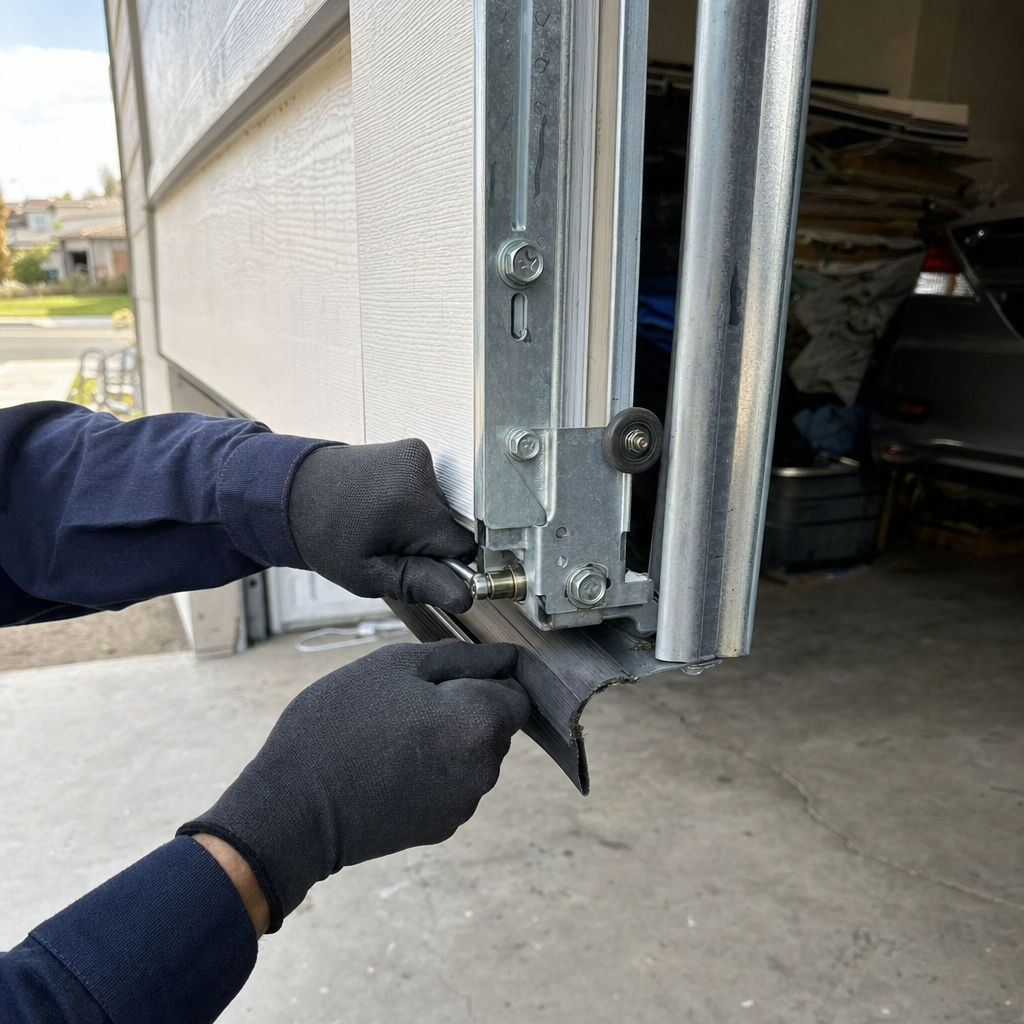
Hinge cracks versus hinge wear: Steel hinges crack at the knuckle where the two leaves pivot. The crack starts as a hairline and propagates across the hinge body. Nylon hinges wear differently; the pivot hole elongates into an oval, letting the door panel shift side-to-side. A cracked hinge will fail suddenly. A worn nylon hinge causes gradual misalignment that damages rollers and tracks.
Cable “birdcaging”: When a cable’s outer wires separate from the core, they flare outward like a birdcage. This is visible at the bottom bracket where the cable terminates, and at any point where the cable wraps around the drum. Birdcaging means the cable has lost structural integrity and will fail under load.
Spring coil gaps: A torsion spring at rest should have coils that touch or nearly touch along its entire length. Gaps between coils, especially uneven gaps, indicate that some coils have stretched permanently while others have not. The spring is no longer distributing load evenly and is living on borrowed time.
Track dents and misalignment: Vertical tracks should be plumb; horizontal tracks should slope slightly back toward the motor. Dents from vehicle contact, common in narrow Los Angeles driveways, create roller bind points that accelerate wear. Look for shiny metal where rollers have been scraping, or paint worn off the track edges.
The Counterintuitive Sign: When Quieter Means Worse
A door that suddenly runs quieter is not fixed. It is warning you.
Nylon rollers with sealed bearings are popular in Los Angeles for their quiet operation. When the bearing fails, the nylon wheel still turns, but it turns on the steel shaft instead of on its bearings. The grinding stops. The door gets quieter. Homeowners think the problem resolved itself.
What is actually happening: the nylon wheel is wearing eccentrically, the shaft is scoring, and the roller bracket is elongating. The door may run quiet for two to four weeks. Then the wheel cracks, the shaft seizes, or the bracket tears out of the door panel. The repair escalates from replacing a $12 roller to replacing a $200 door section.
We see this pattern in Santa Monica and Manhattan Beach, where homeowners paid extra for “quiet” nylon rollers and now assume silence means health. If your door was noisy and is now quiet without any service, inspect the rollers immediately. Spin each roller by hand with the door open; a healthy roller spins freely and quietly. A failed roller spins roughly, not at all, or with visible wobble.
The same principle applies to opener chain drives that go quiet. A loose chain slaps the rail and makes a characteristic rattle. When the chain stretches further, it stops slapping and runs silently, but it is also skipping teeth on the sprocket and wearing the drive gear internally. Quiet here means damage is accumulating out of sight.
What Happens If You Ignore It: 30, 60, and 90 Days
Every warning sign follows a predictable escalation. Knowing the timeline helps you judge urgency and cost.
Grinding roller bearings:
- Day 1-30: Bearing races score. Roller turns roughly. Noise worsens.
- Day 31-60: Bearing seizes. Roller slides, not rolls. Track wear begins.
- Day 61-90: Roller stem wears through bracket. Door binds or jumps track. Repair cost typically triples from roller replacement to track realignment and bracket welding.
Popping torsion springs:
- Day 1-30: Individual coils fatigue and separate. Popping occurs at random intervals.
- Day 31-60: Popping becomes frequent. Spring loses 10-20% of lift capacity. Opener strains.
- Day 61-90: Spring breaks, often with loud bang. Door crashes or hangs crooked. If both springs were installed together, the second spring fails within days due to carrying full load alone. Cost escalates from $180-$280 spring replacement to $400-$600 if the door jumps track or damages panels.
Fraying cables:
- Day 1-30: Outer wires separate. Rust streaks appear. Scraping sound audible.
- Day 31-60: Cross-section reduced 25-40%. Cable stretches visibly. Door may run slightly crooked.
- Day 61-90: Cable snaps. Door drops on one side. Bottom bracket may tear from panel. In extreme cases, the released cable whips and damages vehicles or injures bystanders. Cost escalates from $150-$220 cable replacement to $500-$900 if panels or brackets require replacement.
Loose hardware:
- Day 1-30: Bolts back out. Rattling worsens. Hinges shift slightly.
- Day 31-60: Holes elongate. Door alignment drifts. Rollers bind in tracks.
- Day 61-90: Bolts fall out. Hinge or bracket separates. Door section may detach. We have responded to emergency calls in the San Fernando Valley where a single missing hinge bolt led to a door panel folding in the tracks.
Los Angeles climate accelerates some of these timelines. Coastal salt air corrodes cables and hardware faster than inland dry heat. Valley heat cycles stress springs more severely. Neither environment forgives neglect.
Garage Door Opener Warning Signs
Opener problems are often mistaken for door problems, and door problems are often mistaken for opener problems. The manual lift test separates them, but openers have their own warning signs. For a complete preventive approach, see our Garage Door Repair Maintenance Checklist for Los Angeles Homeowners.
Reversing before hitting the floor: The safety sensors are misaligned, or the close-force setting is too sensitive. In Los Angeles, where garage floors settle unevenly on hillside lots, doors may encounter slight resistance that triggers reversal. But if the sensors are clean and aligned and the door still reverses, the opener motor may be struggling against a door that is too heavy due to spring failure.
Intermittent response to remote or wall button: This is usually logic board or travel module failure in older Craftsman, Raynor, or Chamberlain units. Before replacing the opener, check whether the door runs smoothly by hand. A door that binds will cause the opener to stop and start as its internal overload protects the motor.
Excessive opener head vibration: The opener rail should run steady. Vibration means the door is unbalanced, the rail is loose, or the motor mount is failing. Vibration transfers to the ceiling joists and can damage drywall over time. In older Los Angeles homes with plaster ceilings, this vibration cracks the finish.
Chain or belt sag: A chain should have 1/2 to 3/4 inch of slack at its midpoint. More sag means the chain is stretching and will soon skip teeth. Belt drives do not stretch visibly, but they fray at the edges where they wrap around the sprocket. Check the belt where it exits the motor housing.
Travel limits drifting: If the door no longer opens or closes to its previous positions, the travel limit switches are wearing out. This is common in openers older than 12 years. In Los Angeles, where many homeowners run original openers from the 1990s or early 2000s, this is often the first sign that replacement is more economical than continued repair.
We are factory-familiar with all major brands: LiftMaster, Chamberlain, Genie, Clopay, Amarr, Wayne Dalton, Craftsman, and Raynor. Most opener issues in Los Angeles homes involve LiftMaster or Chamberlain chain-drive units installed in the 2005-2015 period. These are solid openers that often outlast their original springs and hardware, which creates the confusion: the opener works, but it is working too hard because the door is no longer balanced.
Common Mistakes to Avoid
- Assuming noise means the opener is failing. Most “opener” calls we receive in Los Angeles are actually spring or roller problems. The manual lift test prevents this misdiagnosis and saves the cost of an unnecessary opener replacement.
- Lubricating without inspecting first. Spray lubricant can silence a grinding bearing temporarily, hiding the failure until the roller seizes. Inspect first, lubricate second.
- Replacing only one spring. Torsion springs are installed in matched pairs. When one fails, the other has experienced identical cycle fatigue. Replacing one guarantees a second failure within weeks. We replace both, every time.
- Ignoring a door that runs crooked. A crooked door means unequal spring tension or a failing cable on one side. Continuing to operate it damages the tracks, rollers, and opener. Stop using it and call for service.
- DIY spring or cable repair. Torsion springs store enough energy to cause serious injury or death. Cables under tension can whip when released. These repairs require proper tools and training. In Los Angeles, unlicensed garage door repair is also a permit and liability issue.
- Waiting for total failure. The cost difference between catching a fraying cable and replacing a snapped cable with panel damage is typically $400-$700. The warning signs are visible and audible. Use them.
- Hiring based on the lowest bid without verifying licensing and insurance. Los Angeles has no shortage of unlicensed operators who disappear after collecting payment. Verify CSLB license, request proof of insurance, and get the warranty in writing.
When to Call a Professional
Call a technician when you observe any of the following: a door that fails the manual lift test, visible cable fraying or birdcaging, spring coil gaps or popping sounds, a door that runs crooked or binds in the tracks, or an opener that strains, reverses unexpectedly, or vibrates excessively. Stop operating the door if you suspect spring or cable failure; the risk of injury or further damage outweighs any convenience.
Garage Door Repair in Los Angeles requires specific expertise in the hardware brands and climate conditions common to Southern California homes. Mainspring Garage Door Co. offers free estimates in Los Angeles, and our technicians arrive with springs, cables, rollers, and openers already on the truck. Most jobs are completed in a single visit. Call (844) 755-5838 to schedule.
Frequently Asked Questions
Most common repairs in Los Angeles range from $150 to $400 for single components like cables or rollers, and $180 to $340 for spring replacement. Before starting major work, check Garage Door Permits, Codes & Inspections in CA: What You Need to Know to ensure compliance. Panel replacement or track realignment runs $400 to $900 depending on door size and material. We state the flat price before any work begins, so there are no surprises on the bill. Call (844) 755-5838 for an exact quote, estimates are free.
No. Torsion springs are under extreme tension and can cause serious injury or death if mishandled. The winding bars, proper technique, and safety protocols require journeyman-level training. We do not recommend DIY spring repair under any circumstances. Our background-checked, uniformed technicians handle this work daily under our K.E.Y.S. values code.
Perform a visual and auditory inspection monthly, and run the manual lift test quarterly. In Los Angeles, where dust, salt air, and heat cycling accelerate wear, quarterly inspections catch problems before they escalate. Our $89 Seasonal Tune-Up includes full inspection, adjustment, and lubrication.
A loud bang is almost always a broken torsion spring. The sound is the release of stored energy when the spring snaps. The door will feel extremely heavy or will not lift at all. Stop using the door immediately. This repair requires professional service and matched spring replacement.
Repair is more economical when the door panels are intact, the track system is undamaged, and the opener is under 12 years old. Replacement becomes the better value when multiple panels are damaged, the track is bent or corroded, or the opener and door are both past their service life. We offer a Free Second Opinion on any written estimate to help you decide.
Yes. We are factory-familiar with LiftMaster, Chamberlain, Genie, Clopay, Amarr, Wayne Dalton, Craftsman, and Raynor. Our trucks carry parts for these brands so most repairs are completed in one visit. Mainspring Garage Door Co. home has more details on our service coverage throughout Los Angeles.
The Bottom Line
Garage door parts communicate their condition constantly. Grinding, popping, scraping, and sagging each point to a specific failing component. The manual lift test reveals spring problems that openers hide. Visual inspections catch cable fraying and hinge wear before they cause catastrophic failure. And the counterintuitive quiet of a failing nylon roller reminds us that improvement without explanation demands investigation. In Los Angeles, where climate and age conspire against garage door hardware, the homeowner who reads these signs saves money and avoids the inconvenience of a door that will not open at all. The homeowner who waits pays for the lesson.
If you have noticed any of the warning signs in this guide, or if your door has simply not been inspected in over a year, call Mainspring Garage Door Co. at (844) 755-5838. We answer live, 24/7, including nights, weekends, and holidays. A technician can be at your home with the right parts on the truck, and we will state the flat price before any work begins. Every job is backed by our 90-Day Done Right Promise, in writing, with no paperwork or dispute process if something needs adjustment. We have been serving Los Angeles since 2016, and we will be here when you need us.
Written by the team at Mainspring Garage Door Co., serving Los Angeles since 2016.