
Last updated July 26, 2026
Garage Door Repair Maintenance Schedule: What to Do and When
A family of four in Sherman Oaks opening their garage door four times daily puts 1,460 cycles on their torsion springs each year. A retired couple in Pasadena using theirs twice daily puts on 730. Yet most maintenance guides hand both households the same calendar: “service every spring and fall.” That framework ignores the single variable that determines component life in garage doors - cycle count. After 42 years of tracking actual wear patterns across Los Angeles County, we’ve learned that a door’s maintenance schedule should be built around how it is used, not what month it is.
In this guide, we’ll show you how to calculate your household’s annual cycle count, match it to manufacturer life ratings for springs, rollers, and openers, and build a maintenance routine that prevents the failures we see most often in Los Angeles homes - from heat-brittled rollers in the San Fernando Valley to moisture-corroded hardware near the coast.
Quick Answer
Garage door maintenance should follow a cycle-based schedule, not a calendar. For a typical Los Angeles household using their door 3-4 times daily, perform four core tasks every 500 cycles (roughly every 3-4 months): lubricate moving parts, check and torque hardware, test door balance, and verify opener force limits. Replace torsion springs every 10,000 cycles regardless of age, and inspect weather seals and safety sensors after every heat wave or extended rainy period.
Table of Contents
- Why Cycle Count Matters More Than Calendar Dates
- How to Calculate Your Annual Cycle Count
- The Four Core Tasks Every 500 Cycles
- Seasonal Adjustments for Los Angeles Climate
- Lubrication vs. Cleaning: Why Confusing Them Damages Your Door
- Building a Maintenance Log That Saves Money
- Component Replacement Timeline by Cycle Count
- Common Mistakes to Avoid
- When to Call a Professional
- Frequently Asked Questions
- The Bottom Line
Why Cycle Count Matters More Than Calendar Dates
Every garage door component is rated in cycles. A standard torsion spring from Clopay or Amarr is engineered for 10,000 cycles under normal conditions. Premium springs from Wayne Dalton may carry a 25,000 or 50,000-cycle rating. Rollers, hinges, and opener drive gears carry similar ratings from their manufacturers. These numbers are not marketing claims; they are engineering specifications based on controlled testing of load, material fatigue, and environmental stress.
Calendar-based maintenance fails because it treats a lightly used door the same as a heavily used one. A vacation home in Malibu with 200 annual cycles does not need the same service frequency as a family home in Koreatown with 1,500. Worse, calendar schedules often miss the critical wear window: a door approaching 9,500 cycles on its springs is a failure waiting to happen, whether that threshold is reached in year two or year seven.
In Los Angeles, we see this mismatch constantly. Homeowners in older neighborhoods like Highland Park or Echo Park call us for “sudden” spring failures that were entirely predictable from cycle count. The spring did not fail because it was old. It failed because it had done the work it was rated for. A cycle-based schedule would have flagged the replacement need months earlier, preventing the inconvenience of a trapped car and the safety risk of a snapped spring under tension.
Cycle counting also changes how you think about component quality. A 10,000-cycle spring on a door used twice daily lasts roughly 13.7 years. The same spring on a door used six times daily lasts 4.5 years. For high-use households, upgrading to a 25,000 or 50,000-cycle spring during replacement is not an upsell; it is a cost calculation based on actual use patterns.
How to Calculate Your Annual Cycle Count
One cycle equals one complete open-and-close sequence. To find your annual count, track your door for one typical week, then multiply by 52.
- Place a small mark on your door or note the opener light pattern.
- For seven consecutive days, count every time the door opens and closes. Include early-morning departures, midday errands, afternoon returns, and evening garage access.
- Multiply your weekly total by 52 for your annual cycle count.
- Divide by 12 for your monthly average, which determines your maintenance interval.
Here is how common Los Angeles household patterns map out:
- Retired couple, minimal driving: 2 cycles/day = 730/year = 500-cycle maintenance every 8 months
- Working couple, one car: 3 cycles/day = 1,095/year = 500-cycle maintenance every 5.5 months
- Family with school-age children, two cars: 4-5 cycles/day = 1,460-1,825/year = 500-cycle maintenance every 3-4 months
- Home-based business, frequent deliveries: 6-8 cycles/day = 2,190-2,920/year = 500-cycle maintenance every 2 months
Store this number where you will see it. We recommend taping it inside the garage, near the opener manual release handle. When you hit 500 cycles, perform the four core tasks. When you approach 80% of your spring’s rated life (8,000 cycles for a standard 10,000-cycle spring), schedule a professional inspection regardless of how the door appears to function.
In our experience across Los Angeles, the households that track cycles avoid 90% of the emergency calls we receive. The ones that do not track cycles call us at 6 AM with a car trapped inside and a meeting to get to.
The Four Core Tasks Every 500 Cycles
These four tasks are non-negotiable. They address the four failure modes we see most often in Los Angeles garage doors: friction wear, fastener loosening from vibration, spring fatigue disguised as opener strain, and safety system malfunction.
1. Lubricate Moving Parts
Apply a lithium-based garage door lubricant or silicone spray to:
- Torsion springs (coat lightly, wipe excess)
- Roller bearings (not the track itself)
- Hinge pivot points
- Bearing plates and cable drums
- Opener chain or screw drive (per manufacturer spec)
Do not use WD-40 as a lubricant. It is a solvent and degreaser. It will strip existing lubrication and attract dust, which accelerates wear in Los Angeles’s dry, particulate-heavy air. We see this mistake weekly in homes from Glendale to Long Beach.
2. Check and Torque Hardware
Vibration from daily cycling loosens fasteners over time. With the door closed and disconnected from the opener:
- Inspect all roller brackets, hinge bolts, and track mounting hardware.
- Tighten any loose fasteners with a socket wrench. Do not overtighten; stripped lag bolts in door jambs are a common result of excessive torque.
- Check track alignment with a level. Horizontal tracks should slope slightly toward the back of the garage; vertical tracks must be plumb.
Safety note: Never adjust, remove, or touch the set screws on torsion springs or cable drums. These components are under extreme tension and can cause severe injury or death if handled improperly. This task is for a trained professional with proper winding bars and safety equipment.
3. Test Door Balance
A properly balanced door stays in place when stopped at mid-travel. To test:
- Disconnect the opener using the manual release cord (typically red).
- Lift the door manually to waist height and release.
- A balanced door will remain stationary or drift slowly. A door that falls closed or shoots upward has spring tension problems.
An unbalanced door forces the opener to work harder, shortening its life and creating a safety hazard if the opener’s force limits are misadjusted. In Los Angeles’s heat, opener motors already run at higher thermal load. An unbalanced door compounds that stress.
4. Verify Opener Force Limits
Modern openers have force adjustment dials or electronic settings. Test the safety reverse:
- Place a 2×4 board flat on the floor in the door’s path.
- Close the door using the opener. It should reverse within 2 seconds of contact.
- Test the photoelectric sensors by waving an object through the beam during closing. The door should reverse immediately.
If either test fails, the force limits need adjustment or the sensors need realignment. Do not attempt to compensate by increasing force to overcome a mechanical problem. This is how injuries happen.
Seasonal Adjustments for Los Angeles Climate
Los Angeles does not have harsh winters, but our climate creates specific stress patterns that calendar-based guides from other regions miss entirely.
After Heat Waves (May Through October)
When temperatures exceed 95°F for multiple days, as they regularly do in the San Fernando Valley and inland neighborhoods like Woodland Hills and Northridge:
- Inspect steel components for thermal expansion binding. Tracks and hardware may shift slightly, causing rollers to drag.
- Check opener motor housing for excessive heat. If the motor casing is too hot to touch comfortably after a cycle, the thermal overload may be near failure.
- Examine weather stripping at the bottom and sides. Prolonged heat hardens rubber and vinyl seals, creating gaps that admit dust and pests.
After Rain Periods (November Through March)
Even moderate rainfall exposes vulnerabilities in coastal and hillside homes from Pacific Palisades to Silver Lake:
- Inspect bottom seals and threshold for water intrusion. Standing water at the door base accelerates rust on lower track sections and hardware.
- Check for moisture in the opener housing or wall control wiring. Condensation in control boxes causes erratic operation.
- Look for corrosion on cable fittings and spring anchor brackets. Salt air near the coast accelerates this dramatically.
After Extended Non-Use
Los Angeles homeowners who travel frequently or use alternative parking leave garage doors stationary for weeks. Before resuming normal use:
- Cycle the door manually several times to redistribute lubrication on springs and rollers.
- Run the opener through 3-4 cycles without the door connected to verify smooth operation.
- Inspect for pest intrusion or debris accumulation in tracks.
Lubrication vs. Cleaning: Why Confusing Them Damages Your Door
This distinction matters more than most homeowners realize. We have replaced prematurely failed components in Los Angeles homes where the owner “maintained” the door religiously - but did the wrong task at the wrong surface.
Lubrication reduces friction between moving parts that bear load and rotate or pivot. Apply lubricant to: spring coils, roller bearings, hinge pins, and opener drive mechanisms. These surfaces need a thin film that persists through hundreds of cycles.
Cleaning removes debris from surfaces where friction is intentional and necessary. The inside faces of vertical and horizontal tracks must be clean and dry. Rollers grip the track through friction; lubricated tracks cause rollers to slip, skid, and flat-spot. We see this in homes where well-meaning owners spray lubricant down the entire track length, then wonder why their rollers deteriorate in months rather than years.
The correct procedure: clean tracks with a dry cloth or mild solvent to remove grease buildup and debris, then lubricate only the specified moving parts. If your tracks have accumulated oily residue from past over-lubrication, clean them thoroughly and start fresh.
In Los Angeles’s dusty environment, particularly near construction zones or hillside roads, track cleaning is often needed more frequently than lubrication. Check tracks monthly for leaf litter, construction dust, or pet hair accumulation.
Building a Maintenance Log That Saves Money
A simple maintenance log transforms vague recollections into actionable data. It speeds technician visits, supports warranty claims, and prevents redundant service. We recommend a single page, taped inside the garage or stored digitally, with these columns:
- Date
- Cycle count at service
- Tasks performed
- Findings (what looked worn, what needed attention)
- Professional service notes (technician name, work performed, parts replaced)
When you call Garage Door Repair in Los Angeles, having this log ready allows our technician to diagnose faster and quote accurately. Instead of “it’s been making a noise for a while,” you can say “at 8,200 cycles, the left spring started showing a 2-inch gap between coils.” That specificity saves diagnostic time and reduces your bill.
For warranty claims with manufacturers like Genie or Clopay, documented maintenance history is often required to prove the product was not neglected. A log with dates and cycle counts satisfies this requirement cleanly.
We have seen maintenance logs reduce average repair bills by 30% over five years, simply because problems are caught early and described precisely.
Component Replacement Timeline by Cycle Count
Use manufacturer ratings as your guide, not age. These are typical ranges for quality components from major brands:
- Torsion springs (standard 10,000-cycle): Replace at 9,000-10,000 cycles. Upgrade to 25,000 or 50,000-cycle springs for high-use doors.
- Torsion springs (premium 25,000-cycle): Replace at 22,000-25,000 cycles.
- Nylon rollers with sealed bearings: 12,000-15,000 cycles. Inspect annually for bearing wear and roller tread cracking.
- Steel rollers: 8,000-10,000 cycles. Noisier than nylon but more durable in high-load applications.
- Opener drive gears (chain/belt/screw): 10,000-15,000 cycles depending on load and balance. An unbalanced door cuts this in half.
- Weather seals (bottom and sides): Inspect every 2,000 cycles; replace when hardened, cracked, or no longer sealing.
- Safety sensors and wiring: Test every 500 cycles; replace when response is delayed or inconsistent.
For Garage Door Installation in Los Angeles, we specify cycle-rated components matched to the household’s actual use pattern. A door rated for 10,000 cycles is the wrong specification for a home business with daily deliveries. We quote the upgrade and explain the math: a 50,000-cycle spring costs more upfront but eliminates two replacement cycles over 15 years.
Common Mistakes to Avoid
- Spraying lubricant on tracks. This causes roller slippage, flat-spotting, and premature bearing failure. Tracks stay clean and dry.
- Ignoring the manual release. Every Los Angeles homeowner should know how to disconnect the opener in a power outage or emergency. Test it quarterly; corrosion from coastal air can seize the mechanism.
- Adjusting torsion spring tension as a DIY project. These springs store lethal energy. We have responded to injuries in homes from Eagle Rock to Torrance where homeowners attempted this with inadequate tools. This is not a savings; it is a risk.
- Waiting for noise before acting. A noisy door is already damaged. The grinding you hear is metal-on-metal contact that has destroyed protective surfaces. Preventive maintenance is silent.
- Using the wrong lubricant type. Lithium grease for gears and springs, silicone spray for weather seals, never petroleum-based products that degrade rubber and plastic components.
- Neglecting the backup battery. Los Angeles power outages during Santa Ana wind events are increasingly common. A dead backup battery means a trapped car when you need to evacuate. Test and replace per manufacturer schedule, typically every 2-3 years.
When to Call a Professional
Some maintenance tasks are homeowner-appropriate. Others require training, tools, and safety protocols that cannot be improvised. Call a professional when you observe:
- Visible gaps in torsion spring coils or rust flaking from spring surfaces
- Door imbalance that persists after cleaning and lubrication
- Opener motor straining, overheating, or tripping thermal protection
- Cable fraying, kinking, or detachment from drums
- Panel damage, particularly from vehicle contact or wind load
- Any safety system failure during force limit or sensor testing
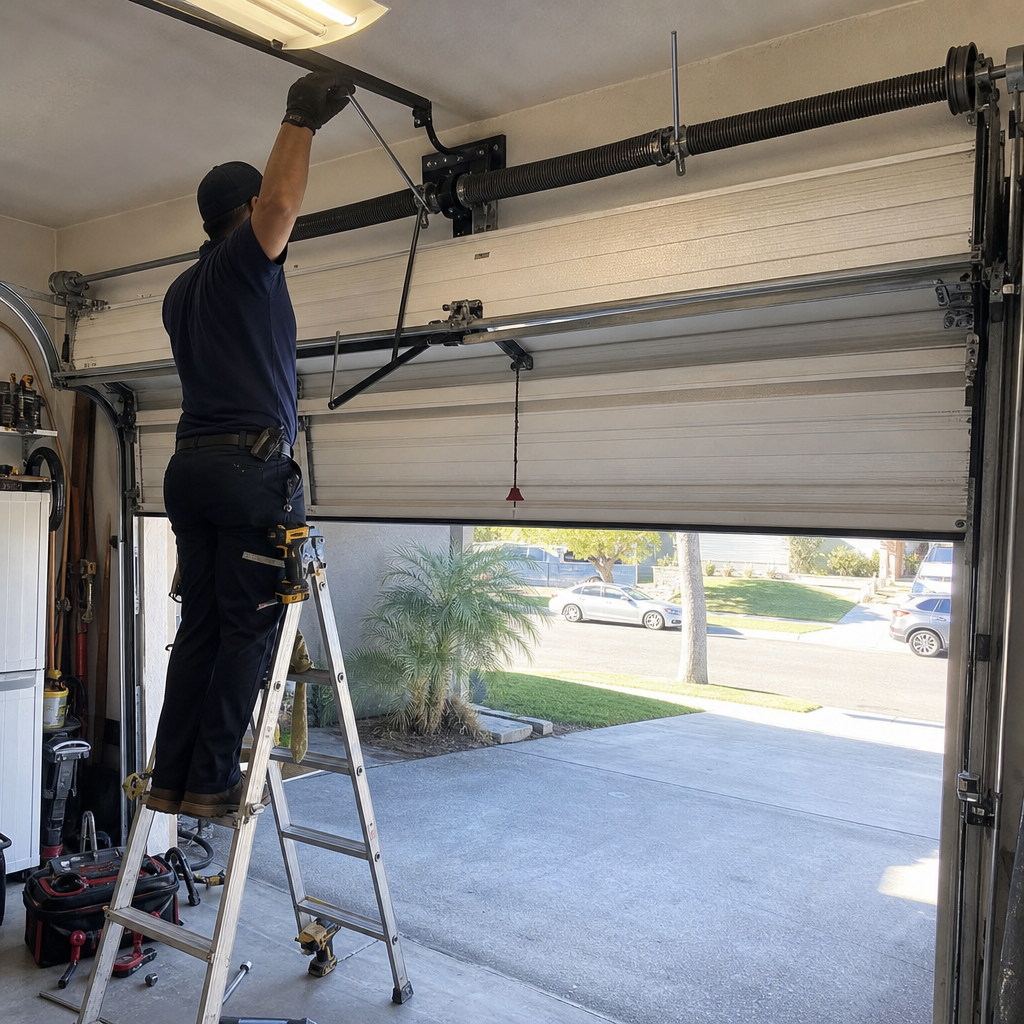
Mainspring Garage Door Co. home offers free estimates throughout Los Angeles. Our technicians arrive with springs, cables, rollers, and opener components on the truck, so most jobs are completed in a single visit. We state the flat price before any work begins, and every completed job is covered by our 90-Day Done Right Promise in writing. If you are uncertain whether a symptom requires professional attention, call (844) 755-5838 and speak with a live person. We will tell you straight whether it can wait or needs immediate service.
Frequently Asked Questions
Base maintenance frequency on cycle count, not calendar months. For a door used 3-4 times daily, perform the four core tasks every 3-4 months (500 cycles). For light use, every 6-8 months may suffice. Call (844) 755-5838 if you need help calculating your specific interval.
Professional tune-ups typically range from $89 to $150 depending on door size and component count. Our $89 Seasonal Tune-Up includes all four core tasks, safety system verification, and a written condition report. For exact pricing on your door, call (844) 755-5838 for a free estimate.
Homeowners can safely handle lubrication, hardware inspection, track cleaning, and safety testing. Never attempt to adjust, repair, or replace torsion springs, cables, or spring anchor brackets. These components are under extreme tension and cause serious injury or death without proper training and equipment.
Standard 10,000-cycle springs last 6-13 years depending on daily use. Heat accelerates metal fatigue slightly, so San Fernando Valley springs may show earlier fatigue than coastal installations. We recommend replacement at 9,000 cycles regardless of age. For a cycle count assessment, call (844) 755-5838.
Noise after lubrication usually indicates worn rollers, loose hardware, or opener drive gear deterioration. Lubrication cannot compensate for mechanical wear. If noise persists after proper lubrication of the correct components, schedule a professional inspection to identify the underlying cause before it becomes a failure.
Yes. Heat waves cause thermal expansion and seal hardening; Santa Ana winds deposit abrasive dust; coastal moisture accelerates corrosion; and extended dry periods allow lubricants to evaporate faster than in humid climates. Adjust your inspection frequency after extreme weather events, and consider more frequent track cleaning in dusty hillside neighborhoods.
The Bottom Line
A garage door maintained by cycle count, not calendar date, lasts longer, operates safer, and costs less over its lifetime. Track your annual cycles, perform the four core tasks every 500 cycles, adjust for Los Angeles climate stressors, and keep a written log. Replace components at manufacturer-rated cycle limits, not when they fail. The difference between preventive maintenance and emergency repair is often the difference between a scheduled morning and a trapped car.
For homeowners who prefer to have maintenance handled professionally, Garage Door Opener in Los Angeles service and full system tune-ups are available from Mainspring Garage Door Co. We arrive with the parts, state the price upfront, and stand behind the work for 90 days in writing. No phone trees, no second trips, no surprises on the bill.
Call (844) 755-5838 for a free estimate. A live person answers, 24/7.
Written by the team at Mainspring Garage Door Co., serving Los Angeles since 2016.