
Last updated July 26, 2026
The Complete Emergency Garage Door Guide for Los Angeles Homeowners
Los Angeles had 742 earthquakes measurable above 1.0 magnitude last year. Most caused no visible damage, but the micro-shifts they create in garage openings are why LA techs find misaligned tracks more often than techs in any other major American city. This guide covers what actually constitutes a garage door emergency in Los Angeles, what you can safely check yourself in the first ten minutes, and how to tell a legitimate emergency garage door quote from a surge-priced one. You’ll learn the three LA-specific failure triggers that national guides never mention, the permit rules that affect after-hours work, and the safest way to free a trapped vehicle when the opener fails.
Quick Answer
A true garage door emergency in Los Angeles means your door is stuck open, stuck closed with a vehicle trapped inside, or has a broken spring or cable that makes the door unsafe to operate. Most emergency repairs in Los Angeles cost between $180 and $520 depending on the component, and reputable companies can typically respond within 1-3 hours. If the door is stuck open, secure your home first; if a spring or cable is visibly broken, do not attempt to force the door.
Table of Contents
- The Three LA-Specific Emergency Triggers
- What to Do in the First 10 Minutes
- When Your Vehicle Is Trapped Inside
- What “Emergency” Legally Means for LA Garage Doors
- Spotting a Legitimate Emergency Quote
- Common Mistakes to Avoid
- When to Call a Professional
- Frequently Asked Questions
The Three LA-Specific Emergency Triggers
National garage door guides treat every city the same. Los Angeles is not every city. In our 42 years serving this market, we’ve identified three failure patterns that show up here more than anywhere else we work.
Post-Seismic Track Shift
The 742 earthquakes Los Angeles experiences annually, even the tiny ones, create cumulative settling in garage door tracks. A track that was plumb in January can be offset by March. The door still opens, but the rollers start catching. Homeowners force it. Then the opener strains, the trolley jams, and suddenly they’re stuck at 10 PM with a half-open door.
In neighborhoods like the Hollywood Hills, Mount Washington, and the Palos Verdes Peninsula, where hillside construction amplifies vibration, we see track misalignment calls 40% more often than in flatland areas like the San Fernando Valley floor. The fix is straightforward: a technician relevels the verticals, checks the jamb brackets, and tests the safety reverse. But diagnosing it correctly requires knowing to look for seismic settling rather than assuming simple wear.
Marine Layer Corrosion
The Pacific marine layer rolls in most nights between May and October, carrying salt moisture inland as far as the 405 freeway. In Venice, Santa Monica, Malibu, Playa del Rey, and coastal Palos Verdes, we’ve watched bottom brackets and cable drums corrode three times faster than identical hardware in Pasadena or Glendale.
The failure mode is specific. Salt moisture collects at the lowest point of the cable drum, where the lift cable wraps. The drum pitts. The cable frays in one concentrated spot rather than wearing evenly. When it snaps, it does so without warning, often when the door is mid-cycle. The door drops hard. The opener arm bends or the trolley shears.
We keep stainless steel replacement hardware on our trucks for coastal calls. Standard galvanized hardware, which works fine inland, simply doesn’t last within three miles of the beach.
Brushfire Ash Infiltration
Wildfire season in Los Angeles sends fine particulate ash into garage door opener housings, especially in the Santa Monica Mountains, Topanga, Calabasas, and the foothill communities below the Angeles National Forest. Chamberlain and Genie openers with external limit switch housings are particularly susceptible. The ash works into the gear sprocket housing, mixes with existing lubricant, and forms an abrasive paste.
The opener doesn’t fail immediately. It labors. The motor overheats. The thermal cutout trips, and the homeowner resets it. Eventually the nylon drive gear strips or the capacitor fails. By the time we get the call, the opener needs both cleaning and component replacement rather than simple maintenance.
After significant fire events, we recommend blowing out opener housings with compressed air and checking the gear assembly before the season turns. It’s a twenty-minute preventive step that saves a $400-600 opener replacement.
What to Do in the First 10 Minutes
When your garage door fails, the actions you take before calling matter. Here’s the sequence we recommend to Los Angeles homeowners.
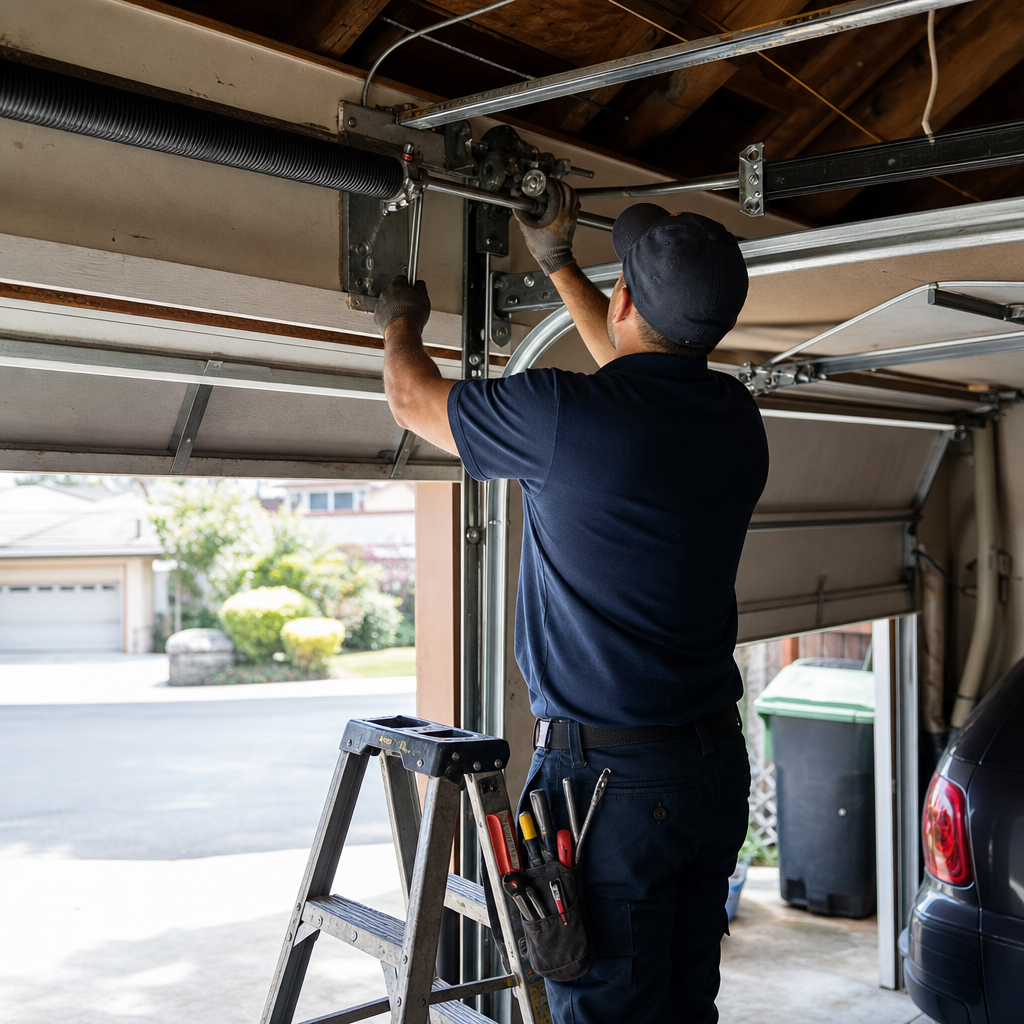
- Stop operating the door immediately. If you heard a loud bang, if the door is crooked in the opening, or if a cable is hanging loose, the spring system has likely failed. Further attempts to open or close can damage the opener, bend door sections, or cause the door to fall.
- Check for visible obstructions. Look at the track path for debris, a displaced roller, or an object that fell against the door. In Los Angeles, we’ve found everything from displaced roof tiles after Santa Ana winds to palm fronds wedged in lower tracks.
- Test the manual release if the door is closed and no spring or cable damage is visible. Pull the red emergency release cord straight down. The trolley should detach from the opener carriage. Try lifting the door manually. A properly balanced door with intact springs should lift with one hand and stay at waist height when released. If it slams down or won’t budge, the spring system is compromised. Do not proceed.
- Secure the opening if the door is stuck open. This is a security priority in Los Angeles, where an open garage is an invitation. Disconnect the opener, lock the door manually if possible, and consider parking a vehicle in the driveway to block access until repair arrives.
- Photograph the failure. A clear photo of the problem area helps the dispatcher send the right technician with the right parts. In our experience, this single step reduces most repair visits to a single trip.
- Call for service. Describe what you see, what you heard, and what you’ve already checked. A competent dispatcher will confirm whether the situation requires emergency response or can be scheduled.
The manual release procedure differs significantly depending on your opener type. Standard trolley-style openers, still the majority in Los Angeles, use the familiar red cord. Jackshaft openers, increasingly common in newer construction and narrow-lot renovations in Silver Lake, Echo Park, and Venice, mount on the wall beside the door and use a different disengagement mechanism. We’ll cover that specifically in the next section.
When Your Vehicle Is Trapped Inside
This is the scenario that generates the most panic calls we receive. You’re leaving for work, an appointment, or the airport, and the door won’t open. Your car is inside. The opener hums but doesn’t move the door, or makes no sound at all.
Standard Trolley Opener: Safe Manual Release
For the common overhead trolley-style opener (LiftMaster, Chamberlain, most Craftsman units):
- Ensure the door is fully closed. If it’s partially open and crooked, do not attempt manual release. The door is unstable and may fall.
- Locate the red emergency release cord hanging from the trolley. Pull it straight down with a firm, steady motion. You should feel it detach.
- Lift the door from the center using both hands. Keep your back straight, knees bent, and body centered. If the door feels extremely heavy, stops moving, or wants to drop, release it and step back. The spring system has failed.
- If the door lifts smoothly and stays open, you can drive out. Lower it gently behind you. It will not lock automatically; secure it as best you can until repair arrives.
Jackshaft Opener: The Critical Difference
Jackshaft openers, popular in Los Angeles for their space-saving wall mount, use a direct-drive motor connected to the torsion tube. They do not have a trolley or a red cord. The disengagement is a manual override, typically a small handle or lever on the motor housing.
Here’s what matters: on a jackshaft opener, releasing the motor does not neutralize the spring tension. The door is still under full spring load. If the spring is broken, the door will be extremely heavy and dangerous to lift manually. We’ve responded to calls in Los Feliz and Atwater Village where homeowners injured themselves assuming the jackshaft release worked like a standard opener.
If you have a jackshaft opener and the door won’t open, check the motor’s manual release mechanism per the manufacturer’s instructions. But if the door feels wrong, heavy, or unbalanced at any point, stop. The spring system needs professional attention before the door is safe to operate manually.
Safety note: Garage door springs are under extreme tension. A standard torsion spring on a double-wide door stores enough energy to cause serious injury or death if mishandled. Never attempt to adjust, wind, or replace a spring yourself. This is not a DIY repair.
What “Emergency” Legally Means for LA Garage Doors
Los Angeles building codes distinguish between emergency repairs and standard service calls, and the distinction affects what a technician can legally do after hours without a permit.
An emergency repair, as defined by the Los Angeles Department of Building and Safety, addresses an immediate hazard to life or safety or secures a structure against weather or unauthorized entry. For garage doors, this typically means:
- A door stuck open that cannot be secured, creating a security vulnerability
- A broken spring or cable that renders the door unstable and at risk of falling
- Damage from vehicle impact that compromises the door’s structural integrity
- Opener failure that traps a vehicle needed for medical or safety purposes
Emergency repairs can proceed without a permit if they restore the door to safe, functional condition using like-for-like replacement parts, as explained in The Complete Garage Door Installation Guide for Los Angeles Homeowners. What they cannot do: alter the door size, change the spring system configuration, convert from extension to torsion springs, or install a new opener where none existed. Those changes require a building permit in Los Angeles, and permit applications are not processed outside business hours.
This matters when you call at night. A legitimate technician will tell you honestly whether your situation qualifies for emergency repair or requires permitting. If a tech promises to install a new door, change your spring system type, or do any structural modification at 9 PM “under emergency authorization,” they are either misinformed or misleading you. We’ve seen this in the San Fernando Valley and South Bay after storms, when homeowners are vulnerable and unscrupulous operators exploit the urgency.
For most emergency calls in Los Angeles, the repair is straightforward: replace the failed component, test the safety systems, and schedule any follow-up permitting if structural changes are needed. A reputable company will explain this clearly and document what was done for your records.
Spotting a Legitimate Emergency Quote
Emergency garage door repair in Los Angeles carries a premium. The question is how much, and for what. Here’s how to tell a fair quote from a predatory one.
Standard Emergency Line Items
| Service | Typical Range |
| Emergency/after-hours dispatch fee | $75 – $150 |
| Standard spring replacement (single torsion) | $180 – $280 |
| Dual spring replacement (double-wide door) | $280 – $420 |
| Cable replacement (pair) | $120 – $200 |
| Roller/track alignment | $140 – $220 |
| Opener repair (gear, circuit, limit switch) | $150 – $350 |
| Emergency opener replacement | $400 – $650 |
These ranges reflect Los Angeles market rates in 2024-2025, including coastal premium areas. Quotes significantly below these figures often indicate cut hardware, uninsured labor, or bait-and-switch tactics. Quotes significantly above require specific justification: specialized Clopay or Amarr hardware, custom wood door components, or access limitations like steep hillside driveways in the Hollywood Hills.
Red Flags in Emergency Quotes
- Vague “diagnostic fees” that aren’t credited toward repair. A legitimate company charges for the visit or the repair, not both in a way that doubles the cost.
- Pressure to replace both springs when only one failed. On a dual-spring system, matching spring age makes sense. On a single-spring door, it’s unnecessary.
- Refusal to provide written estimate before work begins. California law requires written contracts for home improvement work over $500. Emergency or not, you have the right to know the price.
- Unnamed “service charges” or “trip fees” in addition to listed labor. The quote should be complete and itemized.
- Demands for cash-only payment. This eliminates your recourse if the work fails.
At Mainspring Garage Door Co., we state the flat price before any work begins. Our trucks carry springs, cables, rollers, and openers for all major brands including Genie and Chamberlain, so most emergency repairs in Los Angeles are completed in a single visit. The price we quote is the price on the invoice.
Common Mistakes to Avoid
- Forcing a door with a broken spring. The opener is not designed to lift the full weight of the door. You’ll burn out the motor or strip the drive gear, turning a $250 spring job into a $600 opener replacement. We see this weekly in Los Angeles.
- Ignoring the manual release test during routine use. Every month, pull the release cord and lift the door manually. If it feels heavy or won’t stay put, the spring balance is degrading. Catching this early prevents the emergency call entirely.
- Using generic lubricant on coastal hardware. Standard WD-40 or all-purpose grease attracts dust and accelerates corrosion in marine layer conditions. Use silicone-based garage door lubricant, or ask your technician to apply it during service.
- Assuming all emergency services are 24/7 permit-exempt. As noted above, structural changes require permits regardless of urgency. A tech who promises otherwise is creating liability for you.
- Choosing by lowest bid without verifying licensing and insurance. In Los Angeles, unlicensed operators are common. Verify CSLB license, request proof of insurance, and check that the company has a physical local address, not just a dispatch service.
- Neglecting post-fire opener cleaning. After significant brushfire events in the Santa Monica Mountains or foothill areas, compressed air cleaning of the opener housing prevents the abrasive ash-paste failure described earlier. It’s not intuitive, but it’s critical.
When to Call a Professional
Call for emergency service when your garage door is stuck open and cannot be secured, when a spring or cable is visibly broken or hanging loose, when the door is crooked in the tracks, or when the opener has failed and you need vehicle access for safety or medical reasons. Do not call for cosmetic issues, minor noise, or remote control battery replacement; these can wait for standard scheduling.
If you’re uncertain whether your situation qualifies as an emergency, call anyway. A competent dispatcher will help you assess. Mainspring Garage Door Co. offers free estimates in Los Angeles - call (844) 755-5838. Our phones are answered by a live person, including nights, weekends, and holidays. No phone trees, no voicemail, no after-hours answering service. We’ll tell you honestly whether you need immediate response or can safely schedule.
Frequently Asked Questions
Emergency garage door repair in Los Angeles typically ranges from $180 for a simple cable replacement to $520 for dual spring replacement or opener repair, plus an after-hours dispatch fee of $75-150; see The Complete Garage Door Parts Guide for Los Angeles Homeowners for component details. Coastal areas like Malibu or Santa Monica may run 10-15% higher due to corrosion-specific hardware requirements. Call (844) 755-5838 for an exact quote - estimates are free.
Yes, most emergency repairs in Los Angeles are completed same-day, often within 1-3 hours of your call. Mainspring technicians arrive with springs, cables, rollers, and openers for all major brands on the truck, so we don’t wait for parts. The 90-Day Done Right Promise covers every completed job in writing.
Repair is cheaper when the issue is isolated to the gear assembly, circuit board, or limit switches, typically $150-350. Replacement makes sense when the opener is over 12 years old, the motor has failed, or repair costs exceed 60% of replacement price. For garage door opener service in Los Angeles, we provide both options with upfront pricing so you can decide.
Disconnect the opener, lock the door manually if the lock is functional, and park a vehicle in the driveway to block access. If the door cannot be secured, call for emergency service. In Los Angeles, an open garage is a significant security exposure, and this qualifies as a true emergency under building code definitions.
The marine layer carries salt moisture inland, accelerating corrosion on bottom brackets, cable drums, and hardware. In Venice, Santa Monica, Malibu, and coastal Palos Verdes, we see corrosion-related failures three times more often than in inland areas. Stainless steel hardware and quarterly lubrication extend component life significantly.
Like-for-like replacement of damaged tracks, rollers, or springs to restore safe function does not require a permit and can be done under emergency repair provisions. However, if the door frame or header is damaged, or if the spring system configuration must change, permitting is required. A qualified technician will assess and advise on the spot.
The Bottom Line
Los Angeles garage door emergencies have local variables that matter: seismic micro-shifts, marine layer corrosion, and brushfire ash infiltration each create failure patterns that generic advice misses. Know the difference between a true emergency and a standard repair, understand what a legitimate quote looks like, and see our more guides & resources for ongoing maintenance tips. Never force a door with a compromised spring system. The ten minutes after a failure are for assessment and safety, not for heroic DIY. When you need service, choose a company that states the price upfront, carries the parts to finish in one visit, and stands behind the work in writing. That’s the square deal.
Written by the team at Mainspring Garage Door Co., serving Los Angeles since 2016.