
Last updated July 26, 2026
The Complete Garage Door Installation Guide for Los Angeles Homeowners
Most garage door installation guides treat Los Angeles like Anytown, USA. They are not. Homeowners in the Santa Ana wind corridor and beach-facing neighborhoods are required by local codes to meet wind load specifications that standard residential doors do not meet out of the box, and most installation guides do not mention this once. In this guide, you will learn how to select a door that passes inspection the first time, what the real costs look like in the Los Angeles market, and why your ZIP code’s micro-climate should drive your finish and insulation decisions more than any showroom display.
Quick Answer
A proper garage door installation in Los Angeles costs between $1,200 and $4,500 depending on door size, material, and wind load requirements, and typically requires 4 to 8 hours for a standard replacement. New installations or conversions from carport to garage require an LADBS permit and inspection, while direct replacements of existing doors on original framing usually do not. Wind load-rated doors are mandatory in coastal zones and canyon-adjacent areas, and most standard doors sold online do not carry the required W-rating for these Los Angeles ZIP codes.
Table of Contents
- Why Wind Load Ratings Matter More in Los Angeles Than Most Guides Admit
- How LA’s Three Micro-Climates Should Drive Your Door Selection
- LADBS Permits: When You Need One, What Triggers Inspection, and What Inspectors Check
- The Real Cost of Garage Door Installation in Los Angeles
- HOA Architectural Review: Navigating Approval Before You Order
- Steel, Wood, Aluminum, or Fiberglass: What Holds Up in LA Conditions
- Matching Your Opener to Your Door and Your Daily Routine
- What to Expect: Timeline, Preparation, and Day-of Installation
Why Wind Load Ratings Matter More in Los Angeles Than Most Guides Admit
The Santa Ana winds do not negotiate. Sustained gusts of 50 to 80 miles per hour are common from September through March, and canyon corridors like Topanga, Malibu, Pacific Palisades, and the Hollywood Hills experience localized acceleration that exceeds standard residential design assumptions. Los Angeles Building Code requires wind load-rated garage doors in specific exposure zones, yet most homeowners discover this only when an inspector fails their installation or, worse, when a door fails during a wind event.
Here is how to verify your requirement before you spend money:
- Check your property’s wind exposure zone on the LADBS website or request a pre-submittal consultation. Coastal zones and canyon-adjacent areas typically require a W-rating of 20 psf (pounds per square foot) or higher.
- Request the manufacturer’s wind load certification for any door you consider. This is a separate document from the product brochure. Reputable manufacturers like Clopay and Amarr provide these upon request; discount resellers often cannot produce them.
- Confirm the specific door model, not just the product line, carries the rating. A Clopay Canyon Ridge collection door may have wind load options, but the base model does not include them automatically.
- Verify your installer will pull the permit if required and schedule inspection. An unpermitted installation in a wind zone exposes you to liability and insurance denial if damage occurs.
We have replaced doors in Pacific Palisades where the original installer used a standard door rated for 15 psf in a 25 psf zone. The track bent in the first Santa Ana event. The homeowner paid twice. In our experience, the $200 to $400 premium for a properly wind-rated door is the cheapest insurance you can buy in Los Angeles.
How LA’s Three Micro-Climates Should Drive Your Door Selection
Los Angeles is not one climate. A door that performs well in Santa Monica may deteriorate rapidly in the San Fernando Valley or the high-desert transition zones of the far foothills. Your selection should account for where you actually live, not where the showroom is located.
Marine layer coastal: Venice, Marina del Rey, Manhattan Beach, and similar neighborhoods experience persistent morning moisture, salt air, and moderate temperature swings. Steel doors without proper galvanizing and powder coating develop surface rust within 3 to 5 years. We recommend aluminum or fiberglass for coastal exposure, or premium steel with a 25-year corrosion warranty. Wood doors require annual resealing in these conditions, not every three years as manufacturers suggest for inland use.
Inland valley heat: The San Fernando Valley, Pasadena, and eastern Los Angeles neighborhoods see summer temperatures above 100 degrees for sustained periods. Dark-colored doors absorb heat that degrades weatherstripping, warps vinyl components, and stresses opener motors mounted on the ceiling. Light colors or reflective finishes reduce surface temperature by 30 to 50 degrees. Insulation matters less for thermal performance here, your garage is not climate-controlled, but it matters for structural stability: polyurethane-insulated steel doors resist heat-induced warping better than non-insulated alternatives.
High-desert transition: Areas bordering the Antelope Valley or above 2,000 feet elevation experience freeze-thaw cycles and intense UV that embrittle standard vinyl components and fade finishes within 4 to 6 years. We specify UV-stable hardware and darker frame colors that hide oxidation longer than light alternatives.
The R-value debate is largely irrelevant for Los Angeles garages. A door rated R-12 or R-18 sounds impressive, but your garage has uninsulated walls, a concrete slab, and a non-weatherstripped pedestrian door. The door is not the thermal weak point. Spend the premium on finish durability and wind load compliance instead.
LADBS Permits: When You Need One, What Triggers Inspection, and What Inspectors Check
Los Angeles Department of Building and Safety permit requirements for garage doors confuse homeowners because the rules depend on what you are doing, not just what you are installing.
No permit required: Direct replacement of an existing garage door on original framing, with no structural modification to the opening, header, or supporting walls. This covers most standard replacements in Los Angeles.
Permit required: New installation in a previously door-less opening, conversion of carport to enclosed garage, any modification to the header or lateral force-resisting system, or installation of a door in a wind zone that requires engineer certification. Also required if you are altering the garage’s occupancy classification or adding conditioned space.
What the inspection covers: LADBS inspectors verify wind load rating documentation, track mounting to structural framing (not just trim or fascia), spring containment cables on extension spring systems, photo-eye alignment and obstruction sensitivity, and proper reversal force on automatic openers. They do not evaluate cosmetic finish or noise level.
We have attended inspections in Brentwood and Los Feliz where the inspector requested the manufacturer’s installation manual to verify track fastener spacing. Keep this document accessible. A reputable installer arrives with it. If your contractor treats the permit as an afterthought, that is a signal to reconsider.
Permit fees in Los Angeles run $150 to $400 depending on valuation. Plan for 2 to 3 weeks from application to inspection availability during peak season (March through June). Expedited scheduling is available for additional cost but is rarely necessary for residential garage door work.
The Real Cost of Garage Door Installation in Los Angeles
Honest pricing in the Los Angeles market follows a predictable structure. Quotes that seem substantially below these ranges typically omit necessary components or use doors that do not meet local code.
| Component | Typical Range |
|---|---|
| Standard steel door (8×7), single, non-insulated | $650 – $950 |
| Steel door with polyurethane insulation (8×7) | $950 – $1,400 |
| Carriage house style, steel or composite (16×7) | $1,800 – $3,200 |
| Custom wood or full-view aluminum (16×7) | $3,500 – $7,500 |
| Wind load upgrade (W-rating certification) | $200 – $500 |
| Opener installation (chain drive, 1/2 HP) | $350 – $550 |
| Opener installation (belt drive, 3/4 HP, smart features) | $550 – $850 |
| Disposal of old door and track | $150 – $250 |
| Los Angeles labor rate (standard installation) | $400 – $700 |
| Labor rate (complex install, high ceiling, custom framing) | $700 – $1,200 |
| LADBS permit and inspection (when required) | $150 – $400 |
The line items that separate an honest quote from a low-bid surprise:
- Disposal fees: Old doors weigh 150 to 400 pounds. Hauling requires a truck and landfill fees. Quotes that omit this add it later.
- Track modification: Standard 2-inch tracks may not fit doors over 12 feet wide or 8 feet high. Custom radius or vertical lift tracks add $200 to $600.
- Hardware upgrade: Heavy doors require heavy-duty hinges, rollers, and springs. Some contractors quote standard hardware then upsell on installation day.
- Electrical for opener: If your ceiling has no outlet within 6 feet of the opener location, a licensed electrician must add one. This is not a garage door installer’s scope and adds $200 to $400.
At Mainspring Garage Door Co., we state the flat price before any work begins. No surprises on the bill. Our $50 Off Any Repair Over $250 and $89 Seasonal Tune-Up offers are standing commitments, not limited-time promotions. Seniors and veterans receive a permanent 5% discount.
HOA Architectural Review: Navigating Approval Before You Order
Los Angeles has hundreds of active homeowners associations, from century-old covenants in Hancock Park to newer CC&Rs in Playa Vista and the Arts District. Many require pre-approval for garage door changes, and approval timelines can exceed manufacturing lead times by weeks or months.
Check your CC&Rs for these specific provisions:
- Color palette restrictions: Some HOAs maintain approved color lists with specific manufacturer paint codes. “Close enough” is not sufficient; the architectural committee can require repainting at your expense.
- Style mandates: Spanish Colonial, Craftsman, or Mid-Century Modern districts may require panel designs, window configurations, or hardware styles that limit your options and increase cost.
- Material prohibitions: Full-view aluminum or contemporary glass doors are explicitly banned in some traditional neighborhoods.
- Window placement: Privacy concerns in dense neighborhoods may restrict or require frosted glass in door windows.
Submit your application with manufacturer cut sheets, color samples, and photos of installed examples from your specific product line. Vague submissions get rejected. In our experience working with Los Angeles HOAs, the most common delay is incomplete documentation, not committee reluctance. Plan for 30 to 45 days from submission to approval. Do not order your door until you have written approval in hand.
Steel, Wood, Aluminum, or Fiberglass: What Holds Up in LA Conditions
Material selection for Los Angeles should prioritize what fails first in local conditions, not what looks best in the brochure; for component details, see The Complete Garage Door Parts Guide for Los Angeles Homeowners.
Steel: The practical standard. Galvanized steel with baked-on polyester or fluoropolymer finish resists UV and minor impact. We specify 24-gauge or thicker for double doors; 25-gauge is adequate for single doors in protected locations. Insulated steel (polyurethane core) reduces noise and resists heat warping. Clopay and Amarr both manufacture steel lines with Los Angeles-appropriate finish warranties. Steel dents but does not crack; dents can often be repaired without door replacement.
Wood: Cedar, redwood, and mahogany offer unmatched appearance for Craftsman, Spanish, or traditional homes. The maintenance burden is real: restaining every 2 to 3 years in coastal Los Angeles, every 3 to 4 years inland. Wood doors are heavy, requiring heavier openers and more frequent spring service. We install wood doors for homeowners who value appearance over convenience and commit to the maintenance schedule.
Aluminum: Lightweight, corrosion-proof, and ideal for coastal Los Angeles where salt air destroys steel. Full-view aluminum with glass panels is popular for modern architecture in Venice, Silver Lake, and downtown lofts. The frame is durable; the glass and weatherstripping require attention. Aluminum dents more easily than steel and does not return to shape.
Fiberglass: Excellent UV resistance and can mimic wood grain without the maintenance. Less common in the Los Angeles market due to limited style availability. We specify fiberglass for coastal properties where steel corrosion is a concern but aluminum aesthetics are not desired.
Matching Your Opener to Your Door and Your Daily Routine
Opener selection is where homeowners often overbuy or underbuy relative to actual need; for a deeper dive, see The Complete Garage Door Opener Guide for Los Angeles Homeowners. The right match depends on door weight, ceiling height, and how you use the garage.
Horsepower: 1/2 HP handles most single steel doors up to 10 feet wide. 3/4 HP is appropriate for double steel doors, insulated doors, or any wood door. 1 HP is reserved for oversized or solid wood doors exceeding 300 pounds. More horsepower than necessary does not improve longevity; it adds cost and noise.
Drive type: Chain drive is economical and reliable but audible. Belt drive reduces noise by 50% or more, significant if the garage adjoins a bedroom or living space. Screw drive requires less maintenance but struggles with temperature extremes, less relevant in Los Angeles than in mountain or desert climates. We recommend belt drive for most Los Angeles installations where noise matters, chain drive for detached garages or budget-focused replacements.
Smart features: WiFi connectivity, camera integration, and app control are standard on Chamberlain and Genie models we install. These features are genuinely useful for homeowners who receive deliveries or grant access to service providers. They are not necessary for everyone. We do not upsell technology that does not serve your routine.
Safety note: Garage door springs carry the full weight of the door and are under extreme tension. A broken spring or cable can cause serious injury or death. Never attempt spring repair or replacement yourself. Our technicians are trained as journeymen under our K.E.Y.S. values code, and every spring service includes containment cables as standard.
What to Expect: Timeline, Preparation, and Day-of Installation
A standard garage door replacement in Los Angeles follows this sequence:
- Measurement and selection (Day 1): We measure your opening, headroom, and sideroom; confirm wind load requirements; and present options with flat pricing. Most homeowners select their door during this visit.
- Ordering and delivery (1 to 3 weeks): Standard steel doors from Clopay or Amarr arrive within 5 to 10 business days. Custom wood or specialty finishes require 3 to 6 weeks. We do not collect full payment until delivery is confirmed.
- Permit processing (if required, concurrent with ordering): We prepare and submit LADBS applications for installations requiring permits. Scheduling inspection for the same day as installation minimizes delay.
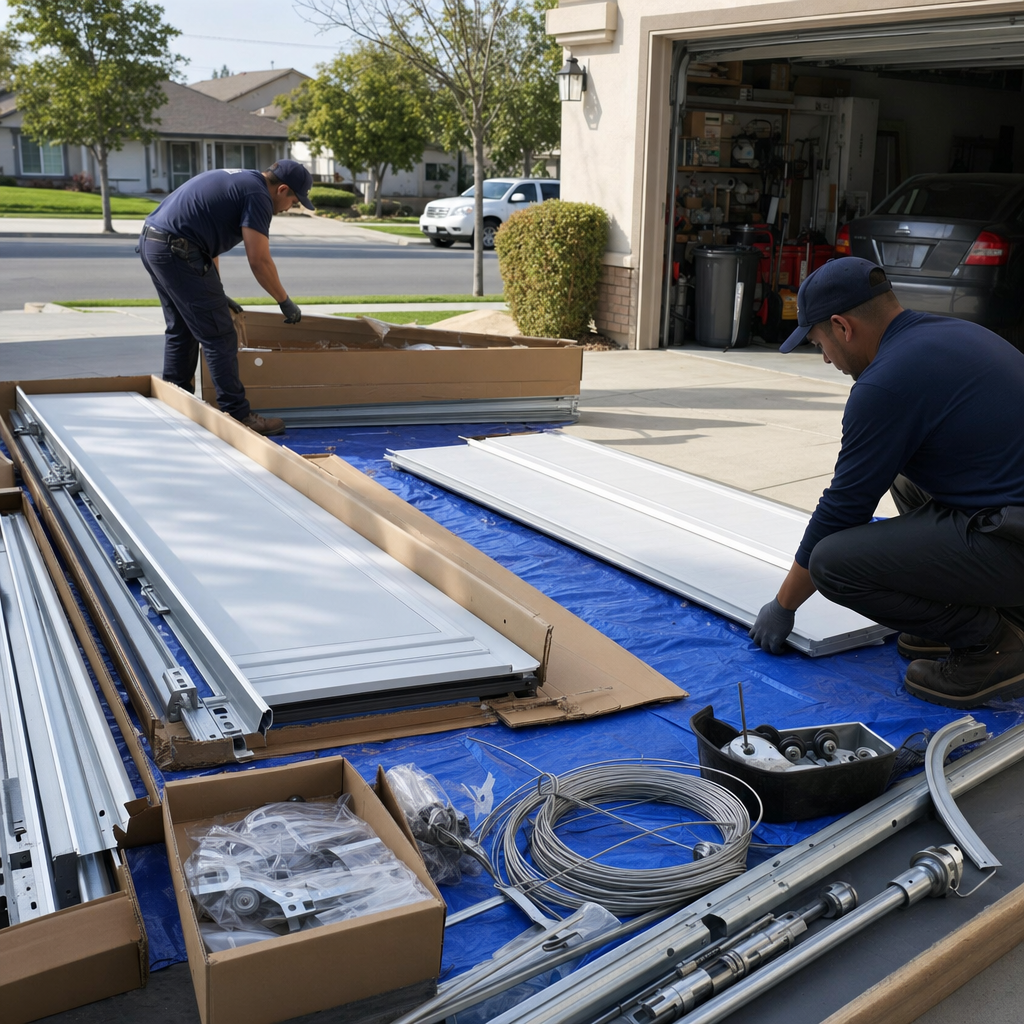
- Installation day (4 to 8 hours): Remove old door and track. Inspect and reinforce framing as needed. Install new track, door sections, springs, and hardware. Install and program opener if included. Test all safety features. Clean and remove debris.
- Inspection (if required, within 48 hours): LADBS inspector verifies code compliance. We meet the inspector and address any corrections immediately.
Prepare by clearing vehicles and storage from the garage, ensuring electrical access for tools, and confirming we have a clear path from the street. Pets should be secured away from the work area. The garage will be unusable for the duration of installation.
Common Mistakes to Avoid
- Buying a door online without verifying wind load certification. Major retailers sell standard doors that do not meet Los Angeles coastal and canyon requirements. The return process is expensive and slow.
- Assuming replacement means no permit. If your original door predates current codes or you are modifying the opening, permitting applies even for “replacement.”
- Choosing dark colors for south-facing doors in the San Fernando Valley. Surface temperatures exceed 150 degrees, degrading weatherstripping and opener motors prematurely.
- Ignoring HOA requirements until after installation. Some Los Angeles HOAs levy fines of $100 per day for unapproved modifications and can require removal at homeowner expense.
- Accepting a quote without line-item breakdown. The lowest bid often excludes disposal, hardware upgrades, or permit fees that appear later.
- Installing an opener without assessing door balance. An unbalanced door strains the opener and creates safety hazards. Spring condition must be evaluated first.
- Neglecting to confirm installer insurance and workers’ compensation. Uninsured contractors working on your property expose you to liability. We carry full coverage and provide documentation on request.
When to Call a Professional
Garage door installation involves high-tension springs, heavy panels, and electrical work that exceeds most homeowners’ comfort and capability. Call a professional if your project involves wind load requirements, permit processing, structural modification, or any spring or cable work. Mainspring Garage Door Co. offers free estimates in Los Angeles. We answer calls with a live person 24/7, including nights, weekends, and holidays. Our trucks carry springs, cables, openers, and hardware so most jobs are completed in a single visit. Call (844) 755-5838 to schedule.
Frequently Asked Questions
A standard single steel door installation in Los Angeles typically runs $1,200 to $2,200 including labor and disposal, while double doors or premium materials range from $2,500 to $4,500. Wind load upgrades, custom finishes, and opener installation add to the total. Call (844) 755-5838 for a free estimate with flat pricing stated upfront.
Direct replacement of an existing door on original framing does not require a permit. New installations, carport conversions, structural modifications, or doors in wind zones requiring engineer certification do require LADBS permits and inspection. We determine permit requirements during our free estimate and handle all paperwork when needed.
Standard replacement takes 4 to 6 hours. Complex installations with custom framing, high ceilings, or opener electrical work may extend to 8 hours. We complete most jobs in a single visit because our trucks arrive fully stocked.
Aluminum or fiberglass resist salt air corrosion better than standard steel. If you prefer steel, specify premium galvanizing and a 25-year finish warranty. Wood requires annual maintenance in coastal conditions. We assess your specific location before recommending material.
Same-day installation is possible for standard sizes if we have your door specification in inventory. Most installations require 1 to 3 weeks for door delivery. Emergency repairs, including broken springs and off-track doors, are available same day. Call (844) 755-5838 to check current availability.
Repair is economical for isolated issues like broken springs, worn rollers, or damaged panels on doors under 15 years old. Replacement becomes the better value when the door has multiple failing components, structural rust, or lacks modern safety features. We offer free second opinions on any written estimate to help you decide.
The Bottom Line
Installing a garage door in Los Angeles requires more than selecting a style and color; for more guides & resources, explore our blog. Wind load compliance, micro-climate durability, permit awareness, and HOA coordination determine whether your installation succeeds without surprise costs or delays. The right door, properly specified and installed, operates quietly and reliably for 20 years or more. The wrong door fails prematurely, costs more to correct, and may expose you to liability. Measure twice, verify certification, and work with a contractor who states the flat price before the wrench comes out. That is how you get a square deal in Los Angeles.
Written by the team at Mainspring Garage Door Co., serving Los Angeles since 2016.